Vocational Language Course (BSK): What is it, who is entitled — everything about DeuFöV 2026
After the integration course, many migrants have German at B1 level — but the first look at job advertisements makes it clear: B1 is not enough for most skilled positions. Caregivers need B2, sometimes C1. Office jobs require fluent German. Craftsmen who communicate with customers must be able to express themselves clearly. The B1 from the integration course is a start — but not yet a ticket to the German labor market.
Exactly for this gap, there is the Vocational Language Course (BSK). It is state-funded, organized by the Federal Office for Migration and Refugees (BAMF), and is free for most participants. And it leads — depending on the course type — from B1 to B2, C1, or even C2. What exactly it is, who is entitled, what courses are available, and how to register — this article explains.
The most important thing upfront: Since January 1, 2025, vocational language courses are prioritized. Not all course types are currently available to the same extent. B2 vocational language courses can be offered almost according to demand — making the B2-BSK the most important and accessible format, especially for people who urgently need to improve their German for work.
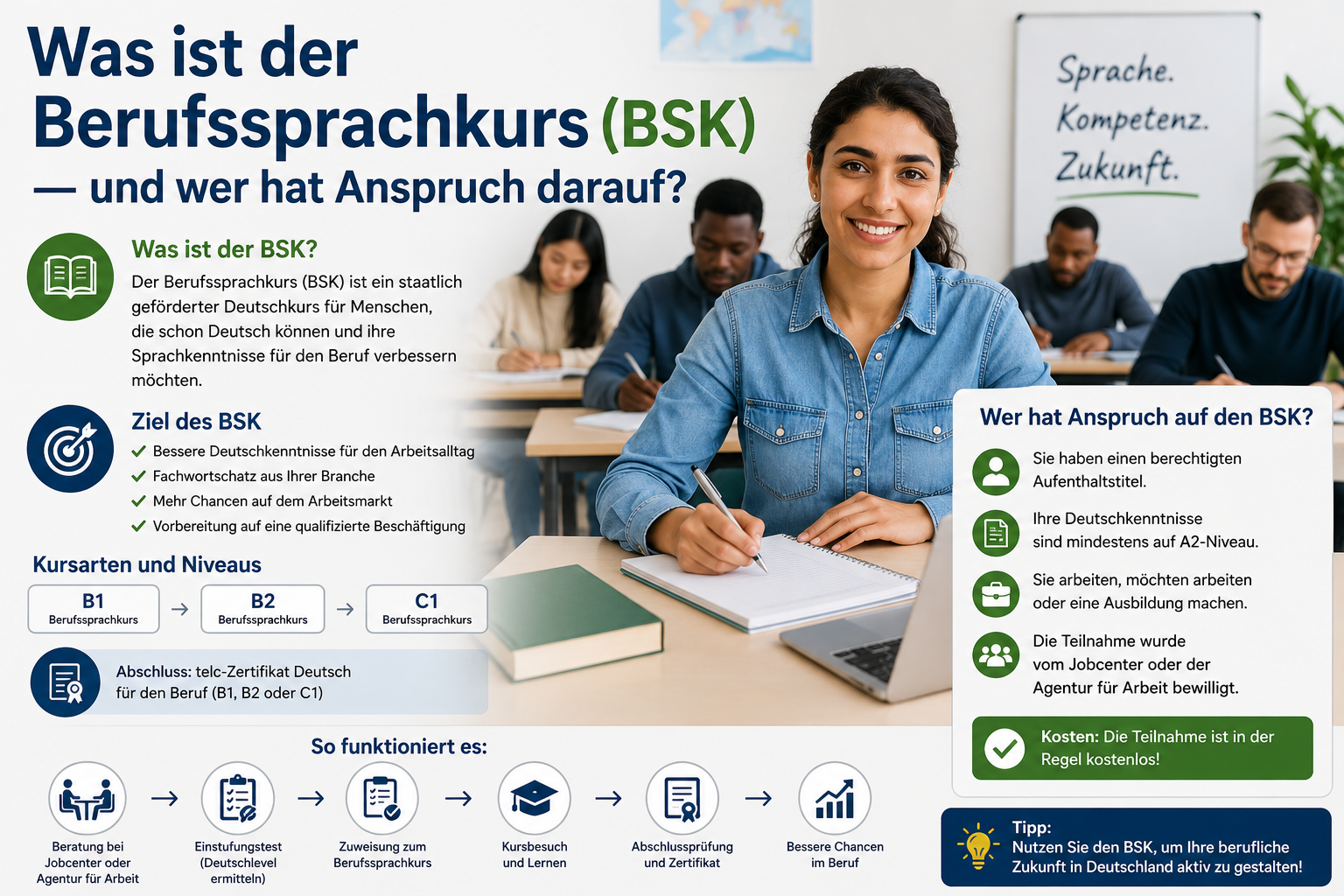
What is the Vocational Language Course — and how does it differ from the Integration Course?
The integration course brings people to B1 level — focusing on general everyday German: shopping, housing, bureaucratic processes, family. Good for getting started in life in Germany. But German in the workplace works differently: You write emails to colleagues, call customers, read technical documents, and participate in meetings.
The vocational language course (officially: job-related German language promotion according to § 45a AufenthG, regulated by the German Language Promotion Regulation DeuFöV) builds directly on the integration course. It teaches job-related German — with topics and situations from real professions, from care to trade to technology and law.
A1–A2
Beginner
Integration Course
B1
End of Integration Course
DTZ Exam
BSK
Vocational Language Course
starts here
B2
Target Basic BSK
DTB B2 Exam
C1/C2
Target Advanced BSK
Academic Professions
Integration Course vs. Vocational Language Course — at a glance:
| Feature | Integration Course | Vocational Language Course |
|---|---|---|
| Goal | General everyday German up to B1 | Job-related German from B1 to B2/C1/C2 |
| Content | Everyday life, authorities, family, housing | Job communication, technical language, applications |
| Duration | 600–900 UE | 100–500 UE depending on course type |
| Cost | Generally free for eligible participants | Generally free (exceptions see below) |
| Certification | DTZ (German Test for Immigrants) | Certificate DTB B2 or telc exam |
| Prerequisite | Residence status | B1 knowledge + eligibility |
You can only start the vocational language course once B1 has been proven. On DeutschMeister, you can specifically prepare for the DTZ B1 — the key to everything else.
Who is entitled to a Vocational Language Course?
The BSK is aimed at a broad audience: migrants from third countries, EU citizens, and also Germans with a migration background who do not have sufficient German language skills for the labor market. The usual prerequisite is proof of B1 knowledge.
Specifically, the following groups of people are entitled to participate:
| Group of People | Entitlement / Access | Responsible Authority |
|---|---|---|
| Job center clients (SGB II) | Direct entitlement through the job center; often automatically suggested | Job center |
| Employment agency clients (SGB III) | Entitlement upon request at the employment agency | Employment agency |
| Employees (with employment contract) | Entitlement to certain course types (Job-BSK); employer can apply | BAMF directly or through employer |
| Apprentices | Apprentice-BSK specifically for apprentices | Employment agency / BAMF |
| Recognition seekers | Recognition-BSK for people in the recognition process | BAMF directly |
| Early childhood education professionals | Early childhood education-BSK for educators/childcare staff | BAMF directly |
| Refugees with residence permit | Access via BAMF approval (§ 44 Abs. 4 AufenthG) | BAMF |
| Germans with a migration background | If insufficient German language skills for the labor market are proven | Job center / employment agency |
Important: Private participation in the BSK without official entitlement is not possible. You always need an entitlement (approval) from the job center, employment agency, or BAMF. Those who inquire directly with a course provider without bringing entitlement cannot be admitted.
The different course types — which one is right for you?
Tip: practise what you've just read with interactive exercises — it sticks better.
Start B2 exercises →The BSK is not a uniform program but a system of different course types tailored to different target groups and job situations. Here are the most important ones — with updated status from 2025.
Basic BSK — from B1 to B2
The most common and important course type. It leads from B1 to B2 and ends with a recognized final exam — the DTB B2 (German Test for the Profession B2) or a telc exam at B2 level. The Basic BSK imparts job-related language skills for general professional fields.
Advanced BSK — from B2 to C1/C2
For people who already have B2 and want to work in academic professions, management, or jobs with high language requirements (e.g., doctor, lawyer, senior caregiver).
Job-BSK — workplace-related, for employees
Specifically tailored to the workplace — the course can even be conducted directly at the employer's premises. Shorter duration, practical content, focus on situational communication at the specific workplace.
Apprentice-BSK — for apprentices
Specifically for people who are undergoing vocational training (apprenticeship) and need language support in a professional context.
Recognition-BSK — for recognition seekers
Those who are in a recognition process for a foreign professional qualification and need technical language skills at B2 level or higher have access to this special course.
Early Childhood Education-BSK — for daycare professionals
Specifically for educational staff in daycare centers, crèches, and similar institutions. Content focus on early childhood education technical language, parent conversations, documentation.
What does the Vocational Language Course cost — and who pays?
The financing model of the BSK is very advantageous for most participants: Generally, participation is free. Only under certain income conditions does a personal contribution arise.
0 €
For everyone receiving citizen's money (SGB II), unemployment benefits I, asylum seeker benefits, or social assistance (SGB XII).
Also for apprentices in recognized training occupations.
50%
For employees with taxable income over 20,000 € (for individual assessment) or over 40,000 € (for joint assessment).
This share can be covered by the employer.
Employee with 25,000 € income:
→ Personal contribution approx. 2.42 € per UE
→ For 300 UE Basic BSK = approx. 726 € — can be covered by the employer.
Additional: The final exam at the end of the BSK (DTB B2 or telc exam) is also free — including one free retake if you do not pass. This is a significant advantage over private language exams, which cost 100–200 €.
How to register — step by step
The path to the BSK always goes through an entitlement — you cannot directly enroll with the course provider without bringing this entitlement. However, the process is manageable.
Obtain entitlement — from the job center or the employment agency
Those receiving citizen's money: Inquire at the job center and actively ask for a BSK. Those receiving unemployment benefits I: Employment agency. Those working and wanting entitlement: Inquire directly at BAMF. The job center issues an official entitlement — a document with a stamp and signature.
Prepare language proof
For the Basic BSK (B1 → B2), you need proof of B1. This can be the DTZ certificate, a Goethe certificate B1, telc B1, or a placement test at the course provider. If the certificate is older than 6 months, a new placement test is often required.
Find a course provider nearby
On the BAMF website, there is a course overview with all approved BSK providers by postal code. Adult education centers (VHS), language schools, and educational providers like BBQ or iOR are common providers. Registration is usually only possible 4–6 weeks before the course starts.
Bring to the registration
Valid entitlement (original with stamp and signature) · Current language certificate or willingness to take a placement test · ID card or passport with residence permit · Possibly performance notice from the job center (for cost exemption).
Complete the course and take the exam
The BSK ends with a state-recognized certificate exam — DTB B2 or telc exam. The certificate is recognized nationwide and can be stated in applications and resumes. As mentioned: The exam is free, including a retake.
Those starting the vocational language course with a strong B1 foundation make faster progress. On DeutschMeister, you practice all four language skills in the exam format — ideal as preparation for DTZ and BSK.
What has changed in 2025 — and why it is now more important to act quickly
Since January 1, 2025, vocational language courses are prioritized by BAMF — this means: Not all course types are fully available. Here is the current status:
| Course Type | Status from 01.01.2025 |
|---|---|
| Job-BSK | ✅ Can start unrestrictedly |
| Apprentice-BSK | ✅ Can start unrestrictedly |
| Early Childhood Education-BSK | ✅ Can start unrestrictedly |
| Recognition-BSK | ✅ Can start unrestrictedly |
| Basic BSK (B2) | ✅ Almost available according to demand — the most accessible BSK type |
| Specialized Practice-BSK | ⚠️ Currently not available |
| A2 and B1 BSK | ⚠️ Currently not available |
What does this mean in practice? The most important course for most people — the Basic BSK from B1 to B2 — is available. Those with B1 who want to enter the labor market can now start a BSK. Those who do not yet have B1 must first pass the DTZ — and can then enter the BSK without waiting.
BSK and specific professions — what does it really bring?
The vocational language course is not a general language course with a slight professional touch. It is specifically tailored to professional fields. Depending on the course provider, there are BSK offers specifically for:
- Care and Health: Writing care reports, patient communication, handover conversations — direct preparation for the telc B1·B2 Care and the technical language exam of the medical association
- Crafts and Technology: Workshop language, customer conversations, writing quotes and invoices
- Commerce and Office: Emails, phone calls, meetings, documentation
- IT and Computer Science: Project language, technical documentation, English-German technical terminology
- Education and Social Work: Parent conversations, protocols, team meetings, funding applications
- Gastronomy and Hospitality: Guest communication, orders, complaints
This makes the difference from the integration course: You do not just learn German — you learn the German you need at work next Monday.
DeutschMeister · B1 Preparation · The key to the BSK
For the Vocational Language Course, you need B1 — you can achieve it on DeutschMeister
The vocational language course opens the door to the German labor market — but you can only enter if you have B1. On DeutschMeister, you prepare specifically and efficiently for the DTZ B1: all four exam parts in the real exam format, with immediate feedback, without waiting. Those who pass the DTZ can directly enter the BSK — without additional courses or waiting times.
Register for free nowImmediate access to all practice tasks — no credit card, no waiting time.
Frequently Asked Questions about the Vocational Language Course
Can you start the BSK before you have a job?
Yes. The Basic BSK is accessible not only for employees but also for job seekers — often even with stronger support because the job center actively supports participation. Especially for people looking for work after the integration course, the BSK is a direct continuation of the language learning path.
What happens if you do not pass the final exam?
The exam can be repeated once for free — directly after the course or shortly thereafter. A second retake is possible but may incur costs. Those who regularly participate in the course and actively engage have a very good chance of passing the exam on the first attempt.
Can the employer apply for the BSK for their employees?
Yes — and this is explicitly desired. Employers can apply directly to BAMF for a Job-BSK for their employees. The course can even take place directly at the company if suitable premises are available. Employers who enable their international employees to receive language support benefit from better integration, lower turnover, and higher productivity.
How long does the Basic BSK last, and how much time per week do you need?
The Basic BSK has a total of 300–400 teaching units (UE). In full-time (20–25 UE per week), it lasts about 3–4 months. In part-time (8–19 UE per week), it takes correspondingly longer — about 4–6 months. Many courses also take place in the evenings or on Saturdays to combine work and course.
What certificate do you receive at the end of the BSK?
At the end of the Basic BSK, there is a certificate exam — usually the DTB B2 (German Test for the Profession B2) or a telc exam at B2 level. The issued certificate is recognized nationwide and internationally and can be directly entered in the resume under language skills: “German B2 (DTB B2, [date])".
Can you also complete the BSK online?
Yes. Since 2020, online vocational language courses and hybrid formats (partly in-person, partly online) are possible and approved. Not all course providers offer all formats — when searching for a course provider, specifically ask about online options. Online BSK are particularly practical for people with limited mobility or in regions with few course offerings.
What is the difference between BSK and the integration course — do you have to do both?
The integration course is the first step and leads to B1. The BSK is the second step and leads to B2 or beyond. You do not have to do both — those who can already prove B1 through another means (e.g., Goethe B1, telc B1, DTZ) can directly enter the BSK without having completed the integration course.
Ready for B2 exercises?
Don't just read — practice now! Hundreds of interactive exercises, audio tasks and exam training are waiting for you.
War dieser Artikel hilfreich?
Ähnliche Artikel
DTZ B1 Writing Brief: Phrases and Templates That Really Work
What sentences do you really need for the DTZ letter? From my own exam experience: salutation, introduction, connectors, requests, and closing — an honest collection of phrases.
DTZ B1 Speaking Part 3: Planning Together — Sample Dialogue, Phrases, and Strategy
What happens in DTZ Speaking Part 3? Planning something together with bullet points. Why the result doesn't count, what a real dialogue sounds like, and which 4 types of sentences are needed.
DTZ B1 Speaking Part 2: Describing a picture and sharing experiences — Method and sample dialogue
What happens in DTZ Speaking Part 2? Describe an image (2A), share experiences (2B). Three-layer method, complete sample dialogue on the topic of shopping, and 4 typical mistakes.