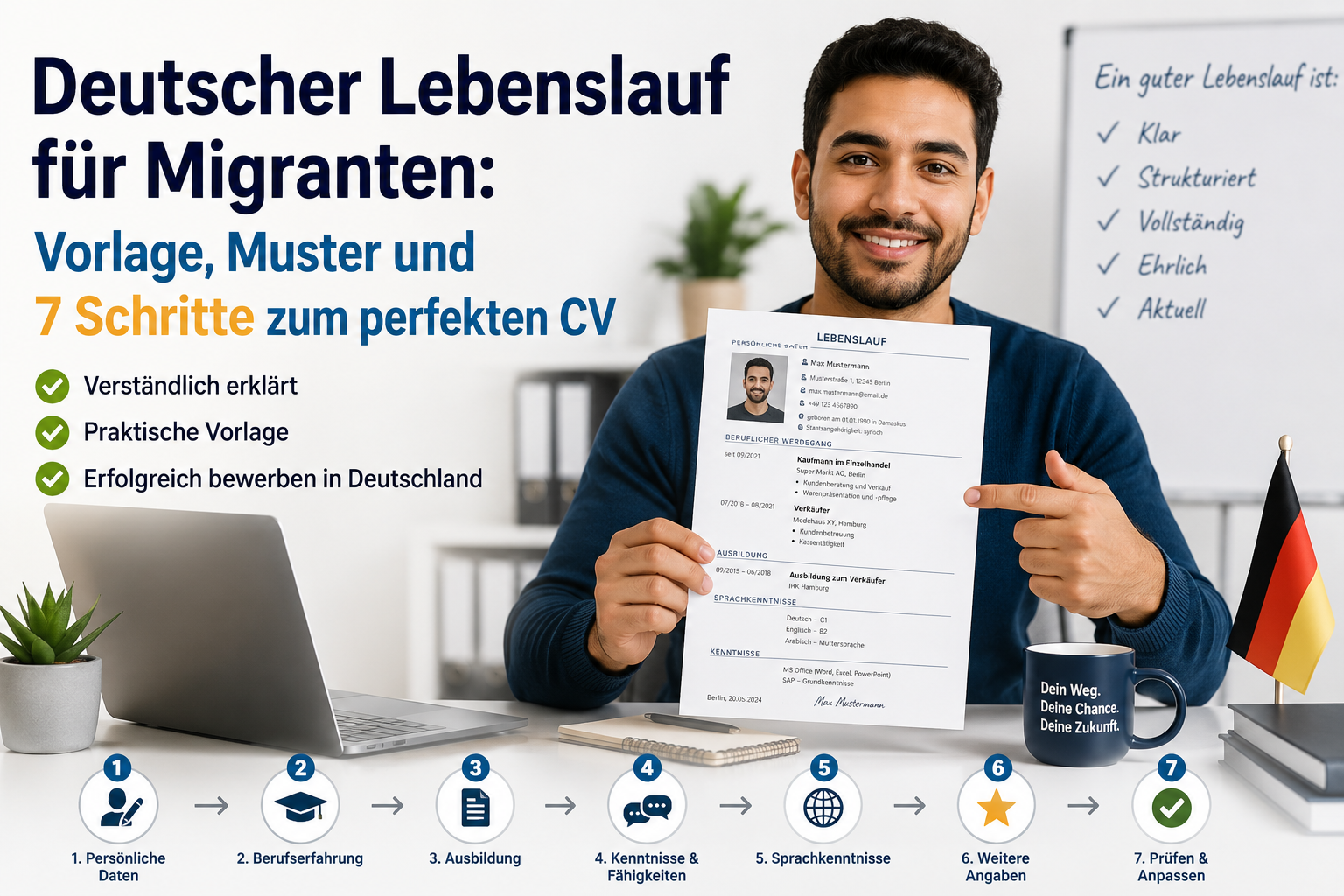
German CV for Migrants: Template, Examples, and 7 Steps to the Perfect Resume
The resume is the first thing an employer sees. Not the cover letter, not the certificates — the resume. In Germany, it has a very clear, expected format. Anyone unfamiliar with this format stands out immediately — and not in a positive way. Even someone with fifteen years of work experience who would be perfect for a position can be eliminated in the first round due to a poorly structured resume.
For migrants, there is an additional challenge: Their professional history takes place in another country, another education system, perhaps in another language. How do you explain foreign qualifications? How do you handle gaps caused by migration? How do you translate job titles that do not even exist in Germany?
This article: The complete structure of a German resume step by step — with a ready-made sample template, concrete phrasing examples, typical mistakes made by migrants, and the knowledge of how to present foreign experiences so that German employers understand and appreciate them.
What distinguishes a German resume from others
In many countries, the resume is a long, personal text. In England, it is called a CV, in America a resume — and it follows entirely different rules. The tabular resume (Tabular Curriculum Vitae), which is standard in Germany, is short, clear, and structured in reverse chronological order: The most recent position is at the top, the oldest at the bottom.
| Element | Germany | Common mistakes from other countries |
|---|---|---|
| Format | Tabular, max. 2 pages, reverse chronological | Continuous text, too long, chronological from the front |
| Photo | Professional application photo, top right or top left — expected but not mandatory | No photo, or vacation/cell phone photo |
| Personal data | Name, address, phone, email, date of birth | Missing address, no date of birth (still common in Germany) |
| Nationality | Optional — does not have to be stated, but does not hurt either | Misunderstood as mandatory or emphasized as an indication of language skills |
| Language skills | Indicated with level: native language / B1 / B2 / fluent / basic knowledge | No level indication — “I speak German” without classification |
| Signature | Handwritten (or digital), with place and date at the end | Completely missing — expected in Germany |
The sample template: This is what a good German resume looks like
Before we discuss each section individually, here is the complete template — as expected by a personnel officer in Germany. The annotations (yellow note fields) explain directly in the document what is particularly important for migrants.
📄 Sample Resume — tabular, reverse chronological (as of 2025/2026)
Olena Kovalenko
Nursing Specialist | Nurse
Work Experience
Nursing Assistant (Recognition Internship)
Senior Residence Golden Autumn GmbH, Frankfurt am Main
Basic care and support of 18 residents · Documentation in the nursing software DAN · Support of certified nursing professionals in medical procedures
Nurse (Analogous Profession: Nursing Specialist)
Municipal Hospital Kyiv, Ukraine
Inpatient care on the internal medicine ward · Administration of medications · Wound care · Coordination with doctors and relatives
Education & Qualifications
Recognition Procedure Nursing Specialist
Government Presidium Darmstadt
Partial recognition granted — adjustment qualification ongoing (expected completion 12/2025)
Nursing (Bachelor of Nursing, equivalent to German Nursing Specialist)
National Medical University Kyiv, Ukraine
Graduated with honors · Focus: internal medicine and geriatric care
Language Skills
IT & Other Skills
Frankfurt am Main, 07.06.2026
Olena Kovalenko
The B1 or B2 certificate is the strongest you can enter in the language skills section. At DeutschMeister, you will prepare specifically for the DTZ B1.
Step by Step: How to correctly fill out each section
Tip: practise what you've just read with interactive exercises — it sticks better.
Start practicing →Personal Data — complete, but without unnecessary details
Name, address, phone number, email address, and date of birth are mandatory. Marital status, children, and religion are optional in Germany — you do not have to state them, but you can. Most personnel officers do not place importance on them. Indicating nationality is also optional.
What many forget: A professional-sounding email address. olena_kovalenko@gmail.com sounds good. olenka_1990_butterfly@gmail.com does not.
The application photo — an investment that pays off
In Germany, a job application photo is officially no longer mandatory — but it is still standard and expected. Those who do not include a photo stand out and leave an incomplete impression.
The photo should be professional: neutral background (white, light gray, or subtle blue), suit or neat everyday clothing depending on the industry, friendly facial expression. No vacation, selfie, or passport photo — a professional business photo taken by a photographer costs about €30–60 in Germany and looks immediately better compared to a poorly taken phone photo.
Work Experience — correctly presenting foreign positions
This is the crucial section — and the most difficult for migrants. You have real, valuable work experience. But the job titles, institutions, and sometimes even the activities are unfamiliar to German employers. Here are the three most important rules:
Rule 1: Reverse chronological. The most recent position is at the top. This is unfamiliar to many — but this is how the German standard expects it.
Rule 2: Name the German analogous profession in parentheses. “Nurse (equivalent to German Nursing Specialist)” or “Accountant (Analogous Profession: Tax Clerk)”. This makes the foreign qualification immediately comparable.
Rule 3: Describe activities concretely. Not just the job title, but what you actually did — in 2–3 short bullet points.
Education — convincingly presenting foreign degrees
Foreign university degrees and vocational training are not automatically recognized in Germany — but that does not mean that you should hide them in your resume. On the contrary: You should include them, briefly explain them, and indicate whether a recognition process is ongoing.
If the recognition process is still ongoing: “Recognition process [profession] — ongoing (responsible authority: …)” with the expected completion date. This immediately shows the employer: The person is actively working on having their qualification recognized. This is a positive signal.
Useful website for the correct German analogous profession: anerkennung-in-deutschland.de — the official BIBB portal that helps to assign foreign professional qualifications to the German system.
Language Skills — the most important for migrants
The language skills section is particularly important for migrants — and at the same time, it is the one that is most often filled out incorrectly. The solution is simple: always indicate the level in parentheses and, if available, the certificate with the date.
✗ Not like this
Ukrainian: Native Language
German: good
Russian: very good
English: basic knowledge
✓ Better like this
Ukrainian: Native Language
German: B2 (DTZ B1·B2 Nursing, 03/2024)
Russian: fluent in spoken and written
English: basic knowledge (A2)
Standard phrases for language levels without a certificate: Native language · negotiation level · fluent in spoken and written · advanced knowledge · good knowledge · basic knowledge.
Gaps in the resume — explain honestly and confidently
Migration often leaves gaps in the resume: The time between leaving the home country and the first German job. Or a year of full-time German course. Or a break due to childcare. Hiding these gaps or simply omitting them is a mistake.
What helps instead: Fill the gap with an honest, positive entry.
Examples of gap entries:
📍 08/2022 – 01/2024 · German Course and Reorientation after Migration — Integration course (600 UE), DTZ preparation, first orientation in the German job market
📍 03/2020 – 09/2021 · Parental Leave — Full-time care of two children, online further education in parallel
📍 01/2022 – 12/2022 · Building a livelihood after relocating to Germany — Language course, apartment search, familiarization with the German social system
Signature, place, and date — almost everyone forgets this
In Germany, every resume ends with place, date, and signature. This is not a formality — it shows commitment and personal authenticity. Those submitting the resume digitally can either use a scanned signature or save the document as a PDF with a signature image.
Format: Frankfurt am Main, 07.06.2026 and below your name in italic or handwritten font.
The 6 most common mistakes in the resumes of migrants
| Error | Why it stands out | The solution |
|---|---|---|
| Chronological order | In Germany, reverse chronological is expected — otherwise, the recruiter has to flip to the last page | Most recent position at the top, oldest at the bottom |
| No job titles in German | “Медична сестра" or “Pielęgniarka" — not readable without translation | Always in German, with German analogous professions in parentheses |
| Language skills without level | “German: good” does not tell the recruiter anything concrete | Indicate GER level + certificate + year |
| Leaving gaps uncommented | Gaps without explanation raise suspicion | Actively fill gaps — name German course, parental leave, migration transparently |
| Resume too long | German resumes have a maximum of 2 pages | Shorten to the essentials, omit irrelevant details |
| Missing signature | Expected in Germany — without a signature, the resume appears unfinished | Always include place, date, and signature at the end |
Foreign degrees: What to have recognized — and what you can write now
Since 2012, all migrants in Germany have the right to have foreign professional qualifications checked for equivalence. The recognition process takes time and sometimes money — but it is worth it. With a recognized degree, doors open that were previously closed.
For the resume, this means:
- Degree not yet recognized: Still include it — with the addition “Recognition applied for at [authority]” or “Recognition process ongoing”
- Partial recognition received: Explicitly state so, with date and authority
- Full recognition: Use the German job title — for example “Nursing Specialist (state-recognized, RP Darmstadt, 12/2025)”
- No recognition sought: Explain foreign degree with German equivalents and emphasize work experience
Free consultation: The IQ network offers free consultation throughout Germany for the recognition of foreign degrees — regardless of residency status or origin. You can find contact points at anerkennung-in-deutschland.de or under the hotline “Working and Living in Germany” (+49 30 1815-1111).
The B1 certificate is the strongest you can enter under language skills. Prepare for the DTZ in 4 weeks — on DeutschMeister, in the real exam format.
Free tools to create a resume
Those who do not have a word processing program or a template can create a German resume completely free online. Here are the best German tools:
| Tool | Advantages | Especially suitable for |
|---|---|---|
| lebenslauf.de | Optimized for German standards, photo upload, export as PDF | Everyone — easiest entry |
| zety.de | Professional designs, content evaluation, phrasing suggestions | Those who want a particularly appealing resume |
| canva.com | Very many free designs, custom design possible | Creative professions (design, marketing) |
| europass.europa.eu | EU-standardized format, available in German, free | Those planning applications in several EU countries |
DeutschMeister · B1 Preparation · For Application and Interview
Resume ready — now comes the interview
A good resume gets you to the interview — but the interview decides whether you get the job. The B1 certificate is the strongest proof you can enter in your resume. At DeutschMeister, you prepare specifically for the DTZ B1 — with listening, reading, writing, and speaking in the real exam format. Those who pass the DTZ can show in the interview that the certificate is not a coincidence.
Register for free nowImmediate access to all practice tasks — no credit card, no waiting time.
Frequently Asked Questions about the German Resume for Migrants
Do I have to state my nationality in the German resume?
No — nationality does not have to be stated and is not expected by most HR departments. The General Equal Treatment Act (AGG) protects applicants from discrimination based on origin. However, if someone wants to state their nationality, they can — it usually does not hurt.
How long can a German resume be?
The standard resume in Germany is one to two pages long. As a career starter or with little experience: one page. With more than five years of work experience: two pages. More than two pages is unusual in Germany and appears unprofessional — no matter how much experience one has. Shorten to the essentials.
How do I translate foreign job titles into German?
First, check anerkennung-in-deutschland.de — the official portal lists the German equivalents for hundreds of foreign professions. If there is no direct equivalent: Translate the original title into German and add the next German analogous designation in parentheses. For example: “Economist (equivalent to German Business Economist)” or “Engineer for Building Technology (equivalent to German Supply Engineer)”.
What to do if I cannot obtain work references in my home country?
This is a common problem — especially for people from countries where written work references are not common. In this case: Mention reference persons (former supervisors) in the resume or cover letter who can provide information upon request. Or include a short self-declaration: “Work references from the home country not available — employment can be confirmed by reference persons.”
Can I state language skills that I have not yet proven with a certificate?
Yes — you can and should assess and state your own language level. If you believe you speak B1 but do not yet have a certificate, write: “German: B1 (exam planned)” or simply “German: good knowledge”. Important: The level should be realistic — in the interview, it quickly becomes clear whether the self-assessment is accurate.
Should I submit my resume in German or English?
In Germany, always in German — unless the job advertisement is explicitly in English and the company works internationally in English. For German companies, authorities, clinics, and the vast majority of employers, German is the expected application language. Submitting an English resume when the position is advertised in German signals that you do not read the expectations.
What is the difference between a resume and a cover letter?
The resume (CV) lists tabular what you have done — stations, qualifications, skills. The cover letter (also motivation letter) explains why you are applying for this specific position, what you bring, and why this company. Together, both documents form the complete application — the resume is the framework, the cover letter is the personal text.
Ready to practice your German?
Don't just read — practice now! Hundreds of interactive exercises, audio tasks and exam training are waiting for you.
War dieser Artikel hilfreich?
Ähnliche Artikel
DTZ B1 Writing Brief: Phrases and Templates That Really Work
What sentences do you really need for the DTZ letter? From my own exam experience: salutation, introduction, connectors, requests, and closing — an honest collection of phrases.
DTZ B1 Speaking Part 3: Planning Together — Sample Dialogue, Phrases, and Strategy
What happens in DTZ Speaking Part 3? Planning something together with bullet points. Why the result doesn't count, what a real dialogue sounds like, and which 4 types of sentences are needed.
DTZ B1 Speaking Part 2: Describing a picture and sharing experiences — Method and sample dialogue
What happens in DTZ Speaking Part 2? Describe an image (2A), share experiences (2B). Three-layer method, complete sample dialogue on the topic of shopping, and 4 typical mistakes.