
The difference between A2 and B1: What really changes — and how I made the leap.
When I first heard about A2 and B1, I thought: It doesn't matter — both are German, right? Two letters, a number, a difference that sounds big but is small. Then came my first German course. And then the first exam. And I quickly understood: No, A2 and B1 are not the same. They are two different worlds.
Today I want to tell you about what I experienced on the way from A2 to B1, what these two levels really mean — and what helped me make that leap.
What A2 means — and why it feels good until you move on
At the end of my A2 course, I was satisfied with myself. I could form sentences. I could communicate in the pharmacy, make a doctor's appointment, tell the bus driver where I wanted to get off. I filled out forms, read simple emails, had short conversations. It felt like progress — and it was.
But then I stumbled into a real German conversation for the first time. A colleague asked me about my weekend. Not slowly, not with pauses, not with simple words — just like Germans talk to each other. I understood about every third word. I nodded. I smiled. I had no idea what she said.
That was the moment I realized: A2 means I can survive. B1 means I can really communicate.
What does the Common European Framework of Reference (CEFR) say?
A2: “Can communicate in simple, routine situations that require a simple and direct exchange of information."
B1: “Can understand the main points when clear standard language is used and when it comes to familiar matters related to work, school, leisure, etc. Can express themselves on most topics of their everyday life."
The difference in practice: At A2, the brain is still waiting for each word individually. At B1, the brain begins to understand meaning in whole sentences — without translating everything word for word. This is a fundamental difference, and it does not happen suddenly. It comes slowly, with each hour of real input.
The specific difference — what really changes between A2 and B1
I have long tried to put this difference into words. In the end, there are four areas where you feel it most clearly — in speaking, listening, writing, and reading.
| Skill | Level A2 | Level B1 |
|---|---|---|
| Speaking | Short, isolated sentences. Many pauses. Only familiar topics, memorized phrases. | Smoother sentences with interruptions to plan. Expressing own opinions. Keeping conversations going. |
| Listening | Understand slowly spoken, simple sentences. Real conversations are difficult. | Understand main points of conversations in standard German, even when the pace is higher. |
| Writing | Short simple messages. Only familiar structures. Many mistakes in more complex sentences. | Coherent texts with connectors (because, although, therefore). Letter with clear structure. |
| Vocabulary | Basic everyday words for concrete situations. No leeway with unfamiliar topics. | Wide enough to manage most everyday topics with paraphrasing. |
What surprised me the most: The leap from A2 to B1 is not primarily about grammar. You can still make grammar mistakes at B1 — even the official assessment criteria of the DTZ say so. It's about whether you are understood. Whether you can convey an idea, even if the sentence is not perfect.
Three interesting facts I wish I had known earlier
Tip: practise what you've just read with interactive exercises — it sticks better.
Start A2 exercises →Fact 1: You can achieve B1 in the DTZ even without perfect speaking
This really reassured me when I discovered it. In the DTZ (German Test for Immigrants), the speaking component is assessed based on five criteria: task completion, pronunciation, fluency, correctness, and vocabulary. For the B1 level in speaking, you need 75 out of 100 possible points. That's not easy — but it doesn't mean you have to speak error-free. You can still make mistakes and still get B1 if you are fluent enough and remain understandable.
What really shocked me, however: Anyone who scores below A2 in speaking — that is, below 35 points — receives no certificate at all, no matter how well the other parts were. Speaking is the only mandatory requirement. This is something everyone preparing for the DTZ should know.
Fact 2: A2 and B1 are determined by the same exam in the DTZ
I have long wondered whether I needed a different exam for B1 than for A2. The answer: No. In the DTZ, the exam is the same — only the result matters. If you score 33–45 points in listening and reading combined, you are at B1. If you score 20–32 points, you get A2. This means: You enter the same exam room, take the same test booklet — and receive a different certificate depending on your performance. This makes A2 a safety net, which I greatly appreciated.
Fact 3: The brain needs time — but it makes the leap on its own
At the A2 level, you are still in conscious learning mode: You actively think about grammar rules when speaking, search for words, translate in your head. At B1, something begins to happen that linguists call “automation.” The language settles in — not as rules, but as patterns. I remember the day this happened to me for the first time: I gave an answer without first considering whether the sentence was correct. It wasn't perfect. But it was spontaneous. That was B1.
What really helped me — five honest tips
These tips are not from a textbook. They are from my own experience — what worked and what didn't.
15 minutes daily instead of two hours once a week. This sounds trivial, but it changed everything. The brain learns through repetition over time, not through intensity in one day. Reviewing ten vocabulary words every morning, reading a German text for five minutes — this was more effective than learning marathons.
Listen to real German, not just textbook audio. The show “Nicos Weg” from Deutsche Welle was a turning point for me. Real dialogues, everyday situations, understandable pace — and everything with subtitles. I watched each episode twice: once with subtitles, once without.
Practice writing, even if no one reads it. I started writing three to four sentences in German every evening — what I ate, what annoyed or pleased me that day. Three months later, they became little letters. The writing part of the DTZ felt much more familiar afterward.
Know the exam structure before going to the exam. I knew people who could speak B1 — and still didn't pass the exam because they didn't know the format. In the DTZ, there are four parts, each with its own rules and time limits. If you don't know the format, you lose valuable minutes in the exam room. Do at least two real practice sets from g.a.s.t. — they are available for free at gast.de/dtz.
Don't stop when you hit a plateau. There is this moment between A2 and B1 where nothing seems to happen for weeks. You learn, you repeat, you practice — and feel like you're not making progress. That's normal. The brain is processing everything in the background. Enduring this plateau might be the hardest task in language learning.
A small practical tip for DTZ preparation: In the official practice set from g.a.s.t., there are detailed scoring tables that show how many points you need in each part for A2 and B1. These tables are worth their weight in gold — you immediately know where you stand and what is still missing. Check this out before you start practicing, not afterward.
To everyone currently learning German and preparing for the exam — this part is for you.
I know how it feels. The long evenings with vocabulary cards. The feeling that everyone else is learning faster. The moments when you would rather give up. The exam anxiety that comes, even though you have prepared.
I want to tell you something that I missed back then: You are not slow. You are not talentless. You are learning a language as an adult, in a foreign country, under real pressure. That is extraordinarily difficult — and you are doing it anyway.
The leap from A2 to B1 is not just a linguistic step. It is a sign that you have not let yourself be discouraged. That you have kept going, even when it wasn't easy. Every day you practice German — even if it's just ten minutes — is a day that counts.
And when the exam comes: You are prepared. You have come a long way. Take a deep breath, go in — and show what you can do. Because what you can do is more than you currently believe.
Start practicing now — on DeutschMeisterReady for A2 exercises?
Don't just read — practice now! Hundreds of interactive exercises, audio tasks and exam training are waiting for you.
War dieser Artikel hilfreich?
Ähnliche Artikel

I almost failed at B1: what no one told me about the structure of the German exam.
A personal story about preparing for the DTZ B1 — and the lessons one should better read before opening the first textbook.
DTZ not passed: Consequences for residence permit, settlement permit, and naturalization
What really happens if you fail the DTZ? Consequences for residence permit, settlement permit, and naturalization — clearly explained with the current status in 2025.
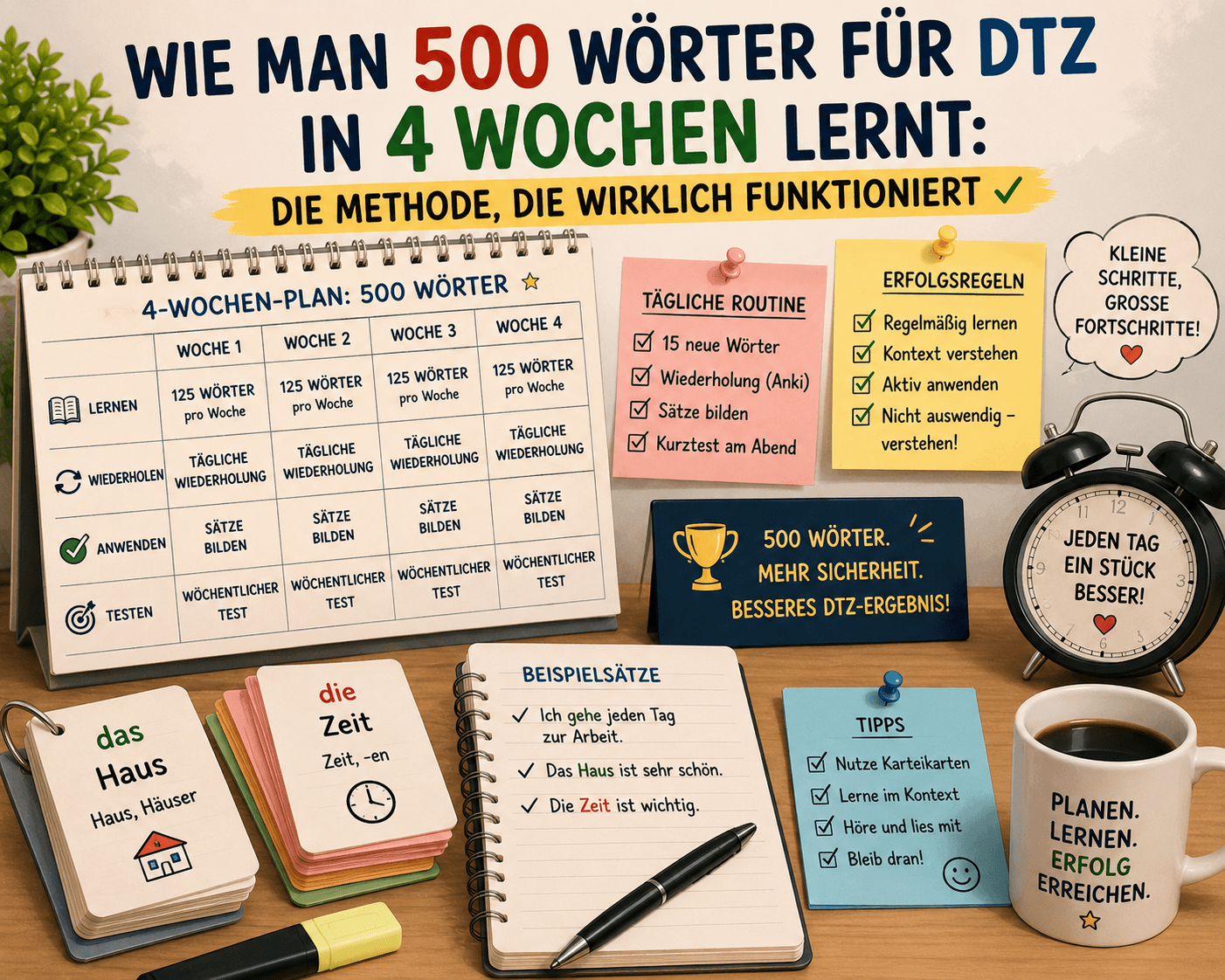
500 DTZ vocabulary in 4 weeks: Spaced Repetition Method with weekly plan
Which 500 words actually appear in the DTZ, how to confidently learn them with Anki in 4 weeks, and why most traditional methods fail — with a concrete daily plan.