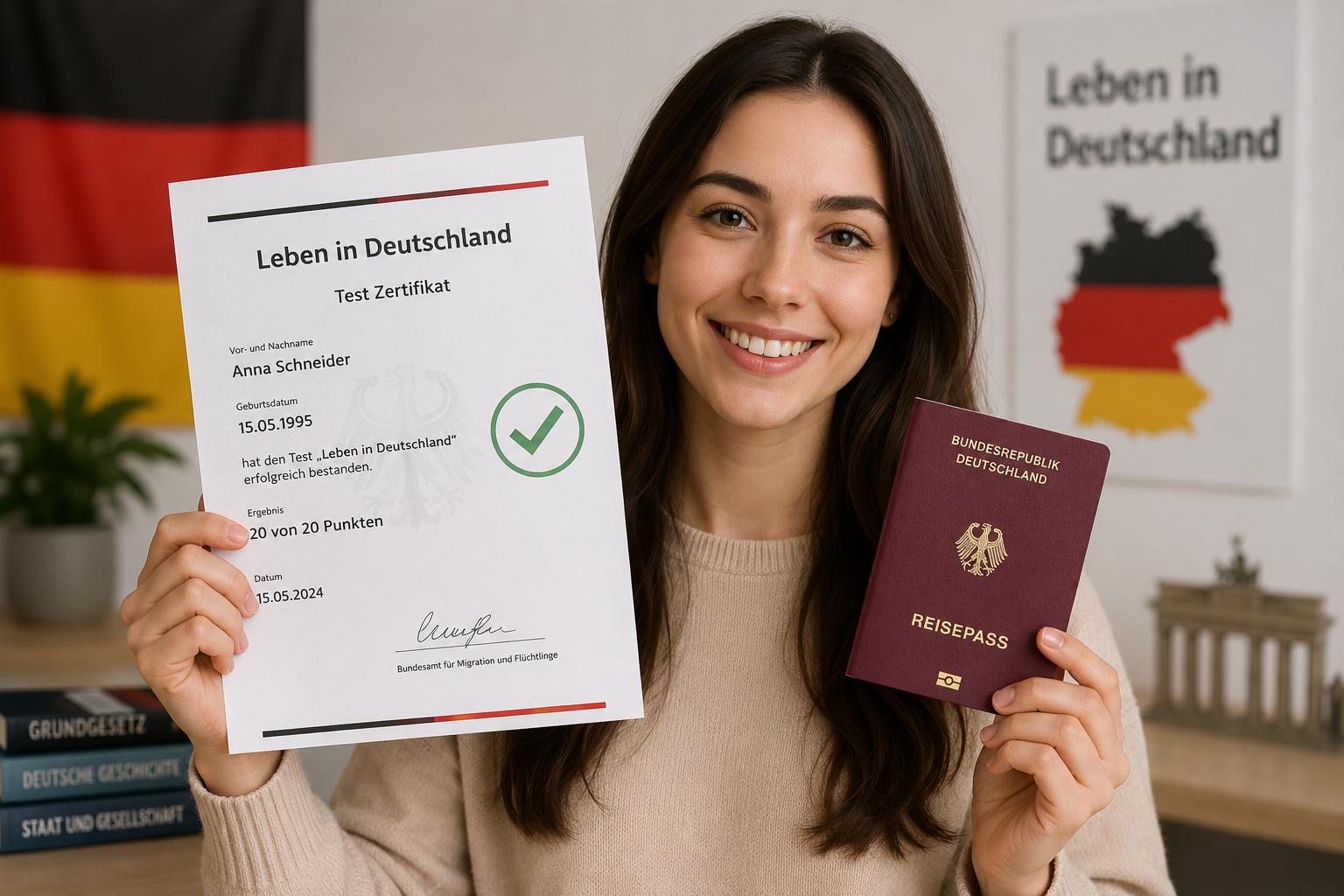
Test "Living in Germany": What is it, who has to take it — and how do you pass it?
At the end of the integration course, there is not only the DTZ — the language test. There is a second exam that many underestimate or even forget: the Test "Life in Germany" (LiD). Those who are not familiar with it go into an exam unprepared, which influences the integration course certificate — and with a higher score, even the naturalization.
This article explains everything you need to know: what the test is used for, how it is structured, what topics are asked, when it takes place — and how to prepare so that you pass it on the first attempt.
Summary: The Test "Life in Germany" consists of 33 multiple-choice questions, lasts 60 minutes, and tests knowledge about politics, history, law, and society in Germany. 15 correct answers = completion of the integration course. 17 correct answers = proof for naturalization. The questions come from a publicly accessible catalog of 300 federal questions + 10 questions per federal state.
What is the Test "Life in Germany" used for?
The final test of the integration course consists of two exams: the language test DTZ (German Test for Immigrants) and the Test "Life in Germany". Together, they result in the Integration Course Certificate — and this has far-reaching consequences.
Depending on the result of the LiD test, different options open up:
No certificate. Test can be repeated.
Integration Course Certificate. No proof of naturalization.
Proof for the Nationality Act (§ 10 StAG) — valid for naturalization application.
This practically means: Those who answer 17 or more questions correctly do not have to take a separate naturalization test for naturalization — the LiD result counts as equivalent proof. This saves time, fees (€25), and an additional visit to the authorities.
Important: With successful participation in the orientation course, participants can also prove basic knowledge of the German legal and social order — this is required when applying for a settlement permit. Therefore, the LiD test is not only relevant for naturalization but also for the settlement permit.
How is the test structured? — Format, Time, Questions
All test participants receive a questionnaire with a total of 33 questions. On the questionnaire, there are four possible answers for each question. Participants must mark the correct answer for each question. For 33 questions, participants have 60 minutes.
| Element | Details |
|---|---|
| Number of Questions | 33 questions — 30 about Germany in general + 3 about one's own federal state |
| Answer Format | Multiple Choice — 4 answer options, exactly 1 is correct |
| Time | 60 minutes for all 33 questions (approx. 1.8 min. per question) |
| Passing Score LiD | 15 out of 33 correct answers (≈ 45 %) |
| Passing Score Naturalization | At least 17 out of 33 points for proof according to the Nationality Act (≈ 52 %) |
| Total Question Catalog | 300 nationwide questions + 160 state-specific questions (10 each per federal state) |
| Costs | Free in the integration course. Separate naturalization test: €25 fee |
| Repetition | Multiple times possible. No set waiting period between attempts |
Decisive: On the day of the exam, all participants receive their own test sheet with 33 individual questions — of course, all test sheets are equally difficult. The questions are randomly drawn from the public catalog. Those who know the entire catalog are optimally prepared.
The DeutschMeister LiD trainer includes all federal questions and state questions from the official BAMF catalog — with explanations and exam simulation.
What topics are tested?
Tip: practise what you've just read with interactive exercises — it sticks better.
Start practicing →The test includes questions about the political system of Germany, religious diversity, and gender equality. Specifically, the questionnaire covers the following topic blocks:
Politics & Democracy
Bundestag, Bundesrat, parties, voting rights, separation of powers, Basic Law, Federal Constitutional Court, federalism
Law & Rule of Law
Fundamental rights, freedom of expression, freedom of religion, equality, AGG, nationality law, residence law
History of Germany
National Socialism, Holocaust, Second World War, GDR, reunification, post-war history, Jewish life in Germany
Society & Values
Tolerance, freedom of religion, equality, anti-Semitism, integration, diversity, family, compulsory schooling
Economy & Social Affairs
Social security system, health insurance, pension insurance, labor law, taxes, EU membership
State-specific Questions
History, state constitution, landmarks, state capital, state politics — 10 questions each for the 16 federal states
What do the questions look like? — Three examples
All questions follow the same format: a question, four answer options (A–D), exactly one is correct. Here are three typical examples from the official question catalog:
When and where does the test take place?
The Test "Life in Germany" takes place after an orientation course on a separate date. This means: It is part of the integration course — directly after the orientation course (100 teaching units), which follows the German course part (600–900 teaching units).
Integration Course — German Course Part (600–900 UE)
German learning course A1 to B1. Completion with DTZ exam.
Orientation Course (100 UE)
Society, politics, history, and values in Germany. Content preparation for the LiD test.
Test "Life in Germany" — own exam date
33 questions, 60 minutes, at the course provider. Directly after the orientation course.
Result and Certificate
With ≥ 15 points: Integration Course Certificate. With ≥ 17 points: additionally valid proof of naturalization according to § 10 StAG.
Important Update Fall 2025: The option to be naturalized after 3 years with C1 language skills was abolished again in Fall 2025. For naturalization, the regular waiting period applies again. This makes the LiD test even more relevant for everyone who aims for citizenship in the long term — the result remains valid.
How to best prepare?
The key to preparation lies in the question catalog. You can best prepare for the Test "Life in Germany" by interactively working through the respective question catalog. After working through each question, you will see the correct answer. The complete catalog is public — all 310 possible questions can be viewed and learned.
The three most effective preparation methods of our users:
- Systematically work through the question catalog — all 300 federal questions + 10 questions from your own federal state. Do not memorize, but understand: Why is this answer correct?
- Take practice tests under real conditions — 33 questions, 60 minutes, without help. Those who regularly take practice tests go into the real exam without surprises.
- Targeted review of weak topics — identify sources of errors and deepen exactly those topics again. History and state questions are often underestimated.
DeutschMeister · Life-in-Germany Trainer · Official BAMF Question Catalog
310 Questions — interactive, with explanations, for all 16 federal states
On DeutschMeister, you prepare directly with the official BAMF question catalog — all 310 questions, with immediate display of the correct answer, short explanations for each topic, and a real exam simulation: 33 random questions, 60 minutes, automatic evaluation. This way, you know exactly whether you are ready for the real test.
Train for free nowNo account, no credit card. Practice all questions immediately — including state selection.
Test "Life in Germany" vs. Naturalization Test — what is the difference?
Many confuse the two tests — they are two different examination formats with different contexts but identical questionnaires.
| Feature | Test "Life in Germany" | Naturalization Test |
|---|---|---|
| Context | Completion of the integration course (orientation course) | Separately, without a course — for individuals without an integration course |
| Questions | Identical — both from the same BAMF question catalog (310 questions) | |
| Exam Location | At the course provider (VHS, language school, etc.) | BAMF examination centers, VHS, approved institutions |
| Costs | Free in the integration course | €25 exam fee |
| Passing Score Course Completion | 15 out of 33 | — |
| Passing Score Naturalization | 17 out of 33 (LiD result counts as proof) | 17 out of 33 |
| Who takes it | Integration course participants at the end of the course | Direct applicants — e.g., EU citizens, individuals without a course |
Frequently Asked Questions about the Test "Life in Germany"
Can you retake the test if you do not pass?
Yes — the test can be repeated as often as desired. There is no legally mandated waiting period between attempts. Those who do not pass the test as part of the integration course can retake it at the course provider or at another approved examination center.
Which state questions are included in the exam?
Each test sheet contains 30 questions about Germany in general and 3 questions about the federal state in which one lives. So if you live in Bavaria, you will get 3 questions from the Bavaria question catalog. These 10 state questions per federal state are also part of the public BAMF overall catalog and can be practiced specifically.
Are there groups of people who do not have to take the LiD test?
Yes. Exempt from the test requirement are, among others: individuals with a German school diploma or university degree in social sciences, law, or political science, individuals who cannot participate due to illness, and in certain cases, late repatriates. The exact exceptions are regulated by the course provider in conjunction with BAMF.
How long is the LiD test result valid?
The result of the Test "Life in Germany" and the naturalization test is valid indefinitely — there is no expiration date. Those who answered 17 or more questions correctly can present this result at any time in the naturalization process, even many years later.
Where can you find the official question catalog?
The complete question catalog for the Test "Life in Germany" and the naturalization test can be downloaded as a PDF document from the website of the Federal Office for Migration and Refugees. Additionally, the BAMF online test center is available for free — and on DeutschMeister, all 310 questions with explanations and exam simulation are interactively accessible.
What happens if you do not pass the LiD test but have already passed the DTZ?
The two tests are independent of each other. Those who pass the DTZ B1 but do not pass the LiD test do not receive an Integration Course Certificate. The DTZ proof remains valid and can be used for residence permits or the professional language course. The LiD test can be repeated separately without having to retake the DTZ.
Ready to practice your German?
Don't just read — practice now! Hundreds of interactive exercises, audio tasks and exam training are waiting for you.
War dieser Artikel hilfreich?
Ähnliche Artikel
Test Life in Germany (LiD): Structure, Topics, Points, and Why It Is Important
What is the "Living in Germany" test? 33 questions, 60 minutes, 3 topic blocks — and why 17 out of 33 points determine naturalization and certification. All important information explained.

DTZ B1 Writing Brief: Phrases and Templates That Really Work
What sentences do you really need for the DTZ letter? From my own exam experience: salutation, introduction, connectors, requests, and closing — an honest collection of phrases.

DTZ B1 Speaking Part 3: Planning Together — Sample Dialogue, Phrases, and Strategy
What happens in DTZ Speaking Part 3? Planning something together with bullet points. Why the result doesn't count, what a real dialogue sounds like, and which 4 types of sentences are needed.