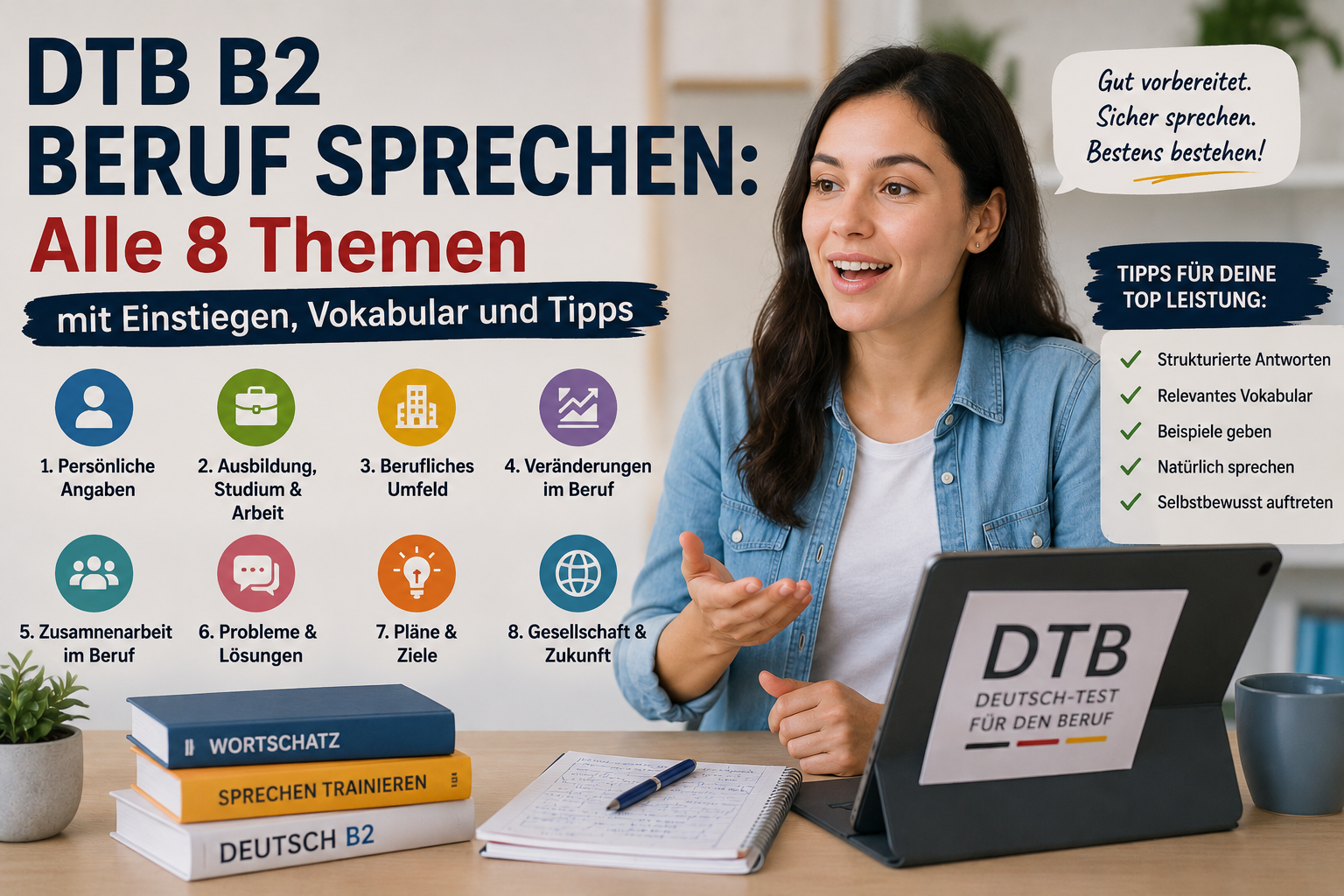
DTB B2 Profession Speaking: All 8 Topics with Introductions, Vocabulary, and Tips
The oral part of the German test for the profession B2 worries many candidates more than the written parts. Not because the German suddenly becomes more difficult — but because in Speaking Part 1, one suddenly has to speak for two minutes straight on a topic, spontaneously, without notes, in front of two examiners and a second person who is taking notes at the same time.
What hardly anyone knows before they prepare intensively: The eight topics that the exam sheet consists of are always the same. There are no surprises. Those who have thoroughly prepared all eight topics do not enter the exam room with a topic they have never considered — but with one they have practiced at least five times. That changes everything.
This article: All 8 topics for Speaking Part 1 of the DTB B2, each with the official task description, key vocabulary for B2 level, tips for structure, and an example introduction. Additionally: How Part 1 is evaluated, what the difference between B1 and B2 is — and how to truly prepare for the exam in two weeks.
The oral exam DTB B2: Structure and what is at stake
Before we get to the topics, a brief look at the structure is worthwhile. The oral part of the DTB B2 lasts about 16 minutes and is conducted as a pair examination — with two candidates (A and B) and two examiners. There is no preparation time.
Important: In Part 1A, you choose which of the 8 topics you want to talk about. Therefore, you should not be equally intensively prepared for all 8 — but work deeply on 2–3 favorite topics so that you can confidently speak for 2 minutes. The topic you know best is the right one.
The 8 topics for DTB B2 Speaking Part 1 — fully explained
Tip: practise what you've just read with interactive exercises — it sticks better.
Start B2 exercises →The following task formulation corresponds to the official exam structure. Each topic includes: the task as it appears on the exam sheet, key vocabulary at B2 level, and a possible opening sentence for the first few seconds — because those count the most.
My previous employer
Describe and evaluate — positively and critically
Official task description
“Describe your previous employer. What experiences did you have there?”
This is the most common opening topic — and at the same time the most personal. Those who answer well here immediately take control of the conversation because the examiners know little about the employer. One speaks from genuine experience.
Good answers not only describe facts (industry, size, activities) but also evaluate: What was good, what could have been better, what have you learned? B2 means expressing differentiated opinions — not just “It was nice” or “It was hard”.
Possible opening
“I would like to tell you about my previous employer — a medium-sized company in the healthcare sector. I worked there as a nursing assistant and during this time gained many important experiences, both positive and those that made me think…”A good work environment
What makes a good workplace?
Official task description
“What do you understand by a good work environment? Describe what is personally important to you.”
This topic offers great scope — and that can become a trap. Those who answer too generally (“I think it’s good when everyone is nice”) sound like A2. B2 means: name concrete aspects, justify them, give examples, perhaps also address controversial points (e.g., home office vs. presence, control vs. trust).
A good structure for 2 minutes: First, name the two to three most important aspects (team climate, leadership style, development opportunities), then briefly elaborate on each and connect it with a personal experience.
Possible opening
“A good work environment means for me above all one thing: that you look forward to going to work every morning. That sounds simple, but it is not. From my experience, it mainly depends on three things…”My profession / My vocational training
My career path — training, experiences, motivation
Official task description
“Tell us about your profession or vocational training. What have you learned, what do you appreciate about your work?”
Many candidates prepare this topic superficially because they believe it is the “easiest”. But this is exactly where most points are awarded or lost in vocabulary and communicative design — depending on whether one speaks technically precisely and structured or only provides a chronological list.
Important: Not only describe what you have learned, but also reflect — why you chose this profession, what makes it challenging, what motivates you. This shows B2 competence: independent thinking in the foreign language.
Possible opening
“I completed my nursing training in my home country and worked for seven years in a children's clinic there. The decision for this profession was not easy — but in hindsight, it was the right one…”A job interview
Experiences, preparation, tips from first-hand
Official task description
“Describe a job interview you have experienced, or explain how to prepare for a good job interview.”
This topic is rewarding because one can either tell about a real experience (very credible, personal, concrete) or — if one has no German work experience yet — can give general advice. Both are allowed.
The common mistake: rushing through the points too quickly (bring a resume, be punctual, appear well-groomed). That is A2. B2 goes deeper: What are typical trick questions? How do you explain a gap in your resume? What do you say if you do not yet master the language perfectly?
Possible opening
“I still remember my first job interview in Germany very well. It was a completely different experience than in my home country — the questions were more direct, and I had to pay very close attention to my wording. I would like to tell you what surprised me and what I would do better next time…”My career choice
Why this profession — conviction, coincidence, or reorientation?
Official task description
“How did you choose your profession? Was it a conscious decision, or did things just develop that way?”
One of the most personal questions — and one where honest, reflective answers have the strongest impact. Many people did not “choose” their profession but had to reorient themselves due to circumstances, family, migration. This is not a flaw — it is material for a convincing and authentic answer.
What B2 means here: Not only tell the story but analyze your own decision. What were the pros and cons of this choice? What might you do differently today? What have you taken away from the experience?
Possible opening
“I would not say that I consciously chose my profession — rather, it chose me. When I came to Germany, I had to have my qualifications reassessed, and in this process, I realized that there are fields of work that suit me much better than what I originally learned…”A company I would like to work for
Dream employer — concrete, justified, realistic
Official task description
“Describe a company or organization you would like to work for. What makes it attractive to you?”
Here, it is expected that one becomes concrete — not just “a large international company that pays well”. One can name a real company they know, or an industry, a type of company, an organizational form (NGO, start-up, public service). The justification is important.
What B2 demands here: weigh different aspects (security vs. innovation, size vs. flexibility, salary vs. meaningfulness) and represent one’s own position without making it absolute.
Possible opening
“To be honest, my dream employer is not a large corporation, but a medium-sized organization in the social sector — specifically: a municipal hospital or a care facility with a good reputation in the region. I would be happy to explain why…”My previous work experiences
Reflection and review — what have you taken away?
Official task description
“Tell us about your previous work experiences. What have you learned, what has been particularly formative for you?”
At first glance, this seems similar to Topic 3 (Profession/Training) and Topic 1 (Employer). The difference: Here it is explicitly about multiple experiences over time — what has changed, what have you taken away, what makes you work differently today.
The strongest answers to this topic connect the personal with the professional: a specific moment that changed the perspective on the profession; a difficult situation from which one learned something important; an insight that one could have used earlier.
Possible opening
“My career path has been anything but linear. I have worked in three different countries, in two different industries — and each of these stations has shaped me in a different way. The experience that actually influenced me the most was one that I initially saw as a setback…”Becoming self-employed — describing a business idea
Entrepreneurship, risks, opportunities, and personal plans
Official task description
“You want to become self-employed. Describe your business idea — what product or service would you like to offer?”
This is the most creative of the 8 topics — and for many the most frightening, because there is no obvious “right” answer. However, that is also the advantage: One can determine the idea themselves and choose it in such a way that they can speak confidently about it.
A common mistake: leaving the idea too abstract. B2 requires precision. Instead of “I would like to open a restaurant” rather: “I would like to start a catering service for corporate events that specializes in Ukrainian cuisine.” That sounds concrete, real, and thought out.
Possible opening
“If I had to imagine a business idea, I would — based on my training and previous experiences — prefer to establish a mobile care service for elderly people with a migration background. The need is real, the gap in the market is large, and I know the target group from firsthand experience…”How Speaking Part 1 is evaluated — what lies between B1 and B2
The DTB B2 evaluates speaking according to the same basic categories as most CEFR-oriented exams: content/task fulfillment, communicative design, correctness, and vocabulary. But the difference between B1 and B2 is not just gradual — it is qualitative.
| Criterion | Level B1 — no longer sufficient | Level B2 — what is expected |
|---|---|---|
| Content | Basic statements, simple explanations, remains superficial | Differentiated statements, justifications, counterarguments, personal reflection |
| Structure | Chronological enumeration without a clear thread | Clearly structured contribution with introduction, main part, conclusion, or clear transitions |
| Correctness | Basic structures correct, but frequent errors in subordinate clauses, subjunctive, passive | Mostly correct; subjunctive II, passive, complex sentence structures used confidently |
| Vocabulary | Everyday vocabulary, simple descriptions, many repetitions | Professionally relevant specialized vocabulary, nuances, synonyms, collocations |
| Fluency | Frequent long pauses, visible word search, hesitation | Fluent with short pauses for structuring — not for searching for words |
The decisive difference in one sentence: B1 tells. B2 analyzes, evaluates, and justifies. Those who have internalized this in all eight topics automatically speak at a higher level — regardless of the specific content.
How to prepare the 8 topics in 2 weeks
Two weeks sound like little. But the 8 topics can be divided into three groups — and those who approach this strategically only need to prepare two to three really deeply in the end.
Week 1: Know all 8, work deeply on three
- Day 1–2: Skim through all 8 topics. Note: Which two or three resonate most with you? Where do you have the most personal experiences?
- Day 3–4: Prepare the first favorite topic intensively. Write down bullet points (do not formulate them!), prepare a 5-minute speaking answer, record it, listen to it, improve it.
- Day 5–6: Do the same for the second topic. Then practice both topics alternately — also in combination with possible examiner questions.
- Day 7: Third topic. At the end of the week: three topics are solid, five are known.
Week 2: Exam simulation and fine-tuning
- Day 8–9: Speak all three prepared topics again — but this time with a partner or via video recording. Time limit: exactly 2 minutes.
- Day 10–11: Practice examiner questions. What might be asked after Topic 1? Typical questions: “Why was that so?”, “What would you have done differently?”, “How is that in your home country?”
- Day 12–13: Complete exam simulation: Parts 1A, 1B, 1C in succession, without a break. Then directly practice Parts 2 and 3.
- Day 14: Do not learn anything new. Speak briefly about favorite topics again. Go to bed early.
DTB B2 · Speaking and Listening · Practice in exam format
Knowing the 8 topics is the first step — speaking them fluently is the second
Those who know the 8 topics and have practiced the openings are well prepared. Additionally, those who practice the written parts of the DTB B2 — reading, listening, and writing — in the real exam format will enter the exam with a completely different level of confidence. On DeutschMeister, all exam parts can be practiced in the authentic format.
Start practicing nowThe first task opens directly — no account, no registration. Just get started.
Frequently asked questions about the 8 topics in DTB B2
Do you have to prepare all 8 topics, or is it enough to focus on two?
Strategically, it is sufficient to prepare two to three topics really deeply — because in Part 1A you choose yourself. However, you should at least know all 8 and be able to discuss them roughly in case you do not want to choose your favorite topic for some reason (e.g., if the examination partner has already chosen it). Preparing all 8 at a basic level is doable in 2–3 days.
Can you take notes for Part 1A?
No. There is no preparation time and no opportunity to bring your own notes. You receive the task sheet with the 8 topics, read it briefly — and then start speaking immediately. That is why preparation at home is so important: The monologue must sit in your head, not on paper.
What happens if you finish Part 1A before 2 minutes?
That is a warning signal. If you have nothing more to say after 60–70 seconds, you have not prepared the topic deeply enough or are speaking too quickly. The examiners do not wait passively — they can ask questions or introduce the next section. However, a too-short answer negatively affects the evaluation in terms of content and communicative design.
Can you bring in personal experiences from your home country in Part 1A?
Yes, absolutely. The DTB B2 evaluates generally job-related German — not just experiences in Germany. Those who talk about experiences from their home country often show more depth and reflective ability. Important: Establish the connection to Germany or the current work situation to maintain the professional context.
Which of the 8 topics is the easiest, which is the hardest?
This depends very much on the person. Those with long work experience find Topic 1 (Employer) or Topic 7 (Work Experiences) easy. Those who have just retrained or have no German work experience may find Topic 5 (Career Choice) or Topic 2 (Work Environment) more accessible. Topic 8 (Self-Employment) is often considered the most difficult — although it is the freest because you determine the idea yourself.
How does the DTB B2 differ from the telc German B2 profession?
The DTB B2 (German Test for the Profession B2) is the final exam of the BAMF vocational language course and is conducted by various accredited examination providers, including telc. telc German B2 profession is a standalone certificate from the same provider but can also be taken without a vocational language course. The content and format are very similar — the differences mainly lie in the admission and small format details. Those preparing for the DTB B2 are also well-equipped for telc B2 profession.
What if you have never seriously thought about Topic 8 (Self-Employment)?
Then you invent an idea — that is expressly allowed. The task is not “Describe your real business plan,” but “You want to become self-employed.” It is about the linguistic competence to describe an idea, justify it, and use professional vocabulary. The idea can be hypothetical — the language must be real.
Ready for B2 exercises?
Don't just read — practice now! Hundreds of interactive exercises, audio tasks and exam training are waiting for you.
War dieser Artikel hilfreich?
Ähnliche Artikel

DTZ B1 Writing Brief: Phrases and Templates That Really Work
What sentences do you really need for the DTZ letter? From my own exam experience: salutation, introduction, connectors, requests, and closing — an honest collection of phrases.
DTZ B1 Speaking Part 3: Planning Together — Sample Dialogue, Phrases, and Strategy
What happens in DTZ Speaking Part 3? Planning something together with bullet points. Why the result doesn't count, what a real dialogue sounds like, and which 4 types of sentences are needed.
DTZ B1 Speaking Part 2: Describing a picture and sharing experiences — Method and sample dialogue
What happens in DTZ Speaking Part 2? Describe an image (2A), share experiences (2B). Three-layer method, complete sample dialogue on the topic of shopping, and 4 typical mistakes.