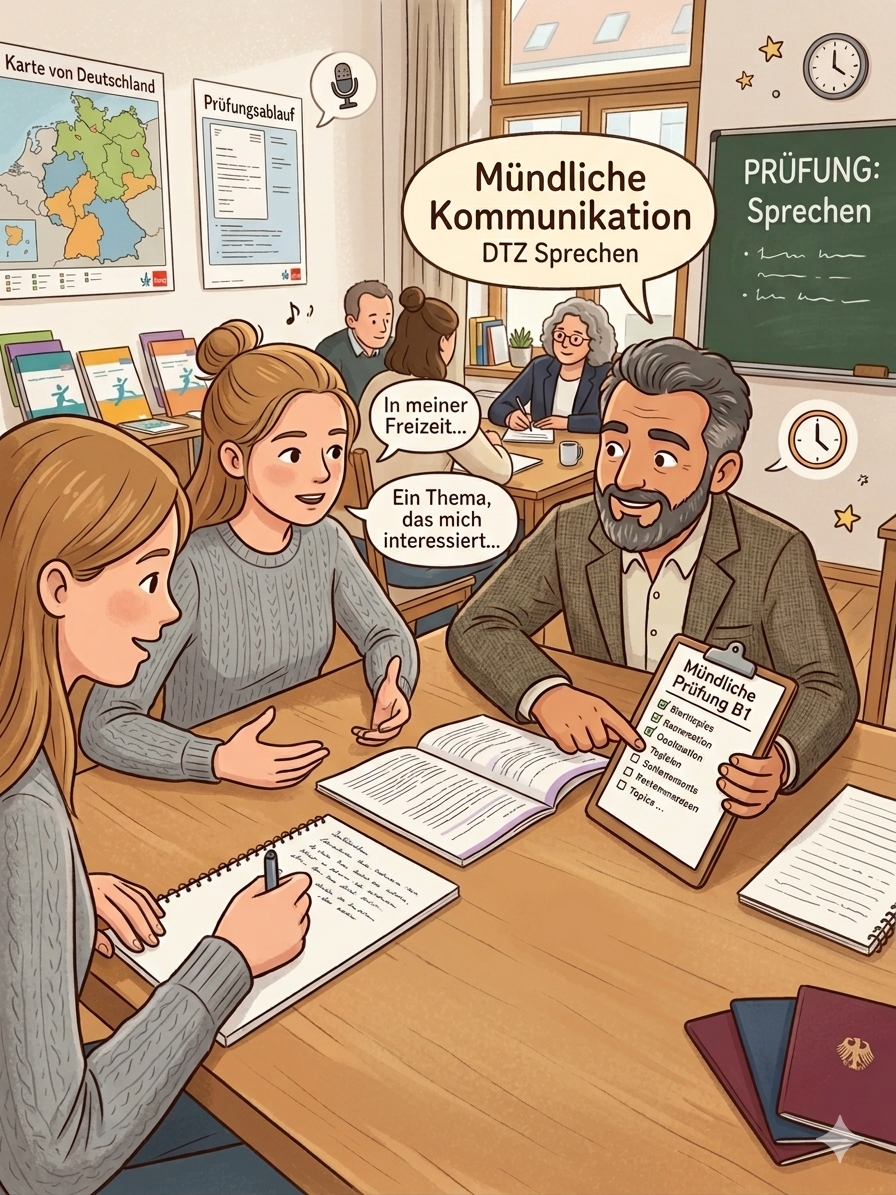
DTZ Speaking: How to Pass the Oral Exam
Many learners practice listening, reading, and writing for weeks – and forget about speaking. That is a dangerous mistake. Because the speaking part is not just one of four – it is the most critical part of the DTZ.
Why? If you fall below level A2 in speaking, you will not receive a certificate – no matter how good your other scores are.
🚨 Important Warning: A speaking result below A2 means: no certificate – even if you have 90 points in the other parts. Practice speaking from the start!
How is the speaking part structured?
The oral exam lasts about 16 minutes – per pair. So you take the exam together with another candidate. There are three parts:
Part 1A: Talking about yourself
You receive a task sheet with keywords. You talk about yourself: origin, profession, family, hobbies, plans.
Example keywords:
Where do you come from? | Where do you live now? | What do you do for work? | What are your hobbies?
Part 1B: Responding to follow-up questions
The examiner asks you additional questions about your answers. Respond naturally and speak in full sentences.
Part 2A: Talking about experiences (with a picture)
You receive a picture and describe it. Then you talk about your own experiences related to the topic.
Example topics:
A market / A language school / A family eating / A doctor’s visit
Part 3: Planning something together
You and your partner plan something together – for example, a party or an outing. You get guiding points and should agree.
Example: “Plan a small party for the office together."
Guiding points: Where? / When? / Food and drinks? / Who brings what?
What do the examiners pay attention to?
- Can you express yourself understandably?
- Are you active in the conversation?
- Do you listen to your partner?
- Do you use different words?
- Do you speak in complete sentences?
Useful phrases for speaking
Talking about yourself (Part 1):
- “I come from … and have been living in Germany for … years."
- “I work as … / I am currently … looking for work."
- “In my free time, I like to …"
Describing a picture (Part 2):
- “In the picture, I see …"
- “In the foreground / In the background there is/are …"
- “The picture reminds me of …"
- “I think that the people in the picture …"
Planning together (Part 3):
- “I suggest that we …"
- “What do you think / What is your opinion on that?"
- “That is a good idea!"
- “I agree."
- “Maybe we could also …"
- “Wouldn’t it be better if …"
Example: Planning together (Part 3)
Tip: practise what you've just read with interactive exercises — it sticks better.
Start B1 exercises →Task: Plan a birthday party for a colleague with your partner.
Guiding points: Where? / When? / Food and drinks? / Gift?
Person A: “I suggest we have the party at the office – after work, around 5 pm. What do you think?"
Person B: “That’s a good idea. We could bring cake. And maybe also coffee and juice?"
Person A: “Yes, agreed. And for the gift – maybe a book or flowers?"
Person B: “I think flowers are nicer. I find that more personal."
How to prepare: Step by step
- Learn typical topics: work, family, housing, leisure, health, authorities.
- Practice aloud: speak German aloud daily.
- Find a practice partner.
- Memorize phrases.
- Simulate the exam (16 minutes).
The 5 most common mistakes in the speaking part
- Answers too short
- Not involving the partner
- Being nervous and silent
- Not paying attention to the guiding points
- Not practicing enough
Frequently Asked Questions (FAQ)
What happens if my partner says nothing?
Try to keep the conversation going. Ask questions and actively lead the conversation.
Am I allowed to make mistakes when speaking?
Yes, mistakes are normal! The most important thing is that you are understood.
With whom do I do the speaking part?
With another exam candidate. The examiners observe both of you.
How often can I repeat the speaking part?
If you do not pass the exam, you can retake it.
Conclusion
The speaking part is not the enemy – it is a chance to show what you can do. With the right phrases, regular practice, and a good partner, you will master it.
Start speaking today – loud, boldly, and in German.
You are not alone in this preparation.
👉 Do you want to pass the exam confidently?
At deutsch-meister-app.com you will find a complete speaking trainer for the DTZ – with typical tasks from all three parts, model answers, and a guide for the conversation.
Ready for B1 exercises?
Don't just read — practice now! Hundreds of interactive exercises, audio tasks and exam training are waiting for you.
War dieser Artikel hilfreich?
Ähnliche Artikel

The difference between A2 and B1: What really changes — and how I made the leap.
What is really the difference between A2 and B1 in German? A personal experience report with 3 surprising facts, 5 tips — and an encouraging conclusion.
Shadowing Method German: Improve Pronunciation and Fluency in 4 Weeks
What is shadowing and how does it work? Step-by-step guide, 4-week plan, and the best free resources for shadowing in German — with a focus on DTZ.
DTZ not passed: Consequences for residence permit, settlement permit, and naturalization
What really happens if you fail the DTZ? Consequences for residence permit, settlement permit, and naturalization — clearly explained with the current status in 2025.