This needs to be known before the exam — not after.
This is what you need to know before the exam — not after:
If you get a result "below A2" in Sprechen — you will not receive any certificate. At all. Even if you passed Hören, Lesen, and Schreiben with excellence.
Most people preparing for DTZ B1 spend the lion's share of their time on written exercises. Hören, Lesen, Schreiben — obviously, there are many tests, and you can practice for hours. But Sprechen? "I speak in classes, it will somehow work out." It is this "somehow" that ends up costing the most.
The oral part of DTZ is the only one where failure completely nullifies the result of the entire exam. And yet it is the one people prepare for the least. In this article, we will analyze how Sprechen is structured in DTZ B1, the criteria by which two examiners simultaneously assess you, the six mistakes that most often cost people their certificate — and what specifically helps to avoid them.
The rule that changes the entire logic of preparing for DTZ
The official methodology of g.a.s.t. (the organization administering DTZ since 2023) establishes the following: the minimum condition for obtaining any certificate is to achieve level A2 or higher specifically in Sprechen. If this does not happen — the results calculation table simply does not issue any certificate, regardless of other scores.
Here is how it looks in practice. Imagine: a person brilliantly handled Hören and Lesen — 40 points out of 45, confident B1. Wrote a decent letter in Schreiben — also B1. And then in Sprechen got flustered from nervousness, fell silent, answered too briefly. The Sprechen result is "below A2." The outcome: the person goes home without any document, although the written part was excellent.
How it is actually determined which certificate you receive
DTZ is a unique exam: the same exam on the same day can give either A2 or B1. It all depends on the combination of results from the three parts. And Sprechen — in each of them — is a mandatory minimum.
| What you want to get | Sprechen | + another part | Result |
|---|---|---|---|
| B1 Certificate | ≥ B1 | Hören/Lesen or Schreiben ≥ B1 | ✔ B1 Certificate |
| A2 Certificate | ≥ A2 | Hören/Lesen or Schreiben ≥ A2 | ✔ A2 Certificate |
| No certificate | below A2 | — does not matter — | ✘ No certificate |
That is why treating Sprechen as a "secondary" part is a strategic mistake. It is not one of four equal parts. It is the foundation without which everything else does not count.
How Sprechen is structured in DTZ: 3 parts, 16 minutes, two examiners
The oral part is conducted separately from the written one and takes about 16 minutes. In the room are two licensed g.a.s.t. examiners, both independently assess you, after which their scores are averaged. This is important: if one examiner gives B1 and the other A2, the final result will be between them. Therefore, consistency throughout the exam is more important than one bright moment.
The exam consists of three parts, each checking a different aspect of oral speech.
1. Teil 1 — Talking about yourself
Teil 1A: You receive a card with key words (name, country, family, work, hobbies, etc.) and briefly talk about yourself — about 1–2 minutes.
Teil 1B: The examiner asks clarifying questions based on your story. This checks not only what you say but also how you react to unexpected questions.
2. Teil 2 — Talking about experiences
Teil 2A: You are shown a photo from a magazine and asked to describe what is depicted and what situation it shows. This is not a vocabulary test — it is a test of your ability to talk about what you see.
Teil 2B: The examiner asks about your own experience related to the photo's topic. If the photo is about online shopping — you will be asked if you shop online and how it looks in your country.
3. Teil 3 — Planning something together
The hardest and most significant part — it gives twice as many points as each subpart of Teil 1 or 2. Together with another participant (or with the examiner) you plan something jointly: a hike, a party, a trip. There is a card with several open points — "where to go," "what to take," "who will come," etc.
The goal is not to reach the "correct" decision but to show that you can propose, agree, object, ask for the other's opinion. This is where it shows whether you know the language as a communication tool.
5 criteria by which your Sprechen is assessed
Sprechen is assessed by two groups of criteria: content relevance to the task (separately for each subpart) and overall language competence (for the entire exam together). Maximum — 100 points.
| No. | Criterion | What is assessed | Max points |
|---|---|---|---|
| I | Aufgabenbewältigung Task fulfillment |
Did you answer the questions? Did you complete the task of each subpart? | 50 |
| II | Aussprache / Intonation Pronunciation and intonation |
Are you understandable? Does your accent interfere with understanding? | 10 |
| III | Flüssigkeit Fluency |
Are there long pauses? Can you continue your thought if you forgot a word? | 10 |
| IV | Korrektheit Grammatical correctness |
Grammatical mistakes in sentences. How serious and frequent are they? | 15 |
| V | Wortschatz Vocabulary |
Variety and accuracy of words. Can you describe a concept if you forgot a specific word? | 15 |
For level B1 in Sprechen you need to score from 75 to 100 points. A2 — from 35 to 74.5. Less than 35 — "below A2," and as we have already established, this means no certificate at all.
Note the distribution: Aufgabenbewältigung gives exactly half of all points (50 out of 100). That means if you speak with a strong accent but answer all questions in substance and complete the tasks — chances for A2 and even B1 remain quite real.
6 mistakes that most often fail Sprechen
Tip: practise what you've just read with interactive exercises — it sticks better.
Start B1 exercises →These mistakes are not theoretical. They happen again and again to people who actually know the language quite well. The issue is not the level — the issue is that the exam requires a completely different behavior than a usual conversation.
Mistake 1: Falling silent from nervousness and giving very short answers
"Ja," "Nein," "Ich weiß nicht" — these are not answers for B1. If your replies consist of 3–5 words, Aufgabenbewältigung rapidly drops down, and with it the overall score.
What to do: Decide in advance that you will expand each answer to at least 2–3 sentences. Even if you are nervous — say more, not less. Any answer is better than silence.
Mistake 2: Being silent in Teil 3, waiting for the partner to speak
Teil 3 assesses both of you simultaneously. If you are silent and waiting — the examiner sees: either you do not understand the task or you cannot initiate conversation. Both options are bad.
What to do: Take the initiative first. Start the conversation with the phrase: "Was meinen Sie — sollen wir…?" or "Ich schlage vor, dass wir…" — and the conversation will flow.
Mistake 3: Stopping in the middle of a sentence because of a forgotten word
One of the criteria is Flüssigkeit (fluency). A long pause or complete stop because you don't remember one word lowers the score more than a grammatical mistake. Native speakers sometimes forget words too — but they do not stop.
What to do: Learn circumlocution phrases: "das Ding, mit dem man…", "so ein Gerät / so eine Art von…", "ich meine damit…". Keep speaking — and the assessor will see that you can circumvent difficulties.
Mistake 4: Speaking only to the examiner, ignoring the partner in Teil 3
In Teil 3 the task is "gemeinsam planen," i.e. planning together. If you address only the examiner and do not involve the partner — you technically do not complete the task, which immediately affects Aufgabenbewältigung Teil 3, which gives the most points.
What to do: Look at your partner. Ask their opinion: "Und was denken Sie?", "Sind Sie einverstanden?", "Finden Sie das auch gut?"
Mistake 5: Preparing a "monologue" for Teil 1 and just reciting it
Some candidates memorize Teil 1A — and it is noticeable. Examiners immediately understand that the person is not speaking but reproducing a learned text. Moreover, after the monologue follows Teil 1B with clarifying questions — and if you are not ready for them, the contrast is very sharp.
What to do: Prepare only the structure and key words — not the text. Answer naturally, allow connections between thoughts, react to the card with prompts as to a supporting outline.
Mistake 6: Not practicing Sprechen aloud, only "in your head"
This is probably the most common mistake among people who study independently. Understanding grammar and being able to speak are two different skills. If you do not regularly practice pronunciation aloud, your mouth simply "does not obey" at the exam even where your head knows the correct answer.
What to do: Speak aloud daily for at least 10–15 minutes. Describe photos, retell what you have read, record yourself on the phone and listen. It is uncomfortable — and it should be at the beginning.
10 phrases that demonstrate B1 level in any Sprechen
Learn these phrases by heart. They are not "magic" — but they signal to examiners that the person can structure speech, agree and disagree, conduct a dialogue. All this directly affects the scores for Wortschatz and Flüssigkeit.
| Situation | Phrase |
|---|---|
| Propose an idea | Ich schlage vor, dass wir… / Wie wäre es, wenn wir…? |
| Agree | Das finde ich gut. / Einverstanden, das klingt gut. |
| Softly disagree | Das stimmt, aber… / Ich sehe das etwas anders, weil… |
| Ask to repeat | Könnten Sie das bitte wiederholen? / Wie meinen Sie das? |
| Fill a pause | Also… / Ich meine damit… / Wie soll ich sagen… |
| Describe a photo | Auf dem Foto sehe ich… / Im Hintergrund ist… / Es sieht so aus, als ob… |
| Talk about experience | Ich habe einmal… / Bei uns in der Ukraine ist es so, dass… / Ich finde das wichtig, weil… |
| Involve the partner | Was denken Sie darüber? / Haben Sie auch Erfahrungen damit? |
| Describe an unknown word | Das ist so ein Ding, mit dem man… / Ich meine diesen Gegenstand, der… |
| Summarize | Also, wir sind uns einig: … / Zusammenfassend kann ich sagen, dass… |
How to practice Sprechen at home without a partner: 4 real methods
Finding a partner to practice with is ideal, but not always possible. Here is what really helps even in self-study format.
Method 1: Shadowing
Take audio from Deutsche Welle or any short video on YouTube. Listen to sentences — and immediately repeat aloud, trying to copy the pace and intonation. This is the fastest way to "develop" pronunciation and feel the natural rhythm of the language.
Method 2: Describe photos aloud
Open any photo in Google Images — and for 2 minutes describe what is depicted, the situation, what people in the picture might feel. Then relate it to your own experience. Repeat daily with different photos.
Method 3: Record yourself on the phone
Record your answers to typical DTZ Sprechen questions (name, where from, hobbies, work, impressions of Germany). Listen and honestly answer: is it long enough? Are there pauses? Is there vocabulary variety? Most people hear their mistakes for the first time in recordings.
Method 4: Tandem partner or online communities
Find someone in a Telegram or Facebook group who is also preparing for DTZ, and practice Teil 3 together via video. Even one 20-minute session per week is a qualitatively different experience than monologues alone.
Frequently asked questions about Sprechen in DTZ
Can I retake only the Sprechen part if I failed?
No. DTZ is an integrated exam, and retaking is possible only fully: all four parts again. Therefore, you need to prepare for Sprechen as seriously as for the written parts.
Does a strong accent affect the Sprechen result?
The criterion Aussprache/Intonation gives a maximum of 10 points out of 100. An accent that is present but does not interfere with understanding will slightly lower the score. It is much more important to expand answers and complete tasks than to speak without an accent.
What if I did not understand the examiner's question?
Ask again — this is absolutely normal and not penalized. Say: "Könnten Sie das bitte wiederholen?" or "Entschuldigung, ich habe das nicht ganz verstanden." It is much worse to stay silent or answer inappropriately.
How much time is given to prepare the answer in Teil 1?
Before Sprechen starts, there are a few minutes to review the cards and collect your thoughts. Use this time: look over the Leitpunkte on the cards, think about 2–3 specific details for each point.
Can it happen that there is no partner in Teil 3?
Yes. If there is no pair, one of the examiners plays the role of the partner in Teil 3. This is a fully equivalent option — it is assessed exactly the same as with another exam participant.
Is there a difference between DTZ Sprechen and Sprechen in telc or Goethe?
Yes, the format is different. DTZ Sprechen has three specific parts with clear tasks (talking about yourself, photo, joint planning). In telc B1 the structure is different, in Goethe — its own. If you are taking DTZ — practice specifically according to the DTZ format, not general textbooks.
Ready for B1 exercises?
Don't just read — practice now! Hundreds of interactive exercises, audio tasks and exam training are waiting for you.
War dieser Artikel hilfreich?
Ähnliche Artikel

The difference between A2 and B1: What really changes — and how I made the leap.
What is really the difference between A2 and B1 in German? A personal experience report with 3 surprising facts, 5 tips — and an encouraging conclusion.
DTZ not passed: Consequences for residence permit, settlement permit, and naturalization
What really happens if you fail the DTZ? Consequences for residence permit, settlement permit, and naturalization — clearly explained with the current status in 2025.
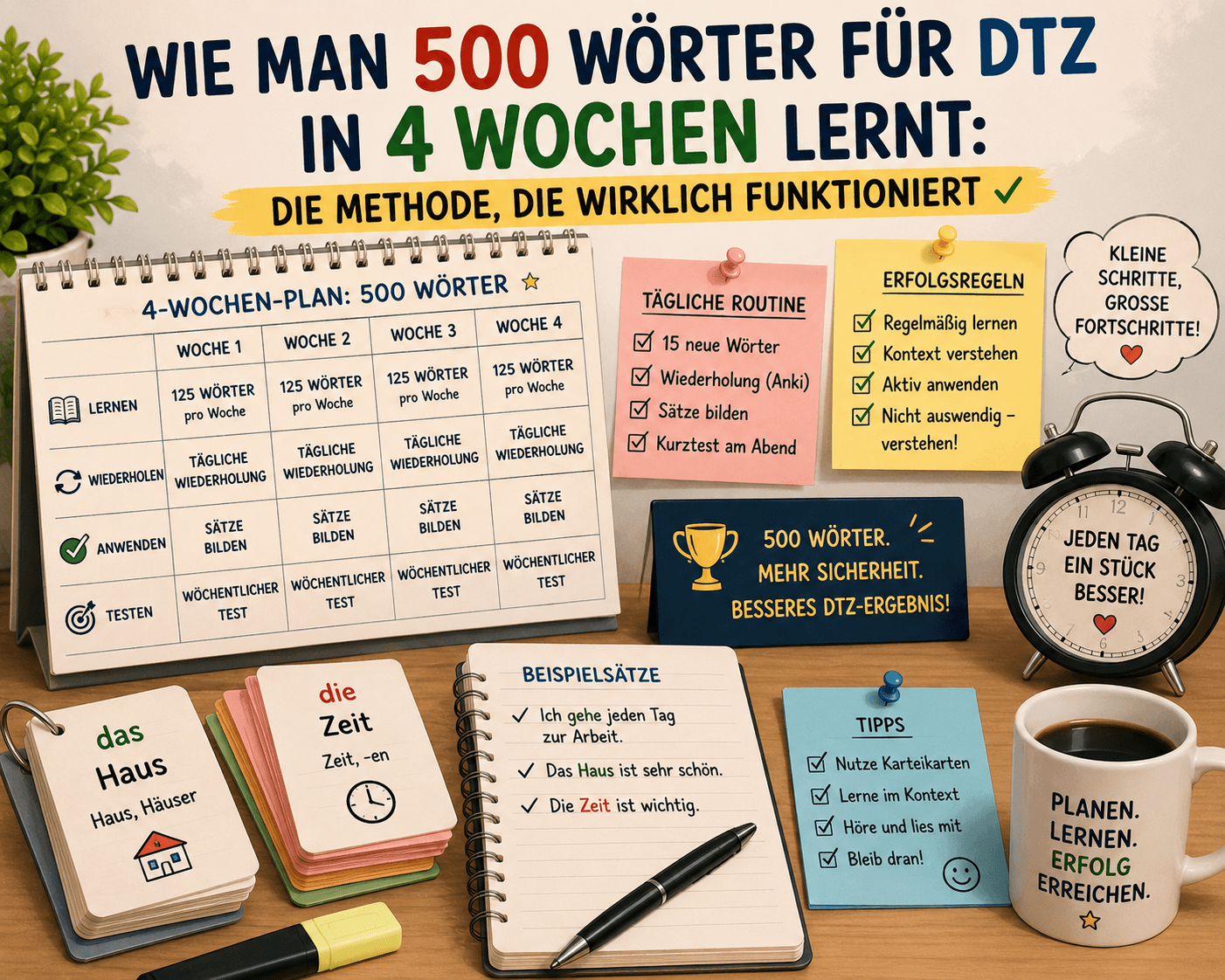
500 DTZ vocabulary in 4 weeks: Spaced Repetition Method with weekly plan
Which 500 words actually appear in the DTZ, how to confidently learn them with Anki in 4 weeks, and why most traditional methods fail — with a concrete daily plan.