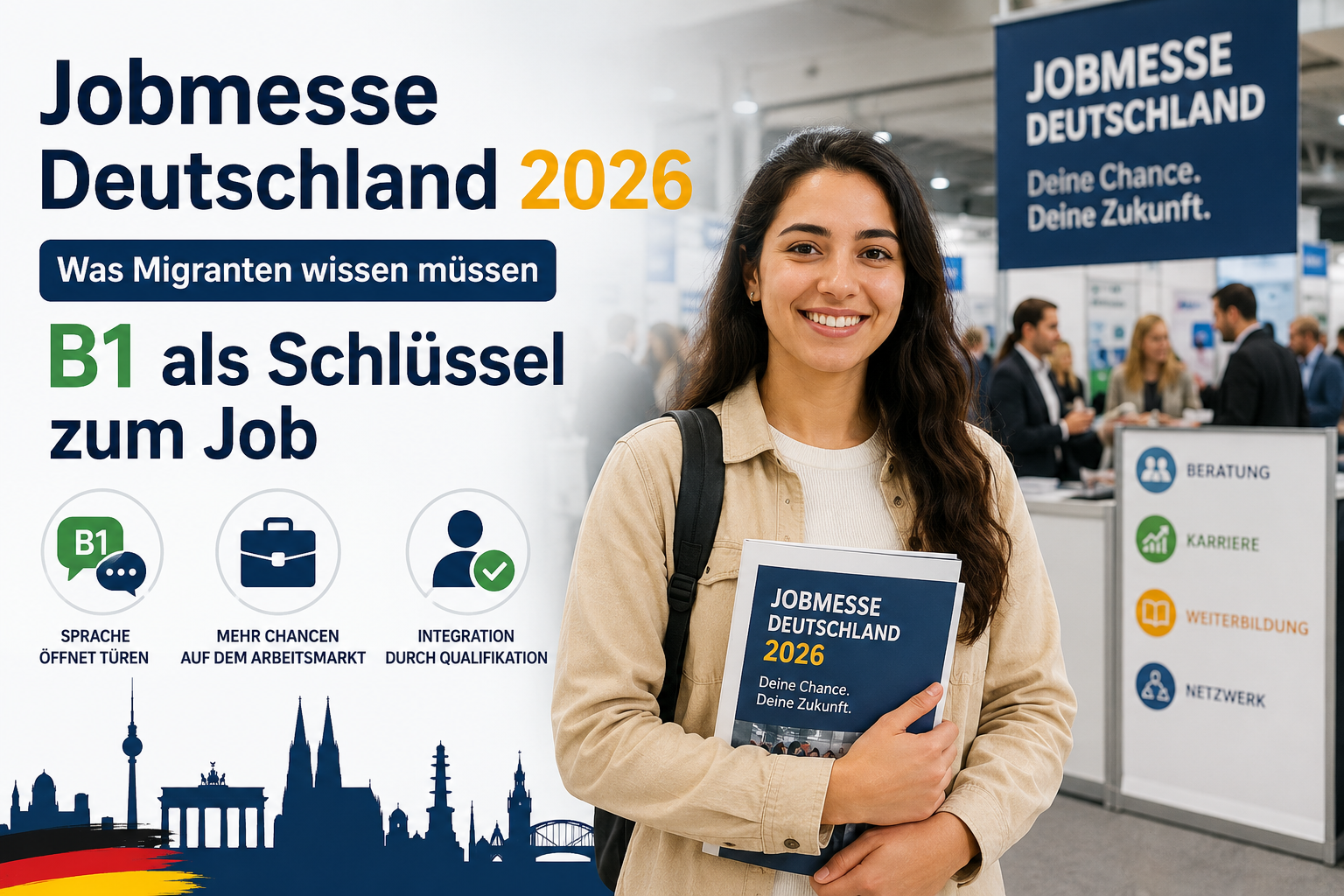
Job Fair Germany 2026: What Migrants Need to Know — B1 as the Key to Employment
Imagine this: a fair where 80, 100, sometimes over 200 companies wait for applicants on a single day — without appointment booking, without long application phases, without waiting lists. You walk in, speak directly with the HR manager, hand in your resume, and receive immediate feedback. This exists. And it exists in almost every German city — several times a year.
Job fairs are one of the fastest and most direct ways for many migrants in Germany to enter the job market. And yet, surprisingly few take advantage of them. The most common reason that employers repeatedly mention at such fairs: the language barrier. “B1 is the minimum for a conversation" — you hear this behind almost every booth.
This article: What a job fair is and how it works, which fairs regularly take place in the largest German cities, why B1 German is the crucial key — and how to prepare specifically in 4 weeks to really make an impression at a job fair.
What is a job fair — and what really happens there?
A job fair (also career fair or recruiting fair) is an event where employers and job seekers come into direct contact. Companies rent booths, introduce themselves, distribute informational materials — and conduct initial conversations with interested parties on-site. Admission is free or very inexpensive at most job fairs.
In Germany, more than 200 job and career fairs take place annually — from small regional events with 20 exhibitors to nationwide career fairs with over 300 companies. Some are aimed at newcomers and students, others at skilled workers and career changers, and more and more specifically at migrants and refugees.
What is possible at a job fair:
- Speak directly with HR managers — without application portals and waiting times
- Hand in your resume directly and receive immediate first feedback
- Get to know various industries and companies in one day
- Gather information on training positions, retraining, and internships
- Build a network — also for future applications
- At some fairs: free consultation on the recognition of foreign qualifications
The language barrier: Why B1 is the crucial key
At Berlin job fairs for refugees and migrants, you hear the same sentence behind almost every company booth: “B1 is the minimum for a conversation." This is no coincidence. German at the B1 level is the legal basic requirement for most occupations in Germany — as stipulated in the Residence Act and the requirements of the Federal Employment Agency.
On DeutschMeister, you can test your current level for free — in 15 minutes, without registration, with immediate results.
Job fairs in your city — the most important events in Germany
Job fairs take place throughout the year in Germany — in every major city and most medium-sized cities several times a year. Here are the most important fair formats and locations that are particularly relevant for migrants and job seekers with B1/B2 German skills.
Berlin
Several fairs per month
Berlin is Germany's most diverse job fair city. In addition to general career fairs, there are regularly specific job fairs for refugees and migrants.
Important fairs: Career Day Berlin (Estrel), connecticum, Health as a Profession, Job Fair for Refugees and Migrants
Munich
Job Fair Munich Tour
Munich is Germany's strongest labor market. The Job Fair Munich takes place several times a year and offers specific advice on labor market integration for migrants.
Important fairs: jobmesse münchen, beruf & bildung münchen, SinoJobs Career Days, Career Day Munich
Hamburg
Port, logistics, services
Hamburg offers particularly many positions in logistics, port operations, care, and gastronomy. Many employers actively seek employees with international experience.
Important fairs: Let's Care Hamburg, Career Day Hamburg, bonding Hamburg, HanseMesse
Cologne & Düsseldorf
NRW — largest economic region
NRW is the most populous federal state with the broadest job offerings. Particularly care, IT, and crafts urgently seek skilled workers.
Important fairs: Connecti Cologne, Online Career Day Düsseldorf, Career Day Construction Industry NRW, Job Fair Duisburg
Frankfurt am Main
Banking, logistics, health
Frankfurt is Germany's financial and logistics center. Many fair formats focus on international aspects, regularly including queer and diversity-friendly career fairs.
Important fairs: women&work Frankfurt, LZ Career Day, ScieCon, Career Day Life Sciences Hessen
Stuttgart
Automotive, mechanical engineering, technology
Stuttgart is the center of the German automotive and mechanical engineering industry. Technical professions and engineering, as well as care and services, are in high demand.
Important fairs: Night of Companies Stuttgart, CAR Connects Stuttgart, Career Day Stuttgart
Hannover & Dortmund
Fairs & trade, industry
Hannover has a strong tradition as a fair city. Dortmund offers numerous positions in industry, logistics, and services.
Important fairs: JOBMEDI Niedersachsen Hannover, VDI Nachrichten Recruiting Day Dortmund, Job Fair Hannover
Eastern Germany
Dresden, Leipzig, Magdeburg, Erfurt
Eastern Germany suffers particularly from a shortage of skilled workers — employers here are often especially open to international applicants with B1 skills.
Important fairs: KickStart-MINT Magdeburg, Forum Via Münster, Job Fair Rostock, deine-jobmesse.de Tour in all cities
Tip: The most comprehensive event calendars for job fairs in your city can be found at karrierebibel.de/jobmessen-kalender, berufsstart.de/jobmessen, and deine-jobmesse.de. Many fairs are free, and some charge reduced admission for students, job seekers, and people with disabilities.
What really happens when the German is not sufficient
Tip: practise what you've just read with interactive exercises — it sticks better.
Start B1 exercises →At a Berlin job fair for refugees, an HR manager reported a typical scenario: A candidate from Syria arrives well-prepared at the booth — resume in hand, documents complete, professional training recognized. The conversation begins. The first sentence: “Tell me a bit about yourself." Silence. Not because the man has nothing to say — but because he doesn’t know how to start.
⚠️ The most common situation at job fairs: The conversation ends after 30 seconds
Employers have about 3–7 minutes per visitor at a job fair. They decide in the first 30 seconds whether to deepen the conversation or politely cut it short. A candidate who hesitates, stumbles, or cannot express important information almost always ends up in the second group — regardless of their professional qualifications.
This is not discrimination. It is simply reality: Those who need to communicate in a job and find the conversation itself difficult will not get the position. The good news: This problem is solvable — and solvable faster than most think.
Ready for the job fair in 4 weeks: What to train beforehand
A job fair is not a job interview — but it is often the first step towards one. Appearing well-prepared greatly increases your chances. Preparation has two sides: the linguistic and the content-related.
The content-related preparation
Resume in German — current and clearly formatted
A German resume has a clear format: photo at the top right, tabular, no prose. Translate job titles correctly and specify recognized qualifications if applicable. Length: max. 1–2 pages.
Prepare self-presentation — 60 seconds, by heart
“My name is …, I come from … and have worked there as a … Now I am looking for a position in the field of … because …" These 60 seconds must be fluent, without hesitation, in German.
Be able to clearly formulate your goal
“I am looking for a position as …" or “I am interested in training as …". A clear goal shows determination — and helps the HR manager quickly decide whether to ask further questions.
Prepare 3 questions for the employer
“What German skills do I need at a minimum?" / “Do you offer onboarding programs for international employees?" / “What does the onboarding process look like?" — asking shows interest.
Bring multiple copies of your resume
At least 10–15 copies. Those who come to a booth without anything rarely receive a callback. Paper signals seriousness.
Appropriate clothing for the target profession
For office jobs: neat business casual. For crafts or care: clean and tidy, not necessarily a suit. No rule applies everywhere — but care in clothing shows respect for the conversation.
On DeutschMeister, you practice listening, reading, writing, and speaking in the real DTZ format — the fastest preparation for the B1 certificate that employers require at the job fair.
The linguistic preparation
Having German at B1 level and using it under pressure at a job fair — these are two different things. The following linguistic skills are crucial at a job fair:
| Language situation at the job fair | What is needed | Practice with |
|---|---|---|
| Self-presentation (60 sec.) | Fluent speaking, clear structure, no long pauses | DTZ Speaking Part 1A — same structure |
| Answering questions | Reaction to unforeseen questions, expressing opinions | DTZ Speaking Part 1B — examiner questions |
| Reading job descriptions | Quick reading comprehension of job postings | DTZ Reading Part 2 — ads and notices |
| Listening to announcements and information | Understanding announcements and snippets of conversation | DTZ Listening Parts 1 and 2 |
| Sending an email or message | Short professional message after the fair conversation | DTZ Writing — semi-formal letter |
It is noticeable: The language used at a job fair is almost identical to what is tested in the DTZ B1. Those who prepare for the DTZ are simultaneously preparing for the job fair — and vice versa. This is no coincidence. The B1 level covers exactly the linguistic minimum necessary for professional communication in Germany.
The concrete plan: 4 weeks before the job fair
Many job fairs are announced 4–8 weeks in advance. This is enough time for targeted preparation — if you use the time wisely. Here is a realistic weekly plan:
| Time period | Linguistic goal | Practical goal |
|---|---|---|
| Week 1 | DTZ exercises: Practice Speaking Part 1A (self-presentation) daily for 10 minutes and record | Create or revise a German resume. Research job titles in German. |
| Week 2 | Job fair vocabulary: Read job postings, note terms (full-time, career changers, probation period, etc.) | Research the fair: Which exhibitors? Which industries? Mark 5–10 interesting companies. |
| Week 3 | Practice self-presentation with a partner or via video. Simulate 3 typical fair conversation scenarios. | Prepare questions for employers. Print resumes (min. 15 copies). |
| Week 4 / Fair Day | Practice self-presentation again — out loud, in front of a mirror or by recording. | Prepare clothing. Study the fair plan. Get up early — fairs are quieter in the morning, conversations are better. |
What matters after the job fair — the follow-up makes the difference
Many fair conversations are forgotten — on both sides. Those who do not follow up after a job fair lose the advantage of the personal conversation. Sending a short email within 24 hours sets you apart from 90% of other applicants.
Template for a follow-up email after the job fair:
Subject: Follow-up on our conversation at the [fair] on [date]
“Dear Ms. / Mr. [Name],Thank you very much for the friendly conversation at the [job fair] on [date]. You told me that you are currently looking for [positions/training places] in the area of [X]. I am very interested in this opportunity and would like to submit my application documents.
Could you please let me know to whom I should send my application?
Best regards,
[Your Name]"
This email is formulated at B1 level — clear, polite, to the point. Those who have practiced the DTZ writing part can write it themselves.
Special opportunities: Care, crafts, and IT are looking everywhere
Three industries are particularly active at German job fairs — and are especially open to applicants with a migration background:
- Care: There is an acute shortage of care workers in almost every German city. Those with a care qualification from their home country who can have it recognized find immediate conversation partners at job fairs — provided their German is sufficient for communication with patients. For professional recognition in care, B2 is required in most federal states — the telc German B1·B2 Care exam is the direct path there.
- Crafts: Electricians, plumbers, painters, carpenters — skilled workers are missing in almost all trades. Many companies at job fairs also hire without perfect German if the craft qualification is right. B1 is often sufficient as a starting point.
- Logistics and production: Drivers, warehouse workers, production staff — large logistics and industrial companies regularly have booths at job fairs and actively seek international applicants with B1 skills.
DeutschMeister · B1 Exam Preparation · For Job Search and DTZ
The job fair is not waiting — nor is the language certificate
The B1 certificate is the minimum that employers require at job fairs. On DeutschMeister, you prepare specifically for the DTZ B1 — in all four exam parts, in the real exam format, with immediate feedback. Those who pass the DTZ not only have a certificate — they can hold the conversation at the next job fair that counts.
Register for free nowNo credit card required. Immediate access to practice tasks in all exam parts — listening, reading, writing, and speaking.
Frequently Asked Questions about Job Fairs in Germany
Does it cost money to attend a job fair?
Most general job fairs and career days are free for applicants. At some fairs, visitors pay a small admission fee (1–5 €), with reduced admission for students, job seekers, and people with disabilities. Training fairs and job exchanges specifically organized for refugees are almost always completely free.
Do you need to register or can you just come?
At most job fairs, no prior registration is required — you just come. Some fairs offer the option of online registration, which speeds up entry. Registration is almost never mandatory. Current information can be found on the respective fair's website.
What language level do you really need for a job fair?
For a productive conversation with employers, B1 is the realistic minimum. Those below B1 can attend the fair but will be confronted with the same statement at almost every booth: “Come back when your German is better." Those with B2 are taken seriously by significantly more companies immediately.
Are there job fairs specifically for migrants and refugees?
Yes. In Berlin, Munich, Hamburg, and other major cities, there are regularly specialized job exchanges for refugees and migrants — often in cooperation with the job center, Caritas, or AWO. These fairs often also offer free consultation on the recognition of foreign qualifications, language courses, and funding opportunities. You can search for “Jobbörse Migranten" or “Jobmesse Flüchtlinge" in your city on messeninfo.de.
What to do if the conversation is conducted in English instead of German?
At some international companies and in certain industries (IT, science), English is accepted as the working language. If the employer offers English on their own, that is a good sign. However: In Germany, German is the preferred working language for the vast majority of employers. Those who start in English and offer German — “I can also speak German, my level is B1" — signal initiative and willingness to integrate.
How to find job fairs in your city?
The most reliable calendars are karrierebibel.de/jobmessen-kalender, berufsstart.de/jobmessen, and messeninfo.de. For regional events, it is also worth checking the website of the local job center, adult education center, or chamber of commerce. Many fairs also announce themselves through Facebook groups for migrants and local WhatsApp networks.
Can you be successful at a job fair even without a German qualification?
Yes — especially in industries with an acute shortage of skilled workers (care, crafts, gastronomy), employers look pragmatically at practical experience and language skills. Those who bring foreign work experience and can prove B1 German have quite good chances — even if the qualification is still in the recognition process. Important: address this transparently in the conversation, do not hide it.
Ready for B1 exercises?
Don't just read — practice now! Hundreds of interactive exercises, audio tasks and exam training are waiting for you.
War dieser Artikel hilfreich?
Ähnliche Artikel
DTZ B1 Writing Brief: Phrases and Templates That Really Work
What sentences do you really need for the DTZ letter? From my own exam experience: salutation, introduction, connectors, requests, and closing — an honest collection of phrases.
DTZ B1 Speaking Part 3: Planning Together — Sample Dialogue, Phrases, and Strategy
What happens in DTZ Speaking Part 3? Planning something together with bullet points. Why the result doesn't count, what a real dialogue sounds like, and which 4 types of sentences are needed.
DTZ B1 Speaking Part 2: Describing a picture and sharing experiences — Method and sample dialogue
What happens in DTZ Speaking Part 2? Describe an image (2A), share experiences (2B). Three-layer method, complete sample dialogue on the topic of shopping, and 4 typical mistakes.