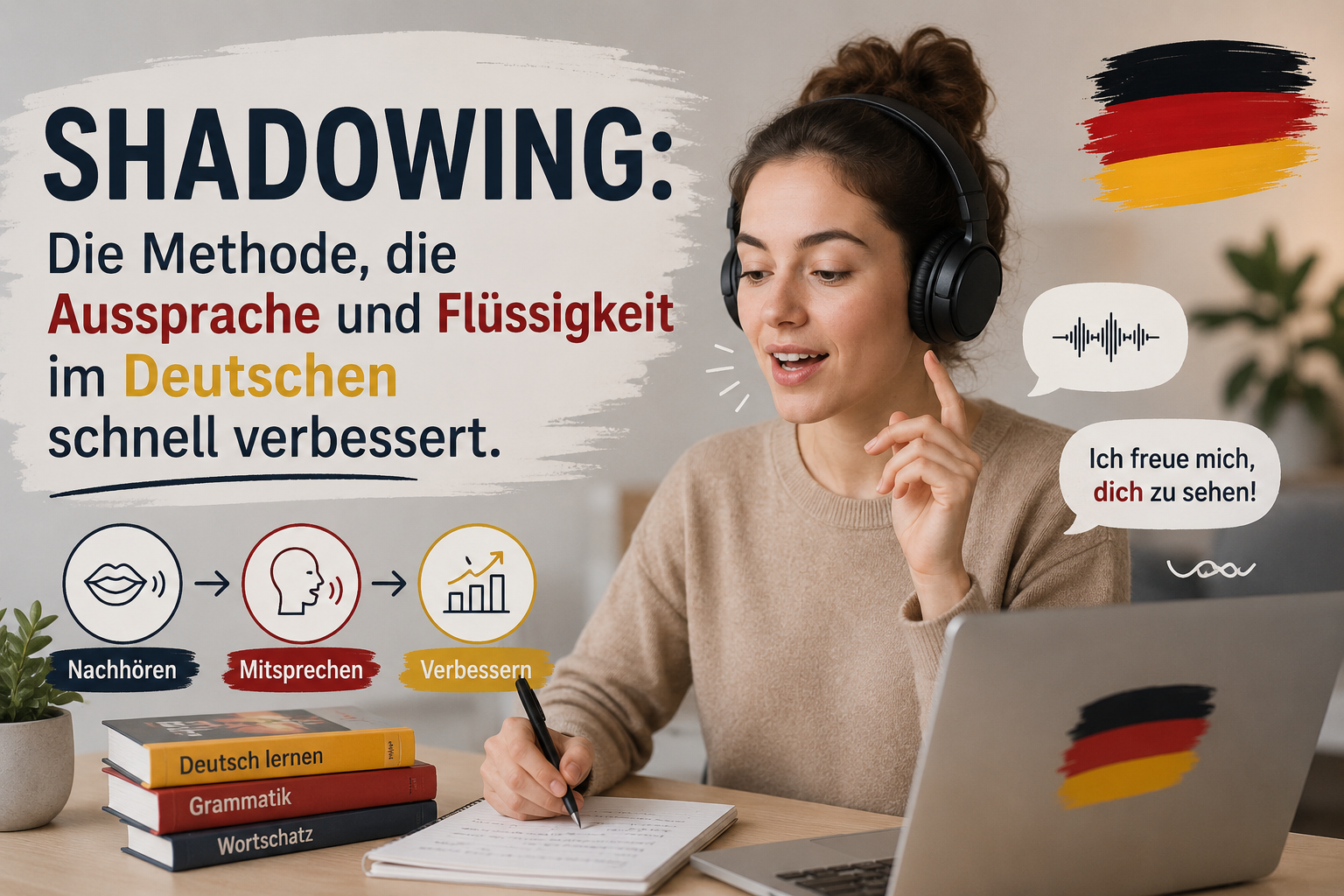
Shadowing Method German: Improve Pronunciation and Fluency in 4 Weeks
There is a moment in learning German that almost everyone knows. You know how a word is spelled. You know the grammar. You can read it. But as soon as you open your mouth, it doesn't sound like what you have in your head. The sentence stumbles, the emphasis is wrong, speaking feels foreign — even though you have heard the word a hundred times.
This is not due to a lack of knowledge. It is because the mouth does not yet know the language. Speaking is a motor skill — like riding a bike or typing. You do not learn it by reading or understanding, but by doing. And there is a method that trains exactly that: Shadowing.
Shadowing literally means "to shadow" or "to follow as a shadow." You listen to a recording and speak along with it — like a shadow that copies every step. Not after, not with a pause: simultaneously. This technique is used worldwide by language learners and speech therapists — and it works because it trains the brain, mouth, and ear at the same time.
How Shadowing Works — and Why It Is So Effective
The core mechanism is simple: When you speak a language, the brain sends commands to the lips, tongue, jaw muscles, and vocal cords. These motor processes — how to form a German "ü," how the voice rises with a question, how "ch" sounds different after "i" than after "a" — are learned patterns. Those who learn these patterns from a book have them in their heads. Those who train them through shadowing have them in their bodies.
This is not a difference in theory. It is the difference between someone who knows how to swim — and someone who can swim.
During shadowing, three things happen simultaneously that occur separately in normal learning:
- The ear receives — you hear rhythm, emphasis, connections between words.
- The brain processes — it tries to imitate the sound before it has fully analyzed it. This forces faster, more intuitive processing.
- The mouth produces — the muscles perform the movements and learn through repetition which positions produce which sounds.
After two to three weeks of daily shadowing, learners report that they adopt more native-sounding patterns into their own speech — without consciously thinking about it. That is exactly the goal.
What This Has to Do with DTZ Speaking
The criterion "pronunciation and intonation" accounts for 10 out of 100 possible points in DTZ speaking. At level B1, the official g.a.s.t. scale demands: "Speaks clearly, even if a foreign accent is sometimes obvious and some words are pronounced incorrectly."
So you do not need to have perfect pronunciation. But you must be easily understandable. The difference between someone who receives a B1 in pronunciation and someone who gets an A2 often lies not in vocabulary or grammar — but in fluency, rhythm, and intonation. And that is exactly what shadowing shapes.
What the g.a.s.t. assessment specifically requires for pronunciation:
| Level | What Is Assessed |
|---|---|
| B1 | Speaks clearly; accent visible, but not an obstacle to communication |
| A2 | Generally understandable; conversation partner may sometimes ask for repetition |
| A1 | Only understandable with great difficulty; only for someone who knows speakers from this language group |
Shadowing Step by Step — How to Do It Right
Shadowing sounds simple. But there is a difference between true shadowing and what most people do the first time — simply "repeating." The following five steps describe the method as it truly works.
Choose Material — The Right Level Is Crucial
The most common beginner mistake: taking material that is too difficult. If you are constantly searching for words you do not know, the brain cannot follow the rhythm at the same time. The rule of thumb: You should understand at least 80–85% of the content without looking it up.
For DTZ preparation: DW "Slowly Spoken News" for beginners, Easy German for advanced learners, or short dialogues from exam practice materials. Recording length at the beginning: 30–60 seconds. No more.
Listen Once — Just Listen, Without Taking Notes or Translating
Before the first shadowing round, listen to the recording completely once. Do not pause, do not take notes. The goal: to absorb the overall rhythm and melody of the recording. Where is the emphasis? Where does the voice rise? Where do words blend together?
Those who skip this step and start speaking immediately will constantly struggle against surprises during shadowing — and lose track of the speaker.
Speak Along Simultaneously — Not After, Not with a Pause: Simultaneously
This is the actual core of shadowing. You start the recording and speak along from the first syllable — as close to the speaker as possible. No waiting, no thinking: just start and try to follow the voice.
At first, it feels strange. You cannot keep up everywhere, you stumble over words, you lose track. That is normal. The brain is learning something new. After three to five repetitions of the same recording, it already sounds noticeably better.
Tip: Speak loudly — do not whisper. The muscle memory effects only occur through full sound production. Those who whisper train different muscles than in a real conversation.
Record and Compare — The Uncomfortable but Most Valuable Exercise
Once you have done the recording a few times: record yourself while shadowing (a phone microphone is sufficient) and compare your recording with the original. This is uncomfortable. And that is why it is so effective.
You will immediately hear where the rhythm is different, where sounds are missing, where you flatten the intonation. Identify specific spots, repeat that spot in isolation, then shadow the entire recording again.
Regularly — Not Long, but Daily
Shadowing is muscle training. Like in sports: One hour once a week is less effective than 10 minutes daily. The brain and mouth need regular, short impulses — not intense, rare sessions.
10–15 minutes daily is ideal. You can use the same recording for several days — until it feels really natural, then switch material.
The 4 Most Common Mistakes in Shadowing
Tip: practise what you've just read with interactive exercises — it sticks better.
Start practicing →✗ Mistake 1
You speak after instead of simultaneously — one syllable behind, then two, then you lose track completely.
✓ Better
Go along from the first syllable, even if it sounds chaotic. The brain learns through striving for simultaneity, not by imitating at your own pace.
✗ Mistake 2
Changing material too early — a different recording every day, not using a recording multiple times. This prevents anything from really settling in.
✓ Better
Use the same recording for 3–5 days. After the fourth time, you sound noticeably better — change it then, not earlier.
✗ Mistake 3
Whispering or speaking too quietly, "so as not to disturb the neighbors." The muscle memory effect only occurs at full volume.
✓ Better
Practice loudly — if not possible at home, then outside while walking or in the car. It sounds strange, but it works much better than whispering.
✗ Mistake 4
Using material that is too long at the beginning — 5-minute podcasts where you are exhausted after 60 seconds.
✓ Better
30–60 seconds, repeated multiple times. Better to shadow a short section very well than to rush through a long section half-heartedly.
What Shadowing Specifically Trains in German
Shadowing is not equally helpful for all languages. In German, there are very specific sounds and patterns where targeted motor practice is particularly beneficial. Here are the most important ones:
1. The German "ch" — Two Different Sounds
"ch" after "a," "o," "u" sounds like a hard, deep scratching in the throat: Dach, Koch, Buch. "ch" after "e," "i," "ä," "ö," "ü" sounds like a soft, front hissing: ich, nicht, Mädchen. Both sounds do not exist in most native languages of DTZ participants — they need to be practiced motorically.
2. German Vowels with Umlaut — ü, ö, ä
"ü" is not the same as "ü" in Slavic languages. "ö" sounds different than the next sound in Turkish or Arabic. These vowels require a specific mouth position, which is memorized much faster through shadowing than through explanations.
3. Word Stress and Sentence Rhythm
In German, the stress in simple words is usually on the first syllable. In compound words, it is on the first component. And sentences have a rhythm that noticeably differs from Ukrainian, Arabic, Turkish, and Polish. Those who do not know this rhythm sound unnatural even with perfect grammar — and examiners notice that.
4. Mergers in Spoken German
Spoken German swallows syllables, connects words, and shortens endings. "Ich habe das nicht gewusst" becomes "Ich hab das n'gewusst" in everyday speech. Knowing these patterns — and being able to produce them yourself — helps not only with speaking but also with listening.
4-Week Shadowing Plan for DTZ Preparation
The following plan builds from simple to more complex materials — corresponding to the four parts of the DTZ speaking test. Each week has a clear goal and specific materials.
Goal: Basic Rhythm and Simple Sounds
Material: DW "Slowly Spoken News" — a short report daily (30–40 seconds). Use the same report for 3 days.
Focus: Emphasis on the first syllable, sentence melody in questions and statements. Do not focus on connections yet.
Time: 10 minutes. Ideally in the morning — fresh concentration.
Goal: Dialogues and Natural Tempo
Material: Easy German — short street interviews (1–2 minutes). Isolate and shadow sections of 30–40 seconds.
Focus: Recognize and imitate mergers. "haben" → "ham," "nicht" → "nich," connections between words.
Additional: Record yourself once a day and compare with the original.
Goal: DTZ-Relevant Topics and Phrases
Material: Short audio dialogues from DTZ practice sentences (g.a.s.t.). Use as shadowing material — then you will know not only the content but also the sound of the exam language.
Focus: Typical DTZ phrases: "Ich würde gern…", "Meiner Meinung nach…", "Das finde ich gut, weil…". These sentences must flow from the mouth — without thinking.
Goal: Connect Own Answers with Shadowed Rhythm
Material: Shadowing as before — but afterwards: immediately speak your own answer to a DTZ question (without audio), trying to maintain the same rhythm you just practiced.
Goal of the Week: The practiced patterns flow into your own spontaneous speaking. This is the moment you are working towards.
The Best Shadowing Resources for German — Free and Immediately Usable
DW Slowly Spoken News
A2–B1 · BeginnerReal news texts, spoken slightly slower than normal, with a transcript. Ideal for first shadowing sessions due to clear pronunciation and manageable pace.
dw.com → Learn German → News
Slow German (Podcast)
A2–B1 · Beginner–IntermediateMonologues on everyday topics, deliberately spoken slowly, with a transcript on the website. Perfect for the first two weeks of shadowing.
Spotify / Apple Podcasts → "Slow German"
Easy German (YouTube)
B1–B2 · IntermediateStreet interviews with native speakers, bilingual subtitles. Natural speaking pace, real mergers. For shadowing at an advanced level.
YouTube → "Easy German"
Nicos Weg (ARD / DW)
A1–B1 · Beginner–IntermediateVideo series about a migrant in Germany, spoken dialogues on everyday topics like housing, work, health — exactly the topics of the DTZ.
dw.com/nicosweg
Deutschland Radio (Live)
B2+ · AdvancedReal radio pace, real rhythm. Not for beginners, but excellent for anyone who wants to test their level after 2–3 weeks of shadowing.
deutschlandradio.de · free livestream
DTZ Practice Sentences (g.a.s.t.)
B1 · Exam FormatOfficial audio recordings in DTZ format. Use dialogues from the listening part as shadowing material — then you will know not only the content but also the sound of the exam language.
gast.de/dtz · free download
Practice Speaking in DTZ Format · Level B1
Shadowing Trains Pronunciation — Exam Tasks Train Application
Shadowing improves how you sound. Exam exercises show what you need to say. Both together are the complete preparation for the DTZ speaking part. On DeutschMeister, you can practice all three parts of the DTZ speaking with real tasks — and simultaneously apply the shadowing technique with the audio material.
Start Task in Exam FormatThe task opens directly — no account, no registration. Listen and simultaneously try the shadowing technique from this article.
Frequently Asked Questions About Shadowing in Learning German
Do you need to understand the text while shadowing, or is it enough to mimic the sounds?
Both together are most effective. If you do not understand the content, you can copy the sounds — but the rhythm and emphasis will not be fully internalized because you do not know which words are significant. Ideal shadowing material has a comprehensibility level of at least 80% — you understand most of it, but not everything. This is the optimal learning area.
How long does it take for shadowing to show visible results?
Most report a noticeable difference after 2–3 weeks of daily practice — especially in fluency and intonation. Pronunciation details like the German "ch" or umlauts take longer, 4–8 weeks. Important: the improvement is often not heard during shadowing itself, but when you speak freely afterwards. That is the moment that counts.
Can you also do shadowing with YouTube videos that do not have a transcript?
Yes. Transcripts are helpful, but not mandatory. You choose a short section, listen to it twice, and then shadow it. The advantage of material with a transcript: You can check what you said after shadowing and identify differences from the original. Without a transcript, you work purely by ear — which also works but makes self-correction harder.
Is shadowing also useful for higher levels than B1?
Yes, definitely. Shadowing is not a beginner technique — professional interpreters use variations of it for C1–C2 level and beyond. For higher levels, you choose correspondingly more complex and faster material. The basic method remains the same.
Does it hurt if I make many mistakes while shadowing and constantly lose track?
No — that is part of the process. The point is not to keep up perfectly, but to force the brain to process faster than during normal speaking. If you keep up 40% at first and 70% after ten days, you have learned well. If you keep up perfectly from the start, you are practicing with material that is too easy.
Can shadowing completely eliminate an accent?
This is not a realistic goal — and also not necessary. For the DTZ, it is sufficient to be easily understandable. A recognizable accent is still compliant with B1 according to g.a.s.t. criteria. Shadowing helps reduce the accent to a level where it no longer hinders communication — and that is exactly the goal.
Can you practice shadowing in German without living in Germany?
Yes, completely. Shadowing is based on recordings, not on contact with native speakers. Those who practice daily with DW, Easy German, and g.a.s.t. practice materials receive the same input as someone living in Germany — as long as they actively use it and do not just let it run passively in the background.
Ready to practice your German?
Don't just read — practice now! Hundreds of interactive exercises, audio tasks and exam training are waiting for you.
War dieser Artikel hilfreich?
Ähnliche Artikel
DTZ Writing: How to Write a Good Letter
DTZ Writing — how to write a good letter: step-by-step guide with a real example and the most common mistakes to avoid.
DTZ Speaking: How to Pass the Oral Exam
DTZ Speaking: How to pass the oral exam — why speaking is the most critical part of DTZ and how to prepare effectively to get a certificate.

Passing the DTZ Exam: Your Step-by-Step Guide
Passing the DTZ exam: structure, typical tasks and the best preparation tips — your complete step-by-step guide for success.