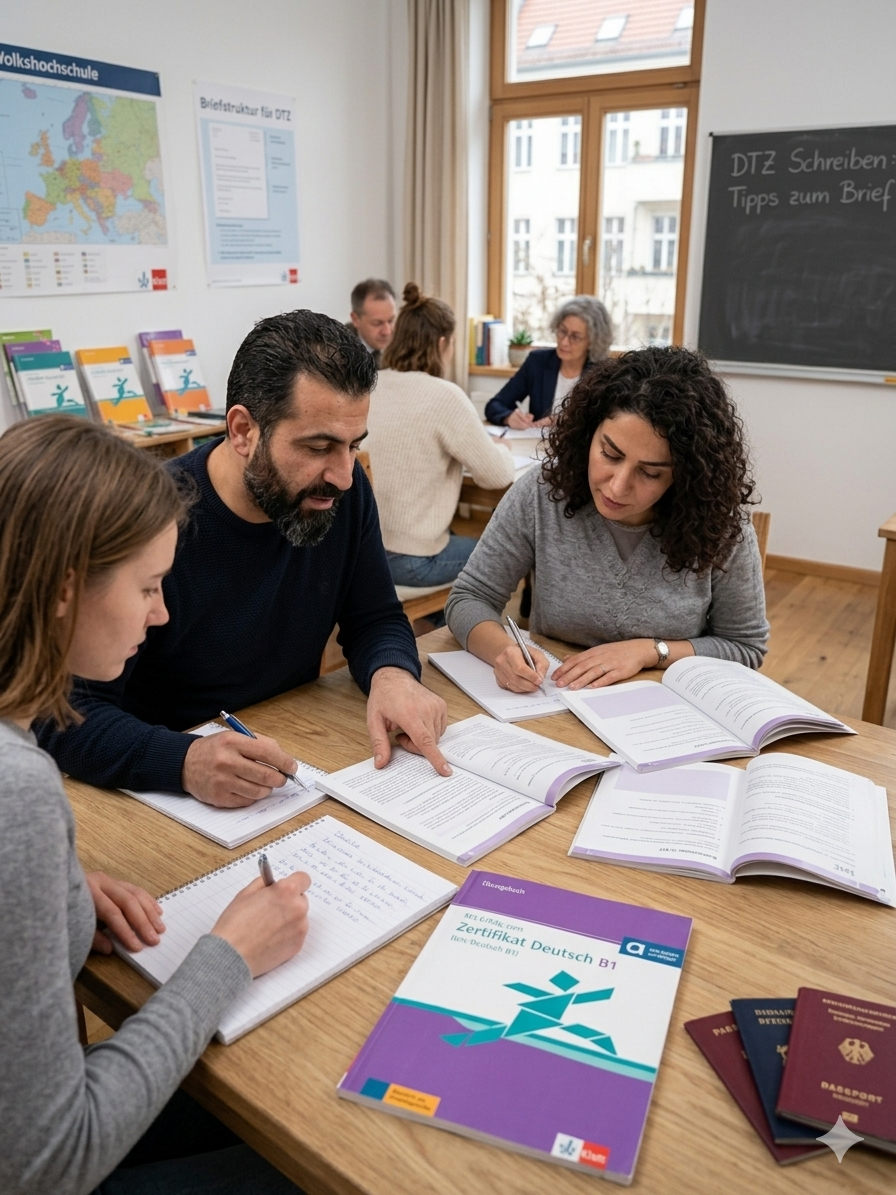
DTZ Writing: How to Write a Good Letter
The writing section in the DTZ scares many learners. 30 minutes, one topic, four guiding points – what exactly is expected? How long should the letter be? Which mistakes cost points?
Don’t worry. In this article, we explain step by step how to write a good letter – with a real example and the most common mistakes you should avoid.
What is required in the writing section?
In the writing section of the DTZ, you have 30 minutes. You write a semi-formal or formal message – for example, a letter or an email.
You get:
- A situation (e.g., “You want to cancel a course")
- 4 guiding points that you must address all
- Sometimes a template (e.g., a letter you are supposed to reply to)
⚠️ Attention: You must address all 4 guiding points. If you forget one, you lose points – even if your text is linguistically good.
How is your letter evaluated?
Your letter is evaluated according to four criteria:
-
Task fulfillment
Did you address all 4 guiding points? Is the text appropriate for the situation? -
Coherence and cohesion
Is the text logically structured? Are there linking words between sentences? -
Lexis (vocabulary)
Do you use varied and appropriate words? Or always the same ones? -
Grammar
Are the sentences grammatically correct? Do articles, verbs, and word order match?
How to structure your letter
A letter in the DTZ always has this structure:
- Salutation: “Sehr geehrte Damen und Herren," (formal) or “Liebe Frau Müller," (semi-formal)
- Introduction: Why are you writing? One to two sentences.
- Main part: Here you address all 4 guiding points – in logical order.
- Conclusion: “Ich freue mich auf Ihre Antwort." or “Bitte teilen Sie mir mit, ob …"
- Closing formula: “Mit freundlichen Grüßen," + your name
Example task with model solution
Tip: practise what you've just read with interactive exercises — it sticks better.
Start B1 exercises →Task:
You have enrolled in a German course. Now unfortunately you cannot attend. Write to the course provider.
Write about the following points:
- Why are you writing?
- Why can you not come?
- From when can you attend again?
- Request for confirmation
✅ Model solution:
Sehr geehrte Damen und Herren,
I am writing to you because unfortunately I cannot attend the German course.
I am sick and have to stay at home. The doctor has prescribed bed rest.
I hope that I can attend the lessons again from next week, that is from March 15.
Could you please confirm that my place in the course will be kept? I would be very pleased.
Mit freundlichen Grüßen,
Anna Schmidt
Useful phrases for every letter
For the beginning:
- “I am writing to you because …"
- “With this letter I would like to …"
- “I am contacting you because …"
For requests and inquiries:
- “Could you please let me know if …"
- “I kindly ask you to …"
- “Would it be possible that …"
For the closing:
- “I look forward to your reply."
- “Thank you in advance."
- “Mit freundlichen Grüßen,"
Your plan for the 30 minutes
- 2 min.: Read the task – understand the situation, mark guiding points
- 3 min.: Write notes
- 20 min.: Write the letter – address all 4 points
- 5 min.: Proofread – check grammar and errors
The 5 most common mistakes in the writing section
- Forgetting a guiding point
- Writing too short
- No salutation and no closing
- Writing only simple sentences
- Not checking
Frequently asked questions (FAQ)
How many words should I write in the writing section?
There is no exact minimum number, but a typically good letter has 80–120 words.
Am I allowed to use a dictionary?
No. No aids are allowed during the DTZ exam.
Do I lose points for typos?
Individual small mistakes are normal. Many mistakes, however, lower the score.
Are there typical topics in the writing section?
Yes. Common topics are: cancellations, inquiries, complaints, appointment arrangements, and thank-you notes.
Conclusion
The writing section is learnable. With practice, the right phrases, and a clear structure, you will be able to write a good letter.
The most important thing: Practice regularly and have your text corrected.
You can do it! Good luck with your training.
👉 Do you want to pass the exam confidently?
On deutsch-meister-app.com you can practice writing directly – with real DTZ tasks and AI feedback that evaluates your letters according to the official DTZ criteria: task fulfillment, coherence, vocabulary, and grammar.
Ready for B1 exercises?
Don't just read — practice now! Hundreds of interactive exercises, audio tasks and exam training are waiting for you.
War dieser Artikel hilfreich?
Ähnliche Artikel

The difference between A2 and B1: What really changes — and how I made the leap.
What is really the difference between A2 and B1 in German? A personal experience report with 3 surprising facts, 5 tips — and an encouraging conclusion.

Shadowing Method German: Improve Pronunciation and Fluency in 4 Weeks
What is shadowing and how does it work? Step-by-step guide, 4-week plan, and the best free resources for shadowing in German — with a focus on DTZ.
DTZ not passed: Consequences for residence permit, settlement permit, and naturalization
What really happens if you fail the DTZ? Consequences for residence permit, settlement permit, and naturalization — clearly explained with the current status in 2025.