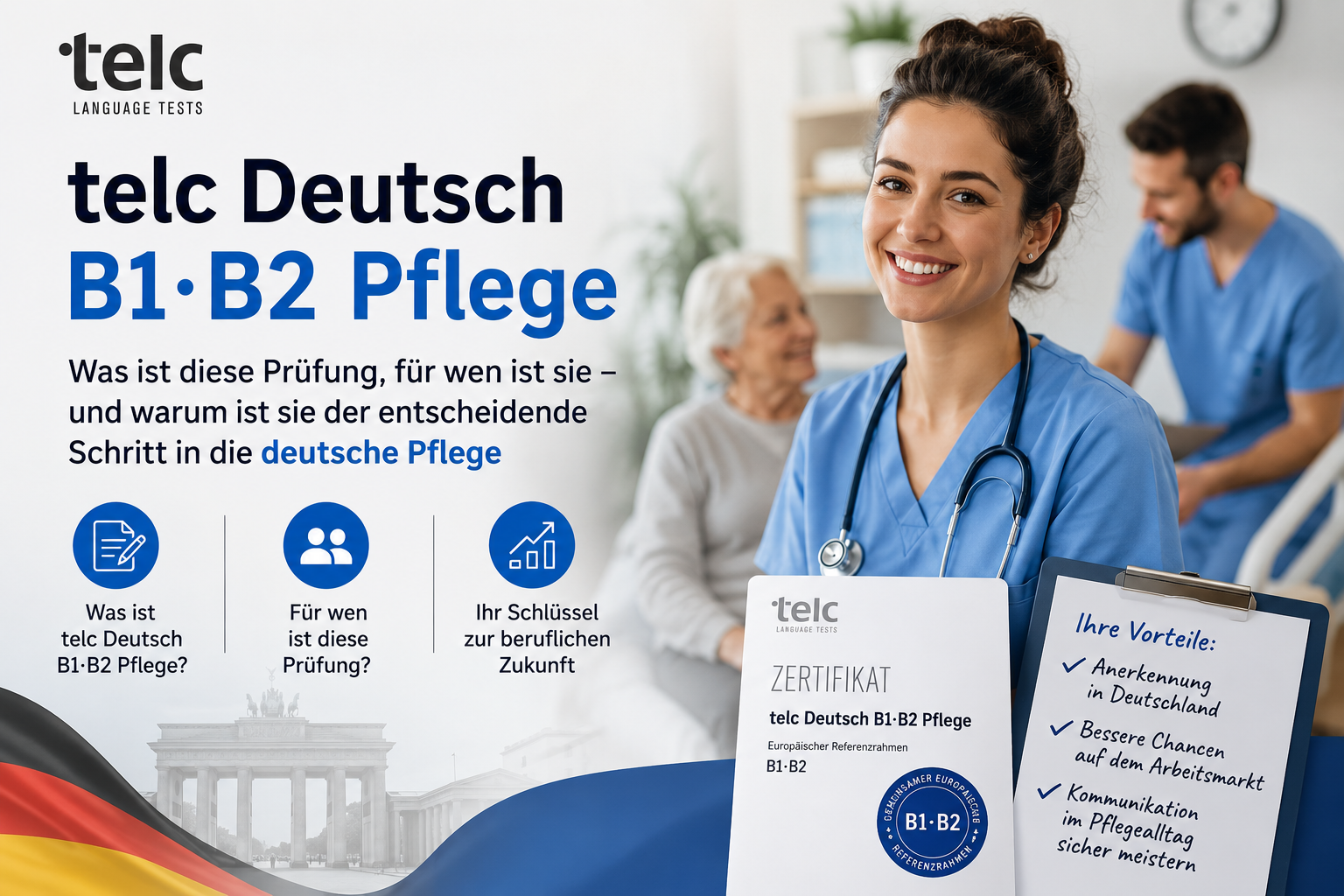
telc Deutsch B1·B2 Nursing: What is this exam, who is it for — and why is it the crucial step into German nursing?
Working in a hospital ward or caring for residents in a nursing home means communication under time pressure, in emotionally challenging situations, with patients of different ages and backgrounds. This requires precise, empathetic, and professionally correct German. Anyone who wants to work as a trained nurse from abroad in Germany or another German-speaking country must demonstrate that they can do just that.
The telc German B1·B2 Nursing exam is the recognized proof of this. It tests not general German, but nursing German: writing nursing reports, understanding handover conversations, conducting patient discussions, and discussing professional challenges. Those who pass this exam have shown that they are capable of communication in professional everyday life — and have not just memorized vocabulary lists.
This article explains: What the telc German B1·B2 Nursing exam is and what it is for, how it is structured, what topics are covered, for whom it is intended, which countries it is most commonly taken in — and how to prepare specifically.
Why this test exists — the nursing shortage as a driver
The nursing shortage in Germany is no longer a future challenge — it is a present reality. And it is larger than many think.
200,000+
missing nurses in Germany (2025)
17.8%
of all nurses are foreign nationals (2024)
306,700
foreign nurses employed with social security contributions (2024)
2.15 million
nurses needed by 2049 (Forecast Federal Statistical Office)
The number of foreign nurses increased from 5.5% to 17.8% of all employees in nursing professions between 2013 and 2024. The employment growth since 2022 is solely due to foreign personnel — the number of German nurses is stagnating or declining. The Federal Employment Agency emphasizes that the nursing sector would already be non-functional today without this immigration.
For all these nurses, the rule is: Anyone who wants to work as a nursing professional in Germany must have their foreign qualification recognized — and demonstrate language skills at a level that is truly applicable in everyday nursing. Not a formal B1 certificate for general German, but proof that is explicitly geared towards the nursing profession. This is exactly what the telc German B1·B2 Nursing exam is for.
What is the telc German B1·B2 Nursing exam?
The telc German B1·B2 Nursing is a specialized language exam for nurses in geriatric and hospital care. It covers the upper range of B1 and B2 in terms of vocabulary and grammatical structures and is aimed at individuals who have a recognized qualification in a nursing profession and need to demonstrate B1 or B2 knowledge of the German language for practicing this profession.
The crucial point: It is a scaled exam — this means you do not decide in advance whether to take B1 or B2. You take the same exam, and depending on the result, you receive either a B1 or a B2 certificate. This relieves the pressure of having to register for the "right" level. Those who are well-prepared will receive B2 — those who are still a bit unsure will receive at least B1, provided the basic requirements are met.
Who issues the certificate?
telc GmbH (The European Language Certificates) is one of the largest and most renowned language examination organizations in Europe. The evaluation is carried out centrally at telc — not at the local examination center. The certificate is internationally recognized and is accepted in Germany by medical associations, district governments, and health authorities as official proof of language proficiency. The results are usually available within 4–6 weeks.
For whom is the exam intended — and who takes it?
The target group is clearly defined: people with a completed nursing education from abroad who wish to work in Germany as a nursing professional or geriatric nurse. It does not matter whether someone already lives in Germany or is still waiting to enter from their home country — many take the exam before entering, as part of the recognition process.
The exam is also relevant for:
- Individuals who are already working as nursing assistants in Germany and wish to advance to nursing professionals
- Trained nurses from EU countries whose language skills need to be formally proven
- Participants in government programs such as "Triple Win" (Federal Employment Agency), which brings nurses from Asia to Germany
- Nurses who want to extend their residence and work permits or apply for a settlement permit
From which countries do most participants come?
The countries of origin of foreign nurses are widely varied. Through the "Triple Win" program of the Federal Employment Agency, around 6,000 nurses came to Germany from 2013 to 2025 — most from the Philippines (2,473), Bosnia and Herzegovina (918), Serbia (825), and India (662). Since the start of the Western Balkans regulation in 2017, the number of nurses from this region has tripled.
Philippines
Largest group in the Triple Win program. Highly qualified nurses with a bachelor's degree. Intensive preparation for telc B1·B2 Nursing even before entry.
India
Rapidly growing group, especially from the states of Kerala and Telangana. Often very well educated, intensive language training before entry.
Western Balkan States
Bosnia and Herzegovina, Serbia, Kosovo, North Macedonia. Significantly increased since the Western Balkans regulation in 2017. Linguistically closer to German.
Tunisia
Part of the Triple Win program. German is often only developed to B1/B2 level after entry. Strong interest in nursing professions in Germany.
Indonesia
Active partner country in the Triple Win program since 2023. Growing group, especially in elderly care. German training before entry is part of the program.
Ukraine
Rapidly growing group after 2022. Many Ukrainian nurses are already working in Germany and need to demonstrate language skills for professional recognition.
Romania & Croatia
EU citizens, recognition is sometimes easier, but proof of language remains mandatory. Among the largest EU countries of origin for nurses in Germany.
Syria, Iraq, Iran
Growing group with nursing qualifications from their home countries. Linguistically often a longer path to B2, but strong commitment to further education programs.
Important: The exam can be taken not only in Germany. Telc has globally authorized examination centers — also in many home countries of the participants. This means: Some of the exams take place even before entering Germany, as a prerequisite for the visa.
Why "Nursing" — and not just a general B2 certificate?
This is a valid question. Some authorities also accept a general B2 certificate (Goethe, telc B2, DTZ B1). But there are good reasons why the specialized language exam for nursing has prevailed — and why it is explicitly required by more and more state authorities.
- General everyday language and written language
- No nursing-specific terminology
- No nursing report, no handover conversation
- Accepted by some authorities, not by others
- No preparation for specific nursing situations
- Specialized language test for nursing and elderly care
- Nursing terminology, documentation, handover
- Patient conversations, communication with relatives
- Recognized by all medical associations and authorities
- Dual-level: provides B1 or B2 depending on performance
In some federal states like Bavaria, B1 is sufficient for professional recognition, while in others B2 is required. With the telc B1·B2 Nursing, you cover both requirements in one exam — and have the strongest possible proof regardless of the federal state.
Structure of the exam: written and oral
Tip: practise what you've just read with interactive exercises — it sticks better.
Start B1 exercises →The telc German B1·B2 Nursing exam consists of a written and an oral part. The written exam lasts 115 minutes and includes the parts listening comprehension, reading comprehension, language components, and written expression. The oral exam lasts about 16 minutes after a 20-minute preparation phase. Both parts usually take place on the same day.
Reading Comprehension — approx. 45 minutes
Texts from everyday nursing: duty rosters, patient records, internal information letters, short reports, patient information sheets. You read and answer questions — not to understand everything, but to find the relevant information.
Listening Comprehension — approx. 25 minutes
Recordings that directly depict everyday nursing: handover conversations between caregivers, doctor instructions, phone calls from relatives, short announcements in the hospital. Each recording is played twice.
Language Components — approx. 15 minutes
Fill-in-the-blank texts from the nursing field, where you choose the grammatically and contextually appropriate option from several choices. Prepositions, verb forms, connectors, and specialized phrases are tested — not in isolation, but in the context of a real nursing text.
Written Expression — approx. 30 minutes
The most creative part of the written exam. You choose between two tasks: writing an admission report (a patient is newly admitted — you describe their condition, biography, and needs) or a biography report (you describe the life of an elderly person based on given bullet points).
Oral Exam — approx. 16 minutes + 20 minutes preparation
The oral exam is a pair exam — two participants and two examiners. There are 20 minutes of preparation time, during which you can read the task sheets and take notes.
Which certificate do you receive — and what counts when?
Participants who achieve a partial result of B1 in the oral expression subtest and in one of the listening/reading comprehension, language components, or written expression parts receive a telc certificate B1 Nursing. Participants who achieve a partial result of B2 in the oral expression subtest and in one of the two exam parts receive a telc certificate B2 Nursing.
Typical topics and situations in the exam
The exam reflects real nursing daily life. Anyone working daily in a nursing home, hospital, or outpatient service encounters these situations — in German, under time pressure. These are the most frequently occurring areas of topics:
| Type of Situation | Specific Situation | Exam Part |
|---|---|---|
| Handover and Documentation | Shift handover, writing nursing reports, documenting vital signs | Listening, Writing |
| Patient Communication | Explaining measures, obtaining consent, dealing with pain | Oral Part 1–3 |
| Communication with Relatives | Phone calls with relatives, passing on information, difficult conversations | Listening, Oral |
| Medical Information | Reading medication plans, explaining diagnoses understandably, implementing doctor instructions | Reading, Listening |
| Professional Discussions | Team discussions, ethical questions in nursing, patient rights | Oral Part 2–3 |
| Biography and Medical History | Admission conversation, biography work, writing a biography report | Writing, Reading |
Building language competence for nursing
The basis for telc B1·B2 Nursing: Understanding and speaking German in a professional context
The telc B1·B2 Nursing builds on general language skills that are specifically oriented towards the nursing context through targeted exam training. On DeutschMeister, all four language skills — listening, reading, writing, and speaking — can be practiced in the exam format. The tasks reflect realistic professional situations and build the competence required in the exam and in nursing daily life.
Start training nowTask opens directly — no registration, no waiting time.
How to prepare specifically — what really helps
Build nursing vocabulary separately
General B2 vocabulary is not enough. Anyone who wants to take the exam needs the vocabulary of everyday nursing: body parts and medical conditions, nursing measures and documentation, medications and nursing aids, legal terms such as care levels or power of attorney for care. The telc manual for the exam contains a framework curriculum with the most important topic areas — a good starting point.
Read real nursing texts — not just textbooks
Nursing reports, discharge letters, internal information sheets from German clinics are publicly accessible (e.g., in practice books like "Focus Nursing" or "Training Units B1·B2 Nursing"). Anyone who reads such a text daily and pays attention to documentation style and technical terms builds exactly the reading comprehension that is required in the exam.
Listen to handover conversations — and imitate
YouTube has a number of videos that simulate or demonstrate handover conversations between caregivers. These are ideal as shadowing material: listen, repeat, internalize pace and technical terms. Those who speak the handover language fluently have a significant advantage in the listening part.
Practice writing nursing reports — regularly
Written expression is the biggest challenge for many participants. Not because the language is too difficult — but because the factual, structured style of a nursing report is unfamiliar. Anyone who writes a report on a fictional patient weekly and then compares it with model solutions quickly learns what the "right tone" looks like.
Simulate the oral exam — with a partner or by recording
The same applies to the oral part as for the DTZ speaking part: the patterns must be internalized in the body, not just in the head. At least twice before the exam, conduct a complete simulation with a time limit — 20 minutes preparation, then 16 minutes speaking — and record it. Listening to your own recording is uncomfortable but crucial.
Frequently asked questions about the telc German B1·B2 Nursing exam
How much does the telc German B1·B2 Nursing exam cost?
The exam fee is approximately €170 per attempt. The fee varies slightly depending on the examination center. In some programs (e.g., Triple Win or employer-sponsored courses), the exam fee is fully or partially covered. The exam can be repeated as often as needed, with each attempt costing the full fee again.
How long is the certificate valid?
The telc certificate has no official expiration date. It is recognized as permanently valid by the issuing authorities unless a legal re-regulation states otherwise. There is no deadline for renewing the certificate for professional recognition in Germany.
Is B1 sufficient for professional recognition, or is B2 always required?
This depends on the federal state. In Bavaria, B1 is sufficient for professional recognition, while in other federal states, B2 is required. Since the telc B1·B2 Nursing is a scaled exam, it is always advisable to aim for B2 — you have the same certificate regardless of where you work later.
Can you take the exam abroad?
Yes. Telc has a global network of authorized examination centers, including in many home countries of foreign nurses (e.g., India, Philippines, Ukraine, Morocco). Especially for programs like Triple Win, it is common to take the exam before entering the home country. The results are evaluated centrally by telc in Frankfurt and have the same international validity.
How long does the evaluation take, and when do you receive the certificate?
The evaluation of the exam takes about 4–6 weeks and is conducted centrally by telc. The certificate is then sent to the examination center or delivered digitally. Digital certificates are often available faster than printed ones.
What is the difference between telc B1·B2 Nursing and the specialized language exam of the medical association?
The telc B1·B2 Nursing is an exam by telc GmbH — internationally recognized, uniform, and can be taken anywhere. The specialized language exams of the medical associations (e.g., for Bavaria, Rhineland-Palatinate) are state-specific exams that sometimes have more specific requirements and are only recognized in the respective federal state. For nurses who want to work flexibly in several federal states, the telc exam is the better choice due to its nationwide and international recognition.
Do you have to attend a preparatory course, or can you prepare on your own?
You do not have to have attended a preparatory course. Telc offers free sample exams and exam tips for download. Those who prepare on their own should work with the official framework curriculum and a practice book. A course with a teacher is recommended if you are unsure whether your level is sufficient — especially for the oral exam, which is difficult to train without a conversation partner.
Is the telc B1·B2 Nursing certificate also valid in Austria and Switzerland?
The telc certificate is internationally recognized and is generally accepted in Austria and Switzerland. However, both countries have their own recognition procedures for foreign nursing qualifications, and the specific language requirements may differ. It is advisable to directly inquire with the relevant authority of the respective country before applying.
Ready for B1 exercises?
Don't just read — practice now! Hundreds of interactive exercises, audio tasks and exam training are waiting for you.
War dieser Artikel hilfreich?
Ähnliche Artikel
DTZ B1 Writing Brief: Phrases and Templates That Really Work
What sentences do you really need for the DTZ letter? From my own exam experience: salutation, introduction, connectors, requests, and closing — an honest collection of phrases.

DTZ B1 Speaking Part 3: Planning Together — Sample Dialogue, Phrases, and Strategy
What happens in DTZ Speaking Part 3? Planning something together with bullet points. Why the result doesn't count, what a real dialogue sounds like, and which 4 types of sentences are needed.

DTZ B1 Speaking Part 2: Describing a picture and sharing experiences — Method and sample dialogue
What happens in DTZ Speaking Part 2? Describe an image (2A), share experiences (2B). Three-layer method, complete sample dialogue on the topic of shopping, and 4 typical mistakes.