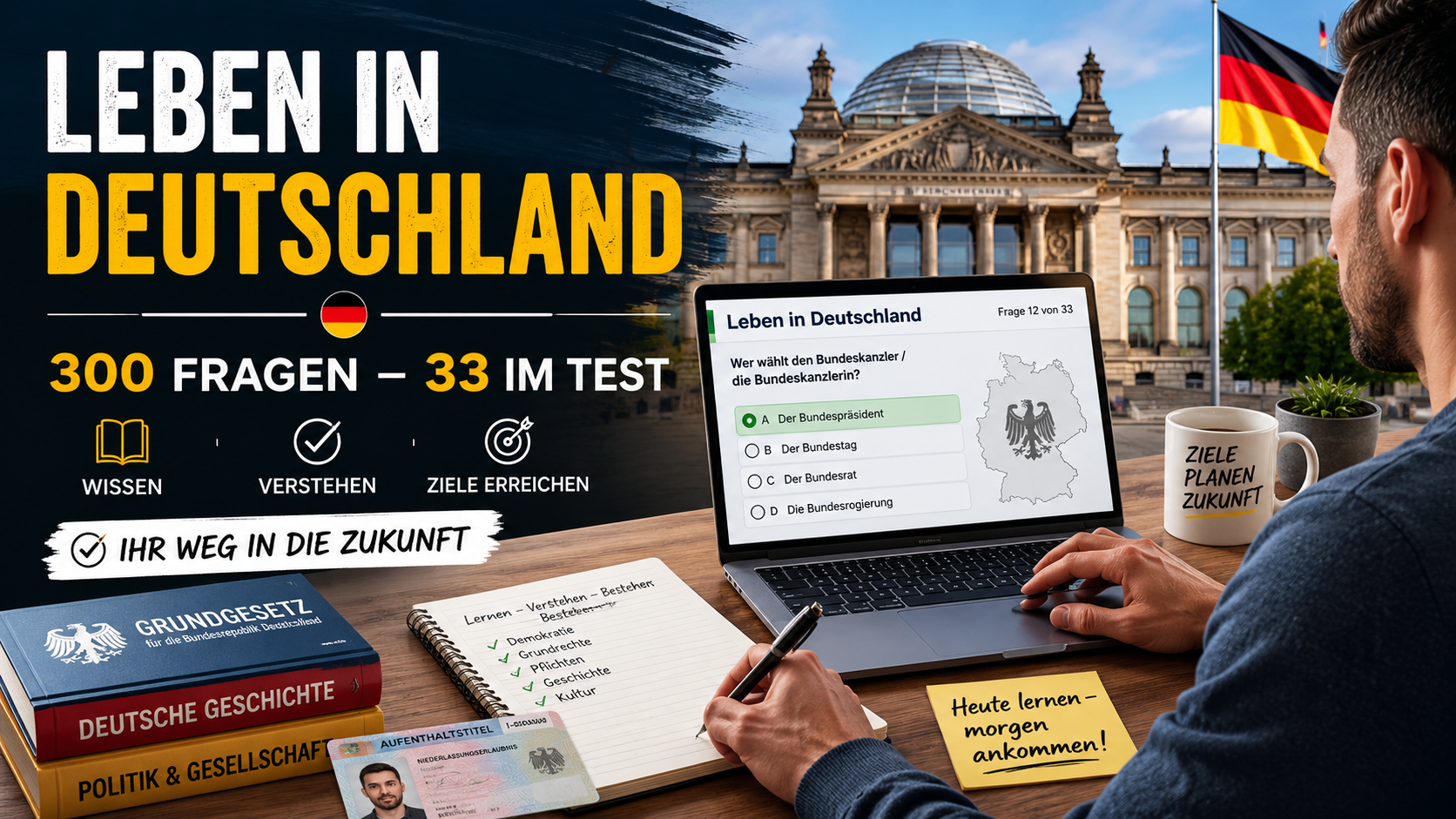
Test Life in Germany (LiD): Structure, Topics, Points, and Why It Is Important
Many people coming to Germany hear the term for the first time in the integration course: “At the end, there is the Test Life in Germany.” Some nod as if they expected it. Others are taken aback — because until then, the discussion had only been about the language test DTZ, and suddenly there is supposed to be a second test. What is it anyway? What will be asked? And why is it more important than it initially seems?
The Test “Life in Germany” (short: LiD) is not an accessory of the integration course. It is the key to two of the most important milestones in the lives of migrants in Germany: the Integration Course Certificate — and naturalization. Those who understand it and prepare properly save time, money, and nerves.
What this article explains: What the Test “Life in Germany” is and what it is for, how it is structured, which topics are covered, how many points are needed, what the difference to the naturalization test is — and why a good result in the LiD literally decides for years.
What is the Test “Life in Germany” — and who has to take it?
The Test “Life in Germany” is the second examination at the end of the state-funded integration course. The first is the DTZ (German Test for Immigrants), which tests language skills. Those who pass both tests receive the official Integration Course Certificate — the document that serves as proof of language proficiency and knowledge of German society.
The LiD does not test German. It tests whether one understands the basic structures of the German state, society, legal system, and history. This may sound dry — but the questions are formulated in such a way that they assess lived knowledge about Germany: What are the fundamental rights? How does the electoral system work? What does the Basic Law mean in everyday life?
Who takes the Test “Life in Germany”?
- All participants in the state integration course — as a mandatory examination at the end of the orientation course
- People without an integration course who want to obtain the certificate later — the test can also be taken without attending a course
- Individuals who wish to be naturalized and have not yet completed a LiD or naturalization test — the LiD (with at least 17 points) is recognized for naturalization
Structure of the Test: 33 Questions, 60 Minutes, 4 Answer Options
The test is a classic multiple-choice test. You receive a test booklet and have exactly 60 minutes. The structure is always the same — regardless of which federal state and course provider you take it with.
| Element | Details |
|---|---|
| Total Questions | 33 questions per test booklet |
| Distribution | 30 questions about Germany in general + 3 questions about the respective federal state |
| Answer Format | Multiple Choice — 4 answer options, exactly one is correct |
| Time | 60 minutes (no preparation time beforehand) |
| Question Catalog | 310 questions in total (300 nationwide + 10 state-specific); the 33 test questions are selected from this |
| Cost | About €55 (LiD in the integration course); retake possible |
| Permitted Aids | None — test booklet and pen, nothing else |
The crucial point: All possible questions are publicly accessible. The BAMF publishes the complete question catalog for free on its website. There are no hidden surprises. Anyone who knows all 310 questions and understands the underlying topics can take the test with a good result.
How many points are needed — and what does the result mean?
This is the point that is most often misunderstood — because there are two different thresholds, depending on what the result is needed for.
Neither Integration Course Certificate nor proof for naturalization. Retake necessary.
Together with DTZ B1 → Integration Course Certificate. But: not recognized for naturalization as proof of language proficiency.
Integration Course Certificate + recognized as proof for naturalization according to § 10 Abs. 1 Nr. 7 StAG. The strongest possible LiD proof.
This should be known: Those who achieve 15 or 16 points in the LiD receive the Integration Course Certificate — but this LiD proof is not recognized as sufficient proof of knowledge of society for naturalization. Those who wish to be naturalized later must either take a separate naturalization test (25 €, also 17/33 needed) or retake the LiD. Therefore, it is worthwhile to aim for 17+ points from the beginning.
The 3 Topic Areas: What is specifically asked
The question catalog is divided into three main areas. All 300 nationwide questions are distributed across these three topic blocks. Those who understand the logic behind it do not learn by heart — but with understanding, which sits better in the long term.
Living in Democracy
The largest and most important block. Covers the political system of Germany, the Basic Law, fundamental rights, state institutions, and the principles of the free democratic basic order.
Example topics: Bundestag, Bundesrat, Federal Chancellor, parties, electoral law, separation of powers, fundamental rights (Art. 1–20 GG), freedom of religion, freedom of expression, rule of law principle.
History and Responsibility
Germany's historical responsibility — particularly National Socialism, the Holocaust, the division of Germany, and reunification. Since May 2025, this block also includes new questions about Jewish life and combating anti-Semitism.
Example topics: Weimar Republic, Nazi era, Holocaust, GDR and FRG, fall of the Berlin Wall 1989, reunification, responsibility for the past, Israel and Jewish life in Germany.
Human and Society
Everyday life in Germany: school system, social security, world of work, family, religion, equality, healthcare, and economic foundations.
Example topics: Social market economy, health insurance, pension insurance, school attendance, gender equality, freedom of religion in everyday life, income tax.
What the questions look like — three examples from the official catalog
Tip: practise what you've just read with interactive exercises — it sticks better.
Start practicing →All questions follow the same pattern: a statement or question, four answer options, exactly one is correct. The questions are formulated in such a way that you either have the knowledge — or you don't. There are no tricks, but also no way to guess.
Example 1 · Topic: Living in Democracy
In Germany, people are allowed to openly say something against the government because …
Example 2 · Topic: Human and Society
In Germany, parents can decide until their child is 14 years old whether it participates in … at school.
Example 3 · Topic: History and Responsibility
Germany is a constitutional state. This means, among other things, that …
LiD or Naturalization Test — what is the difference?
This is one of the most frequently asked questions — and the answer is more complicated than it seems at first glance. Both tests use exactly the same question catalog (310 questions) and have the same format (33 questions, multiple choice, 60 minutes). The difference lies in the context, not in the content.
17/33 → also valid for naturalization
Conclusion: Those who complete the integration course and pass the LiD with at least 17 points have simultaneously provided the proof of knowledge of society for naturalization — and do not have to take a separate naturalization test. This is a concrete advantage of the integration course that is often overlooked.
Why the LiD is more important than it seems — 4 concrete consequences
Consequence 1
Integration Course Certificate — without LiD no certificate
The Integration Course Certificate is only obtained if one has passed both final tests: DTZ at B1 and LiD with at least 15 points. Those who only pass the DTZ do not have a course completion. This certificate is important for cost reimbursement (50% of the course fee) and for accelerated naturalization.
Consequence 2
Naturalization — with LiD (≥17) no extra naturalization test required
For naturalization according to § 10 StAG, one must prove knowledge of the legal and societal order. The LiD with at least 17 points fulfills exactly this requirement. Those who complete the integration course and achieve 17+ points in the LiD do not have to take a separate naturalization test. This saves €25 and an extra appointment.
Consequence 3
Accelerated naturalization after 3 years — only with certificate
Since the reform of the Nationality Act in 2024, one can be naturalized after 3 years of residence under certain conditions. The complete Integration Course Certificate — that is, DTZ B1 and LiD at least 15 points — is recognized as proof of special integration achievements. Without the certificate, this path is not available.
Consequence 4
Settlement permit — certificate as proof of integration
When applying for a settlement permit (unlimited residence permit), it is required to have sufficient knowledge of German society. The Integration Course Certificate is a recognized proof of this — and significantly simplifies the process at the immigration office.
What has changed in May 2025 — new questions in the catalog
The BAMF regularly updates the question catalog. In May 2025, the catalog was expanded with new questions. Those currently preparing should know what has been added.
New in the question catalog from May 2025:
- Jewish Life in Germany: New questions about the history and present of Jewish communities in Germany, their significance for German society, and the state protection of Jewish life.
- Combating Anti-Semitism: Questions about how Germany deals with anti-Semitism, what legal instruments exist, and what attitude is expected from all those living in Germany.
- Existence Right of Israel: The commitment to the existence right of the State of Israel is part of the German state rationale and is now explicitly anchored in the question catalog.
Important for preparation: The current question catalog is available for free download on the BAMF website: bamf.de → Integration → Online Test Center. Always use the current version — older catalogs may not contain these questions yet.
How to prepare — efficiently and without stress
The good news: The Test “Life in Germany” is manageable. All questions are public, the format is known, and most of the content has already been heard in the orientation course. However, if you are still unsure — or want to take the test without a course — you need a clear plan.
Step 1: Download the current question catalog
The complete catalog with 310 questions (300 nationwide + 10 state questions) is available for free on the BAMF website. The BAMF Online Test Center allows you to practice all questions interactively — the correct answer is displayed immediately after each question. This is the official and free basis for any preparation.
Step 2: Learn by topic blocks, not by question numbers
Those who memorize 310 questions will forget them after two weeks. Those who understand why the answer is correct — because the Basic Law guarantees freedom of expression, because the voting age is 18, because Germany is a federal republic — will recognize the answer immediately even with slightly altered wording.
Step 3: Practice state-specific questions separately
The 3 federal state questions are often underestimated. However, they are fixed: For each of the 16 federal states, there is a fixed list of 10 possible questions (e.g., about the capital, state government, historical peculiarities). Memorizing these 10 questions for your own federal state — this can be done in 30 minutes and secures 3 points.
Step 4: Take a practice test
The BAMF offers free sample test sheets on its website — with real exam questions in the original format, 33 questions, 60 minutes. If you take this practice test under real conditions (without looking up, with a timer), you will know exactly where you stand afterward.
DTZ + LiD · Complete Integration Course Preparation
Do not leave the second final test to chance
Those aiming for the complete Integration Course Certificate must pass both tests: DTZ and LiD. On DeutschMeister, you can practice all four parts of the DTZ in the original exam format — listening, reading, writing, and speaking. The combination of language test preparation and LiD knowledge is the safest way to the certificate.
Start DTZ PreparationThe task opens directly — without an account and without registration.
Frequently Asked Questions about the Test “Life in Germany”
Can the Test “Life in Germany” be taken without an integration course?
Yes. The LiD can also be taken without attending the integration course. You register directly with an approved course provider (usually VHS or approved language schools). You do not have to have attended an orientation course. This is particularly relevant for people who completed the integration course years ago but did not receive a certificate at that time.
How often can the test be repeated?
As often as desired. There is no legal limit on attempts. Each attempt costs about €55. Since the question catalog is completely public, targeted preparation after a failed attempt is quite possible.
Is an old LiD proof still valid for naturalization?
It depends on the result. A LiD with at least 17 points — regardless of when it was taken — is recognized for naturalization, provided it was issued by an approved examination center and the BAMF certificate is available. There is no expiration date. In case of uncertainties, it is advisable to inquire with the responsible naturalization authority.
What happens if you pass the DTZ but not the LiD?
Those who pass the DTZ at B1 but score below 15 points in the LiD do not receive the Integration Course Certificate — nor any partial result that helps. The DTZ result alone is usable for the residence permit as proof of language proficiency, but without the LiD, there is no complete course completion certificate.
How long does it realistically take to prepare for the LiD?
It depends on how much one has retained from the orientation course. Those who have completed the course attentively can intensively prepare to reach the level of 17+ points in 3–5 days. Those who take the test without a course or have forgotten a lot should plan for 2–3 weeks — 30–45 minutes daily with the BAMF Test Center is sufficient.
Are the questions in German — or is there a test in other languages?
The exam itself is conducted in German. The official question catalog is also in German. There are no official versions in other languages. Therefore, those preparing for the test must have reading comprehension at level B1 — which is usually the case for integration course participants who have taken the DTZ.
Can the results of the naturalization test and the LiD be exchanged?
Only in one direction: A passed LiD with 17+ points is recognized for naturalization. However, a passed naturalization test does not count for the Integration Course Certificate — for that, the LiD must be taken as part of the integration course. So, if you only have the naturalization test, you can be naturalized with it, but you do not have the Integration Course Certificate in hand.
What does the Test “Life in Germany” cost in 2025?
The examination fee is about €55. For participants in the integration course, the first attempt is often included in the course fee or in state funding. The naturalization test (separate examination) costs €25 per attempt. Both tests can be repeated as often as desired, and each attempt incurs the respective fee again.
Ready to practice your German?
Don't just read — practice now! Hundreds of interactive exercises, audio tasks and exam training are waiting for you.
War dieser Artikel hilfreich?
Ähnliche Artikel
Test "Living in Germany": What is it, who has to take it — and how do you pass it?
What is the "Living in Germany" test? 33 questions, 60 minutes, BAMF question catalog. What is it needed for, how does it proceed — and how can one prepare optimally?

DTZ B1 Writing Brief: Phrases and Templates That Really Work
What sentences do you really need for the DTZ letter? From my own exam experience: salutation, introduction, connectors, requests, and closing — an honest collection of phrases.

DTZ B1 Speaking Part 3: Planning Together — Sample Dialogue, Phrases, and Strategy
What happens in DTZ Speaking Part 3? Planning something together with bullet points. Why the result doesn't count, what a real dialogue sounds like, and which 4 types of sentences are needed.