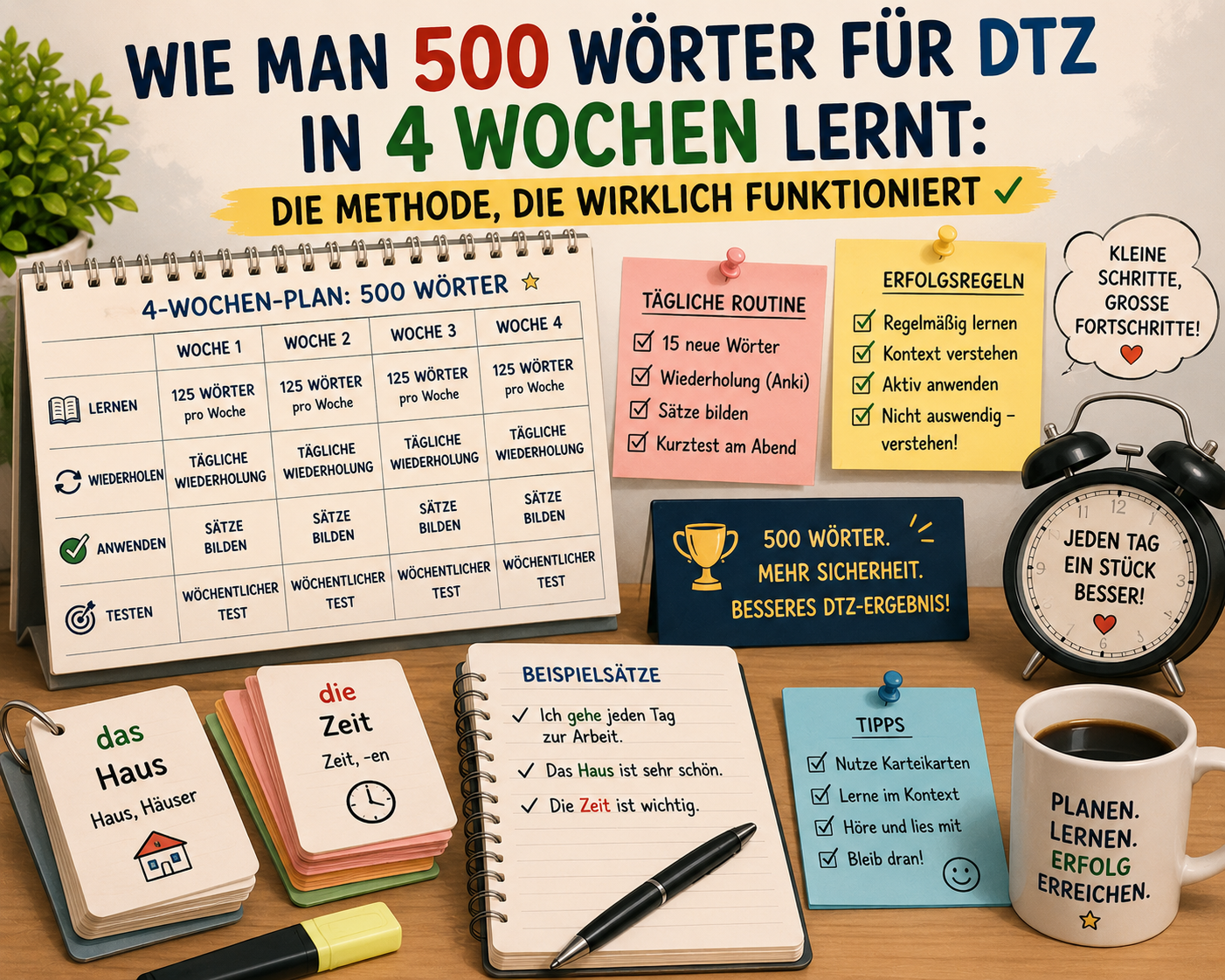
500 DTZ vocabulary in 4 weeks: Spaced Repetition Method with weekly plan
Five hundred words in four weeks. When you hear that for the first time, it sounds ambitious. Perhaps even unrealistic. But let's take a quick look at what that means in practice: 500 divided by 28 days is about 18 new words per day. That's a lot — if you learn vocabulary the way you did in school: read the list, write the translation next to it, forget it by tomorrow.
With the right method, the calculation looks different. Those who work with spaced repetition and context-based learning no longer have to guess whether a word is retained — they know it. And those who also know which words actually appear in the DTZ do not learn 500 random words, but 500 words that truly matter.
What this article provides: A concrete 4-week plan with 17–18 new words daily, the most important topics of the DTZ, the Anki method explained step by step, and why the way of learning is more important than the number of repetitions.
Why most vocabulary learning methods don't work
Before getting into the method, it's worth understanding why classical approaches fail during intensive preparation. Not out of academic interest — but because you only stop doing something wrong when you understand why it is wrong.
✗ What doesn't work
Reading through a word list, writing the translation next to it, repeating it three times. Again tomorrow. Forget almost everything by next week — because the brain does not store information long-term without repetition at the right time.
✓ What works
Each word comes back exactly when you are about to forget it. This is the essence of spaced repetition. The brain evaluates information as "important" when it just had to retrieve it from memory — and stores it longer the next time.
✗ What doesn't work
Learning words in isolation: "Termin = Appointment". When the word then appears in a sentence — "I need an appointment at the foreign office" — it still sounds foreign because the brain has not stored any context.
✓ What works
Always learn words with a real example sentence, preferably from the DTZ topic area. "I need an appointment with the doctor" — this sentence simultaneously stores the word, its typical use, and the context.
✗ What doesn't work
Learning a lot of words at once: 50 in one day, then nothing for three days. The brain needs regularity, not peaks of intensity.
✓ What works
Every day the same amount — even if it's just 15 minutes. Regularity beats intensity. Those who work with Anki for 15–20 minutes daily for 4 weeks will have more in long-term memory after a month than someone who studied for 6 hours over two weekends.
Which 500 words are really important for the DTZ
Not all words are equally valuable. For the DTZ, there are clear topic areas that repeatedly appear in all four parts of the exam — listening, reading, writing, speaking. Those who focus on these areas do not learn abstract vocabulary but exactly the language needed in the exam room.
The official criteria from g.a.s.t. describe for level B1: "Has a sufficiently large vocabulary to express oneself on most topics of everyday life." These are not literary vocabulary — these are the words of everyday German.
Housing & Everyday Life
approx. 80 words
rental agreement, additional costs, termination, apartment size, landlord, deposit, household, neighbor, heating, electricity…
Health & Doctor
approx. 70 words
appointment, health insurance, prescription, pharmacy, symptoms, examination, sick leave, emergency room, referral…
Work & Profession
approx. 75 words
application, resume, employment contract, salary, vacation, termination, full-time, part-time, employment agency, probation period…
Authorities & Documents
approx. 65 words
residence permit, foreign office, registration, form, ID card, approval, application, certificate…
Traffic & Routes
approx. 50 words
timetable, stop, connection, transfer, delay, driving license, trip, route, ticket, train station…
Shopping & Services
approx. 45 words
offer, discount, exchange, receipt, delivery, opening hours, checkout, order, return…
Education & School
approx. 45 words
registration, timetable, report card, homework, parents' evening, tutoring, training, internship, course…
Weather & Environment
approx. 35 words
temperature, precipitation, frost, cloudy, forecast, storm, heat, season, climate change…
Connectors & Sentence Parts
approx. 35 words
although, therefore, because, nevertheless, moreover, so that, however, on the one hand, on the other hand, consequently…
The result: 9 topic areas × an average of 55 words = about 500 words. No literary language, no technical terms. Exactly the German that repeatedly appears in listening, reading, writing, and speaking in the DTZ.
The Method: Spaced Repetition with Anki — how it works concretely
Tip: practise what you've just read with interactive exercises — it sticks better.
Start A2 exercises →Spaced repetition sounds complicated, but it's a simple idea: You don't repeat a word according to a fixed schedule, but exactly when you're about to forget it. The interval between repetitions grows with each successful recall — until the word is firmly established long-term.
Anki is the most well-known program for spaced repetition and is free for desktop and Android (iOS €3.99). There are already ready-made vocabulary decks for the DTZ and B1 vocabulary that you can download and use immediately.
What an Anki card system for the DTZ looks like
A well-built Anki card has more than just the word and translation. Here’s an example that stores all relevant information at once:
Front — what you see
the rental agreement
Topic: Housing · Noun · masculine
Back — after thinking
Mietvertrag = rental agreement / tenancy agreement / contrat de location
Plural: die Mietverträge
“Before moving in, you must sign the rental agreement."
→ The word in the DTZ: Reading Part 2 (ads), Writing, Speaking Part 1
The most important thing: The example sentence comes from the DTZ context. The brain not only stores the word but also where and how it appears. When reading a housing ad and seeing "Mietvertrag," you immediately have the whole context ready.
How spaced repetition builds the repetition intervals
To illustrate: This is what the typical repetition schedule for a new word looks like when you answer it correctly the first time:
If you answer the word incorrectly, Anki resets the interval. This sounds frustrating, but it’s the opposite: The brain realizes that this word is "not yet secure" and processes it deeper the next time it comes up. Incorrect answers are not a setback — they are productive gaps that the system closes.
The 4-Week Plan: 17 words daily, 20 minutes
The plan works with 20 minutes of Anki daily plus 5–10 minutes of context reading. No more — and no less. Those who want to learn more in the first few days should avoid that: The system has its limits, and if you introduce 50 new cards at once, you will have a backlog of repetitions in two weeks that makes learning a nightmare.
Housing, everyday life, and authorities — the foundation
New words per day: 17–18 · Topics: Housing & Everyday Life (80 words) + Authorities & Documents (40 words out of 65) · Total at the end of the week: ~120 words
These words are the absolute basic framework. Rental agreement, registration, foreign office, ID card — these are words that occur daily in life in Germany and appear in almost every part of the DTZ exam. Those who know these words well have a more stable foundation in the reading and writing parts immediately.
Additional task: Read a short housing ad on a German real estate website for 5 minutes daily — see words in context without looking them up. The brain anchors familiar words better when they reappear in real text.
Health, work, and traffic — the exam topics
New words per day: 17 · Topics: Health & Doctor (70 words) + Work & Profession (50 out of 75) · Total at the end of the week: ~240 words
Health topics are particularly common in the DTZ — doctor conversations regularly appear in Listening Part 3, application letters in the Writing part, timetables in Listening Part 1. Those who learn these 120 words in Week 2 will not encounter them as strangers when practicing with the official practice set.
Additional task: Read a job advertisement for 5 minutes daily. Real job ads at B1 level can be found on German job portals (Indeed, StepStone) — and you train your reading skills at the same time.
Shopping, school, and connectors — connecting language
New words per day: 17 · Topics: Shopping (45) + Education (45) + Connectors (30) · Total at the end of the week: ~360 words
The connectors are particularly valuable — and are often neglected. "although," "therefore," "nevertheless," "so that," "because" — these words are worth their weight in gold in the Writing part: Those who use them fluently automatically get better points in the criterion of communicative design. Learn each connector word in Anki with a complete sentence, not in isolation.
Additional task: Write a short letter (5–6 sentences) on a freely chosen topic — and consciously use 3 of the newly learned connectors. This anchors them in the active vocabulary.
Remaining words + consolidation + exam test
New words per day: 17–18 · Topics: Remaining words from all fields + Traffic (remaining 25) + Work (remaining 25) · Total at the end of the week: ~500 words
In Week 4, few truly new words are added — a large part of the daily Anki time will be used for repetitions from the first three weeks. This is normal and intended: The spaced repetition system has now built a complete stack that it optimizes daily.
Additional task from Day 22: Complete the official DTZ practice set from g.a.s.t. — with a real time limit, no dictionary, no looking up. Not to test, but to experience how many of the 500 learned words actually appear in the real exam text. This experience is motivating — and shows where there are still gaps.
The 4 most common mistakes in vocabulary learning for the DTZ
Mistake 1: Too many new cards at once. If you introduce 60 new cards on a free day, you will have a backlog of 150+ cards per day in 10 days. That’s the end of any learning system. Maximum: 20 new cards per day — and stick to that consistently, even if you feel "like more."
Mistake 2: Learning words without articles. In the DTZ, the article is part of the word — a wrong article costs points in writing, and it sounds unnatural in speaking. Always "the appointment," never just "appointment." Always "the apartment," never just "apartment." Those who do this from the beginning won’t have to correct it later.
Mistake 3: Anki cards without example sentences. A word is only truly retained when you have seen it in a sentence. An example sentence on each card is not extra work — it halves the time needed to recognize the word in real text.
Mistake 4: Learning vocabulary without a purpose. 500 random B1 words are worth less than 300 words from the DTZ topic areas. Those who know that "Überweisung" (doctor sends to specialist) and "Überweisung" (money to account) have two meanings and both appear in the DTZ — will immediately understand which one is meant when listening.
How many words do you really need for the DTZ B1?
The honest answer: More than 500. The active vocabulary for B1 is around 2,500–3,000 words according to the European Reference Framework. Those who have completed the integration course already know a large part of this — the question is how many of them are truly retrievable.
| Situation | Known Words (estimated) | What the 500 words provide |
|---|---|---|
| After A2 course (600 hours) | ~1,200–1,500 words (many passive) | Close gaps in DTZ topic areas, activate passive words |
| After B1 course without DTZ preparation | ~2,000 words (many passive) | Secure exam-relevant words, strengthen writing vocabulary |
| Shortly before the exam, gaps known | ~2,000–2,500 words | The last crucial words for a more secure exam performance |
500 words in 4 weeks is not a magic solution. But it is a concrete, measurable progress — that directly contributes to the exam. Those who previously knew what "Nebenkosten" means but stumbled while reading — will read more fluently afterwards. Those who used "weil" in writing but avoided "obwohl" and "trotzdem" — will write with more connectors afterwards and get better points.
Training vocabulary in the exam context · DTZ B1
Learning words is good — applying words in the real exam format is better
Knowing vocabulary from a list and recognizing it in a real exam text — these are two different things. On DeutschMeister, you can practice exactly that: Tasks in the DTZ format, where the learned vocabulary is retrieved in real exam context. Especially Reading Part 5 (completing words in a letter) is a direct test of whether the vocabulary is truly retained.
Start task in DTZ formatThe task opens directly — no account, no registration. Just try it out and see how many of the learned words you recognize in the real exam text.
Frequently Asked Questions about Vocabulary Learning for the DTZ
Do you really have to learn 500 words, or is the integration course enough?
The integration course lays an important foundation. But many participants find that they have heard words in class before — but cannot retrieve them under exam pressure. The problem is not a lack of knowledge, but a lack of activation. The 500 words of this plan are specifically geared towards DTZ topics and are learned in such a way that they can be retrieved under time pressure — not just in calm classroom settings.
How much time do you need daily for Anki?
With 20 new cards per day and the repetitions from the previous days, you will spend 20–30 minutes daily in the second and third weeks. In the fourth week, when hardly any new cards are added, the effort drops to 15–20 minutes because almost everything is just repetition. Those who practice regularly have less effort than someone who skips days and then has to catch up.
Are there ready-made Anki decks for the DTZ?
Yes. On AnkiWeb (ankiweb.net), there are several decks with names like "DTZ B1 Vocabulary" or "German B1 Vocabulary" in the search function. The quality varies — it’s best to choose a deck with example sentences and look at the first 20 cards before downloading it completely. Alternatively, you can build your own deck in 30 minutes — using the topic areas from this article as a basis.
What to do if you still forget many words after 4 weeks?
That’s normal — and a good sign. Anki indicates which words you frequently answer incorrectly. These are exactly the cards you should focus on. If you can recall 500 words with 80% certainty after 4 weeks, you have firmly established 400 words in long-term memory — and the remaining 100 will be automatically caught up in the following weeks through ongoing Anki use.
Is Duolingo an alternative to Anki for the DTZ?
For getting started and for motivation, Duolingo is helpful. For intensive preparation for the DTZ in a limited time, Anki has a decisive advantage: You can create your own cards with exactly the words that appear in the DTZ. Duolingo decides what you learn — Anki allows you to decide. And for 500 specific DTZ words in 4 weeks, you need control over the material.
Does watching German films or series help strengthen vocabulary?
Yes — but as a supplement, not a substitute. If you have learned a vocabulary word in Anki and then hear it in an episode or on the radio, it anchors it deeper in memory. This is called context repetition. But passive watching without an active learning program in the background builds vocabulary too slowly to reach 500 new words in four weeks.
Are 500 words enough to confidently reach B1 in the DTZ?
Vocabulary is just one of four assessment areas in the DTZ — alongside listening comprehension, reading comprehension, writing, and speaking. 500 purposefully learned DTZ words noticeably improve performance in all four parts: You understand more when listening, read more fluently, write with more expressive means, and speak more confidently. But vocabulary does not replace exam format training. Both together — vocabulary plus format — is the complete preparation.
Ready for A2 exercises?
Don't just read — practice now! Hundreds of interactive exercises, audio tasks and exam training are waiting for you.
War dieser Artikel hilfreich?
Ähnliche Artikel

I almost failed at B1: what no one told me about the structure of the German exam.
A personal story about preparing for the DTZ B1 — and the lessons one should better read before opening the first textbook.

The difference between A2 and B1: What really changes — and how I made the leap.
What is really the difference between A2 and B1 in German? A personal experience report with 3 surprising facts, 5 tips — and an encouraging conclusion.
DTZ not passed: Consequences for residence permit, settlement permit, and naturalization
What really happens if you fail the DTZ? Consequences for residence permit, settlement permit, and naturalization — clearly explained with the current status in 2025.