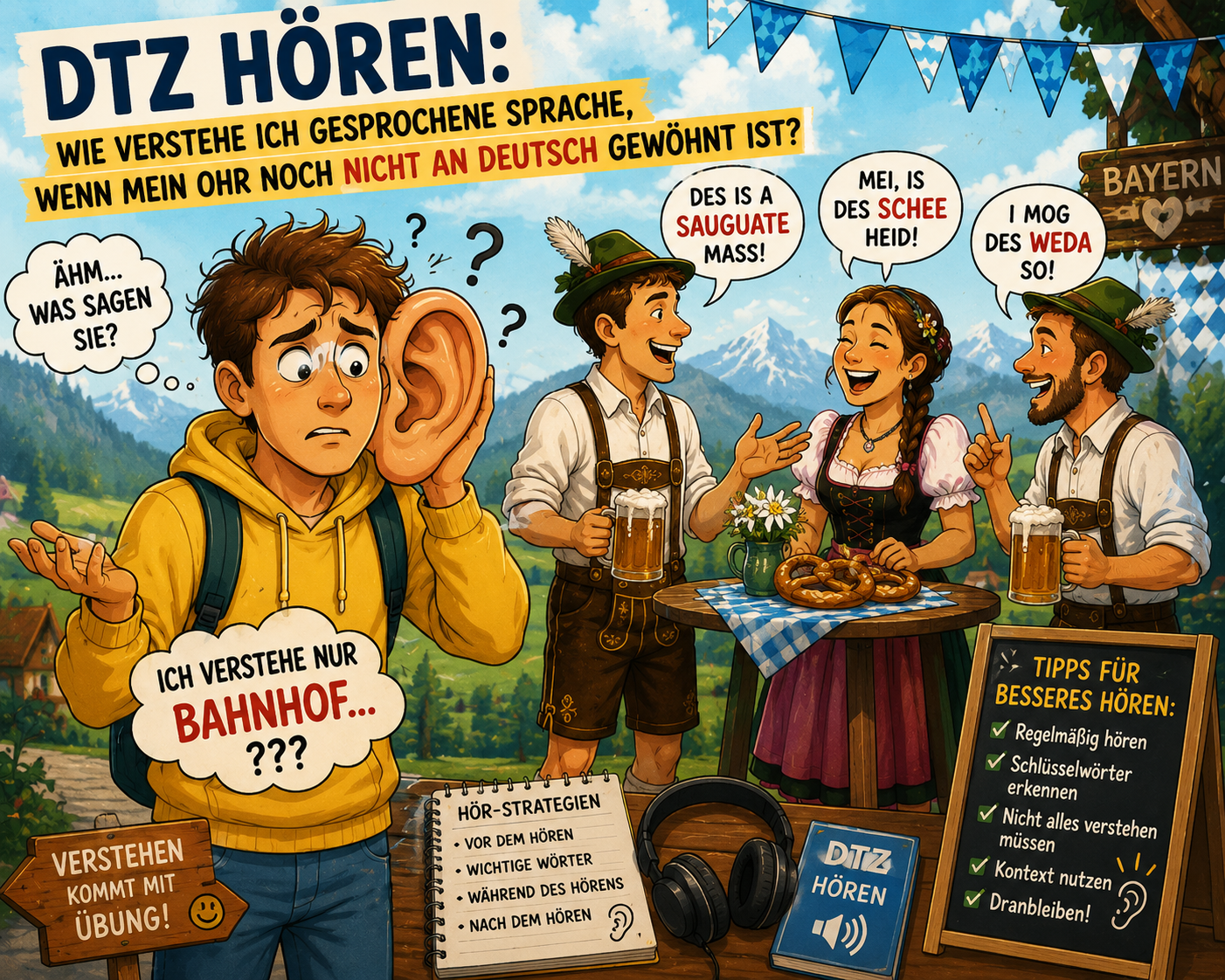
DTZ Listening: How to Understand Spoken German When Your Ear Isn't Used to It Yet
You know the feeling from class: The teacher is speaking, you understand everything. You listen to a recording from the textbook — you understand everything. Then a real announcement at the train station, a conversation between two Germans in a café, a short radio report — and suddenly there is just noise. The words are there, but they come too fast, too unclearly, too blended together for the brain to sort them out in time.
This is not a sign that your German is not good enough. It is a very normal stage in language acquisition — and it has a name: The ear is not yet calibrated. It knows the written language, but not the spoken one. These two things differ more than most learners expect.
For the DTZ listening test, this means: Those who only learn from textbooks are preparing for a language that does not occur in the exam room. The recordings in the DTZ sound like real German — with real speed, real pauses, real reductions. This article shows how to calibrate the ear to it in a short time.
Why spoken German sounds so different from written German
When Germans speak to each other, they do something that no textbook teaches: they swallow syllables, connect words, shorten endings. This does not happen because they speak unclearly — it is simply how spoken German works. And that is exactly the difference between the German you hear in class and the German you hear in the DTZ exam.
A few concrete examples make this clearer than any explanation:
Written language / textbook audio:
“Ich habe das nicht gewusst."
Spoken everyday German:
“Ich hab das n'gewusst."
Written language:
“Was hast du heute gemacht?"
Spoken:
“Was hastn heut gemacht?"
Written language:
“Ich würde gerne einen Termin vereinbaren."
Spoken (announcement, normal speed):
“Ich würd gern'n Termin vereinbarn."
These are not mistakes. This is normal, fluent German. Those who have not internalized these patterns literally hear a different language than someone whose ear is accustomed to it.
The good news: The brain learns these patterns surprisingly quickly — if you give it the right inputs. No more vocabulary, no more grammar. Just more real spoken German, in the right dosage, in the right way.
What the DTZ listening test really tests — and what it does not
Many who see a DTZ listening task for the first time make the same mistake: They think it is about understanding the text as completely as possible. This is wrong — and this misconception costs points.
The listening test in the DTZ tests targeted information retrieval. You hear a short text and must answer a specific question: When does something take place? What should you bring? What opinion does person A represent? This means: You do not have to understand everything, but rather recognize the right spot in the text and answer the question with it.
| Part | What you hear | What you need to understand | Points |
|---|---|---|---|
| Part 1 | Telephone announcements, train station announcements, recorded messages | A specific fact: time, place, instruction | 4 |
| Part 2 | Short radio reports, weather news, announcements | The main information of each report | 5 |
| Part 3 | Everyday conversation between two people | Details of the conversation: what is true, what is not (true/false + multiple choice) | 8 |
| Part 4 | Discussion or interview with several people | Who represents which opinion (assignment) | 3 |
Important: Listening and reading are counted as a combined block. The maximum score is 45 (16 from listening + 29 from reading). For level B1, 33–45 points are needed, for A2, 20–32 are sufficient. Those who work consistently on listening can make up for missing points in reading — and vice versa.
5 techniques to quickly acclimate the ear to real German
The following methods are not abstract — each has a specific mechanism. And each can be tried out immediately, today.
Shadowing — the body learns with the ear
Shadowing means: You hear a sentence and speak it out loud simultaneously — like a shadow. Not afterwards, not with a pause: simultaneously. It sounds strange, but it works quickly. The brain processes not only the sound during shadowing but also the rhythm, the emphasis, and the connections between words. After two to three weeks, you begin to automatically recognize the same connections during passive listening.
For beginners, it is easier to start with slower recordings. Ideal: the DW program “Slowly Spoken News” — real news texts, spoken a bit slower than normal, with a transcript for reading along.
Daily quota: 10–15 minutes of shadowing. After a week, you will notice the difference when listening without speaking along — the ear has become more alert.
Double listening — first without, then with text
You take a short recording (1–2 minutes), listen to it completely once — without text, without pause, without rewinding. Then you ask yourself: What was the topic? What was mentioned? What did I understand, what did I not?
Then you read the text or subtitles and listen to the recording a second time. This time, the parts that were unclear the first time often suddenly become clear — because the brain knows what to look for. This moment of “Aha, that was it!” is very effective from a learning psychology perspective: the pattern is ingrained.
Important: Do not pause or rewind during the first pass. This enforces exactly the technique needed in the real exam: keep listening, even if something was unclear.
Recognizing connections — the invisible seams in spoken German
Spoken German operates according to certain patterns that can be learned. Those who know them suddenly hear much more:
- “haben" → “hab'n" — the -en is often swallowed
- “ein" after verb → “'n" — “Ich möchte einen Kaffee" becomes “Ich möchte 'n Kaffee"
- “nicht" → “nich" — especially in Northern German
- “wir haben" → “wir ham" — everyday language, also in announcements
- Ending “e" often drops — “Ich sage" → “Ich sag"
- Words merge — “Das ist" → “Dass'", “Wie geht es Ihnen?" → “Wie geht's?"
Exercise: Take an Easy German episode on YouTube. Listen to a sentence that was unclear to you — and try to identify the merges. Over time, you will recognize them automatically.
Focus listening — targeted instead of fully understanding
The brain cannot process everything at once. If you try to fully understand every sentence, you will miss the next one. This is the most common reason for poor results in the DTZ listening — not a lack of language level, but a lack of listening strategy.
Focus listening means: You decide beforehand what you are looking for. In the DTZ, this is easy because you can read the questions before listening. If the question is “What are the office hours on Monday?” — then you look for a time indication and the word “Monday.” Everything else is background noise.
Exam technique: For each DTZ task, first look at the answer options and highlight the keywords that differ between the options. Then listen specifically for exactly those words.
The vocabulary of sound — learning words by ear instead of on paper
Most people learn vocabulary by reading and writing them down. The problem: The brain primarily stores the words as visual information — and not as sound. Those who take time to recognize a word while listening often have exactly this problem: The acoustic representation in the brain is weaker than the visual.
The solution is simple: Learn vocabulary with audio. Anki cards with voice recordings instead of just text. Or: pronounce every new word out loud when you learn it. The brain then automatically links sound and meaning — and when listening, the meaning comes faster.
Specifically: When learning a vocabulary word, look it up on Forvo.com to see how it is pronounced by a native speaker. Especially important for words that you have only read so far.
How to prepare for each of the four DTZ listening parts specifically
Tip: practise what you've just read with interactive exercises — it sticks better.
Start A2 exercises →The four parts of the DTZ listening test require slightly different skills. Those who understand what happens in each part can tailor their preparation accordingly — and avoid the typical pitfalls.
Announcements on the phone and public announcements
4 tasks · Multiple choice · 1 fact per recording
These recordings often sound unnaturally fast and echoey — because train station announcements and recorded messages actually sound like that. This is intentional. The ear must learn to cope with the slight loss of quality.
What is almost always asked: opening hours, meeting points, phone numbers, instructions. It is enough to catch the one relevant moment. The rest of the text can remain unclear.
Short information in the media
5 tasks · Multiple choice · one report per question
Five short, independent reports — like a news presenter delivering various topics in quick succession. Each report has a clear introduction: “In road traffic …”, “The weather tomorrow …”, “At today’s city festival …”.
These first words are worth their weight in gold: They tell you where to look. Those who consciously take in the opening of each report already have the context — and can assign the rest more specifically.
Understanding everyday conversations
8 tasks · True/False + Multiple choice · highest weight
Part 3 is the hardest and at the same time the most valuable: With 8 out of 16 possible listening points, it determines half of the listening result. The conversation is longer than the other recordings and sounds natural — with overlaps, short pauses, emotional reactions.
The four true/false statements follow the order of the conversation. You can use this: If you know that task 10 is early in the conversation and task 14 is at the end, you can set mental waypoints and listen specifically at the right spots.
Especially important: For true/false, only the exact statement counts. If the audio says “a large apartment” and the statement reads “an affordable apartment” — that is false, even if both sound positive. Do not add anything.
Different opinions on a topic
3 tasks · Assignment · who said what
Two or three people are discussing, and you must assign who made which statement. This sounds straightforward — but it is not, because people often quote, add to, or contradict each other.
Crucial: Know the signal words for opinions. “I think that …”, “In my opinion …”, “I believe that …”, “I do not believe that …” — these phrases signal: Now comes a personal statement from the person. Who was just speaking and what this sentence means — that is the answer.
Step plan: How to train listening comprehension in 6 weeks
Six weeks are enough to noticeably improve listening — if you divide the weeks sensibly. The logic: First train the ear, then get to know the exam format, then practice under real conditions.
Open the ear — real German daily
20 minutes of real spoken German daily: Easy German on YouTube (watch twice: first without, then with subtitles). In parallel: Shadowing with DW “Slowly Spoken News”. No exam tasks in this phase — just listen and get used to it.
Get to know the DTZ format
Work through the official practice set from g.a.s.t. (gast.de/dtz) — only the listening part, without time pressure. Analyze each task after listening: Why is the correct answer correct? Where in the audio was the information? What did you overlook and why?
Specifically strengthen weak parts
From the analysis in week 3, find out which part was the most difficult (usually part 3 or 4). Look for additional exercises in the same format for this part. At the same time: practice the pre-reading technique — always read the questions first, then listen.
Introduce time pressure
Now practice with a timer: Work through the complete listening block (25 minutes) without pause and without rewinding — just like in the real exam. Then evaluate the results. At least twice this week.
Consolidate routine — no new content
15 minutes daily: One listening block or a podcast. No new material to learn — maintain the level and anchor the exam routine. In the evening, listen to German relaxed, without tasks — just for the ear.
Try it now · DTZ Listening · Level B1
A real listening task in exam format — immediately and without registration
The fastest way to understand what the ear really has to do in the DTZ: try out a real task. On DeutschMeister, you can practice all four listening parts in the original format — with audio, time limit, and an evaluation that explains exactly where in the text the answer was found and why you might have overlooked it.
Start first taskThe task opens directly. No registration, no login — just start listening and see how it feels.
The best free resources for real spoken German
Not every resource is equally useful. Here are those that have proven particularly effective for training the ear — sorted by purpose.
Easy German
YouTube · freeInterviews and conversations with real people on German streets. Bilingual subtitles (German + native language). Ideal for parts 3 and 4 of the DTZ listening test.
youtube.com → “Easy German"
DW Slowly Spoken News
Podcast · freeReal news, spoken a bit slower than normal. With transcript. Perfect for shadowing and for part 2 of the DTZ listening test (media contributions).
dw.com → Learn German → News
Slow German
Podcast · freeMonologues by Annik Rubens on everyday topics, calm pace, clear pronunciation. Good for starting listening training — before transitioning to a more natural pace.
Spotify / Apple Podcasts → “Slow German"
g.a.s.t. Practice Sets
Exam material · freeOfficial practice tasks with real DTZ format, real audios, and answer keys. The only material that matches the real exam 100%.
gast.de/dtz
Forvo
Pronunciation · freePronunciation database with recordings from native speakers for every word. Essential for acoustic vocabulary learning — before you really have a word in your ear.
forvo.com
DeutschMeister
Exam training · freemiumListening exercises in the exact DTZ format — with audio, timer, and detailed evaluation. Explains after each task where the solution was found in the audio.
deutsch-meister-app.com
Frequently asked questions about DTZ listening training
How long does it take for the ear to get used to real German?
This strongly depends on how much contact you have daily with spoken German. With 20–30 minutes of targeted listening training daily — shadowing, double listening, real recordings — most notice a significant difference after two to three weeks. The ear begins to recognize word boundaries faster, even if it does not yet understand everything.
Can you take notes during the DTZ listening test?
Yes. In the task booklet, you can make any markings and notes — underline keywords, circle answer options, put question marks. Only the final answers go on the official answer sheet — and only this will be graded.
What to do if you hardly understood a recording?
Keep going — that is the most important rule. An unanswered question means a lost point. But lingering too long on an unclear point costs concentration for the next task — and that can cost two or three points. If you really understood nothing: circle answer “b” (statistically a bit more often correct than a or c in multiple choice) and continue without losing time.
I understand Germans when they speak to me — but not when they speak to each other. Why?
This is one of the most common and frustrating phenomena in language acquisition. When Germans speak with foreigners, they unconsciously adapt: slower pace, clearer pronunciation, simpler sentence structure. When speaking among themselves, they speak as they really do — without consideration. The gap is real and surmountable, but it requires targeted training with authentic recordings.
Does it help to watch German films and series?
Yes — but with one important condition: watch with German subtitles, not with a translation. Those who watch with translation read the plot and hear the German only as background noise. Those who watch with German subtitles actively connect sound and written form. After a few weeks, you will recognize words in listening faster because you have stored them in both forms.
How does listening in the DTZ differ from the Goethe Certificate or telc B1?
All three test listening comprehension at B1 level, but the format differs significantly: number of parts, task types, length of recordings, type of questions. Those taking the DTZ should practice exclusively with g.a.s.t. materials — not with general B1 practice books designed for the Goethe or telc format. Knowing the format is half the battle.
How many points do I need in listening to reach B1 overall?
Listening and reading are counted together — with a maximum of 45 points (16 from listening, 29 from reading). For B1, you need at least 33 points in the combined block. If you achieve 10 out of 16 points in listening, 23 out of 29 reading points are sufficient for B1. This gives a certain margin — provided you prepare for both parts.
Ready for A2 exercises?
Don't just read — practice now! Hundreds of interactive exercises, audio tasks and exam training are waiting for you.
War dieser Artikel hilfreich?
Ähnliche Artikel

I almost failed at B1: what no one told me about the structure of the German exam.
A personal story about preparing for the DTZ B1 — and the lessons one should better read before opening the first textbook.

The difference between A2 and B1: What really changes — and how I made the leap.
What is really the difference between A2 and B1 in German? A personal experience report with 3 surprising facts, 5 tips — and an encouraging conclusion.
DTZ not passed: Consequences for residence permit, settlement permit, and naturalization
What really happens if you fail the DTZ? Consequences for residence permit, settlement permit, and naturalization — clearly explained with the current status in 2025.