
DTZ not passed: What I did wrong on the first attempt — and how I achieved B1 on the second try
It was a Tuesday morning in October. I was sitting in the waiting room of the exam center, having barely slept for three nights, and was convinced that I was well prepared. I had completed the integration course, done all the homework, even solved a few practice exercises online. What could possibly go wrong?
Three hours later, I knew the answer. I failed the DTZ — and not by a narrow margin. I scored 18 points in listening and reading, 5 in writing. Both below A2. The result: no certificate at all. Only in speaking did I happen to reach B1 — but without the other parts, that meant nothing.
Four months later, I took the DTZ exam a second time — and passed with B1. In this article, I honestly share what went wrong the first time, what I did differently on the second attempt, and the mistakes I repeatedly see among other course participants.
My results then and now — an honest comparison
Before I write about the mistakes, I want to show how big the difference really was. Not to brag, but so you can see: the DTZ exam is definitely doable — if you know what matters.
My DTZ results in comparison
1st Attempt (October)
Listening & Reading
18 / 45
below A2
Writing
5 / 20
below A2
Speaking
78 / 100
B1 — but no certificate
2nd Attempt (February)
Listening & Reading
36 / 45
B1
Writing
16 / 20
B1
Speaking
82 / 100
B1 ✓ Certificate
The same person, four months apart. No intensive course, no private tutoring, no move to Germany. Just a different way of learning — and a fundamental understanding of how the DTZ exam really works.
What I did wrong the first time — 6 honest mistakes
It took me a long time to name these mistakes. Not because they are complicated, but because you only see them in hindsight. Maybe you recognize yourself in one or another.
I didn’t train the exam as an exam — but as a language course
This is the difference most only understand after failing. In the integration course, you learn German — vocabulary, grammar, communication. That is valuable. But the DTZ exam doesn’t test whether you can speak German, but whether you can solve this specific exam type.
I had never seen a real exam format. I didn’t know that each listening recording plays twice. I didn’t know that in reading part 5 you have to complete words from a list. I didn’t know how the writing part is graded. All of this caught me completely unprepared in the exam room.
In writing, I didn’t write a letter — but a text
In writing, there are four key points you must cover. I didn’t know that. I just responded to the topic and wrote whatever came to mind. The result: two out of four points addressed, no date, no proper letterhead, no greeting.
The evaluator judged according to four criteria: content, communicative design, correctness, vocabulary. I had almost zero points in content and communicative design — not because my German was bad, but because I didn’t know what was expected.
In listening, I wanted to understand everything — and ended up understanding nothing
I sat there trying to translate every sentence. While I was still thinking about the first word, the speaker was already on the third sentence. At the end of the recording, I had a vague idea of the topic — but no concrete answer to the question asked.
The crucial mistake: I had not read the questions before the audio started. So I didn’t know what to listen for. When you know the questions, you suddenly listen very differently.
I mismanaged my time in the reading section
Reading has five parts and lasts 45 minutes. I had no idea how long each part should take approximately. For part 3 — a long newspaper article — I spent almost 20 minutes because I wanted to read every sentence carefully. For parts 4 and 5, I then had just 8 minutes left.
The result: parts 4 and 5 almost completely unanswered. These are a total of 9 points — almost a quarter of the total score in the listening-and-reading block.
I didn’t know that speaking decides everything
The first time, I was actually good at speaking — and still got no certificate. That’s due to a rule hardly anyone knows before experiencing it firsthand: If you score below A2 in speaking, you get no certificate at all, no matter how well the other parts were.
For me, it was the opposite: Speaking B1, but the rest below A2. No certificate. If my written parts had at least reached A2 — I would have gotten the A2 certificate. So I had nothing in hand.
I underestimated exam anxiety
I’m generally not an anxious person. But something strange happened in the exam room: I forgot words I had used a hundred times. My hands trembled while writing. In listening, I couldn’t concentrate because I kept thinking: “What if I don’t make it?”
Exam anxiety doesn’t come from bad German — it comes from unfamiliarity. I had never practiced the exam format under real conditions. Everything was new and unfamiliar. That costs energy you actually need for the tasks.
What I did differently on the second attempt
Tip: practise what you've just read with interactive exercises — it sticks better.
Start B1 exercises →After the first failure, I could have given up. Instead, I worked very deliberately for four months — but not more hours, just differently. Here’s what really helped.
I worked through the official practice sets from g.a.s.t. completely
g.a.s.t. is the organization that develops and manages the DTZ. On the official website, there are free practice sets — with exactly the same format, task types, and difficulty as the real exam. This is the only material you can really trust.
I didn’t just do the tasks and look at the results. I analyzed every wrong answer: Why was it wrong? Where in the text or audio was the correct information? What should I have done differently?
In writing, I learned a pattern — and applied it consistently
I looked at the four evaluation criteria and understood what the evaluator actually looks for. Then I practiced a fixed letter structure: date, salutation, opening sentence, cover four key points, closing phrase, signature. Sounds mechanical — but it works because the exam expects exactly that.
Before the second exam, I wrote eight complete letters. Each time aiming to cover all four key points and include connectors like because, although, therefore, furthermore. On the real exam day, the letter was finished before the 30 minutes were up — I had never experienced that before.
In listening, I always read the questions first
It sounds trivial, but it changed more than anything else. When you know the question, you know what to listen for: a time, a place, an opinion, an action. You don’t listen passively anymore — you listen with a purpose.
I also learned to use pauses: Between the announcement of a task and the start of the recording, there are always a few seconds. These seconds belong to preparation, not to thinking about the previous task.
I practiced time limits — like in the real exam room
For the reading part, I developed a simple rule of thumb: each of the five parts gets a maximum of 8 minutes. If I’m not finished after 8 minutes — move on. Better an uncertain answer than no answer in the last parts.
I also kept this time limit during practice: set a timer, after 8 minutes stop, put the pen down. At first, it was frustrating. By the exam, I had internalized it so well that the time pressure was no longer stressful — but a familiar framework.
I fully simulated the exam beforehand — twice
Three weeks before the second date, I did a complete practice test: listening with audio, reading with timer, writing with timer, all in a row, no getting up, no phone. Almost three hours straight.
It was uncomfortable. And exactly for that reason helpful. On the real exam day, I sat in the room and thought: I know this. I know how it feels. This familiarity halved my nervousness.
My study plan for the four months — what, when, and how
I had no fixed course, no teacher accompanying me. I learned independently — with a clear weekly plan that I actually stuck to.
| Period | Focus | Daily | Goal |
|---|---|---|---|
| Month 1 | Get to know the format + error analysis | Analyze 30 min practice set | Understand how each exam part is structured |
| Month 2 | Train writing and reading specifically | 1 letter + 1 reading part | 8 complete letters, practice time limits |
| Month 3 | Intensive listening + vocabulary | 20 min listening + 15 min vocabulary | Fluent understanding without translating |
| Last 4 weeks | Complete practice exams | Full test once a week | Embed time management + exam routine |
I didn’t study four hours every day. But I did something almost every day — consistently, over four months. Regularity beats intensity.
What I would say to someone who just failed for the first time
If you are reading this article because you just got your DTZ result and it wasn’t what you expected — then I want to tell you something I needed back then:
The result doesn’t say anything about whether your German is good enough. It only says that you don’t yet know a certain exam format well enough. That is fixable — and faster than you think now.
The DTZ is not a language test in the sense that it assesses your entire German. It is a standardized test with a defined format, and you can learn this format. Not as a trick or shortcut — but because understanding the exam structure actually helps you recall what you have learned.
The most common reasons for failing the first time are not bad German, but:
- No knowledge of the exam format (what is expected when)
- No time management in the reading section
- No writing according to the four key points
- No targeted listening (reading questions beforehand)
- No practice under real exam conditions
All of this can be caught up with four months of targeted preparation. I am proof of that.
Practice now · DTZ format · Level B1
Exam tasks in original format — just like in the real exam
One of the most important things I did differently on the second attempt: I practiced with real exam tasks in the original format — not with general German exercises. On DeutschMeister, you can train all four exam parts: with audio, timer, and an evaluation that explains where in the text or audio the correct answer was found.
Start practicing nowThe first task opens directly — no registration. See for yourself what the format looks like that awaits you in the real exam.
Frequently asked questions about retaking the DTZ
When can you retake the DTZ after failing?
There is no legal waiting period for the DTZ. The exam can generally be retaken at the next available opportunity. However, availability depends on the respective exam center — some offer monthly, others quarterly dates. It’s best to inquire directly with the responsible institution.
Do you have to retake all parts in the retake?
Yes. The DTZ is a comprehensive exam — there is no option to make up individual parts or carry over a partial result from the first attempt. On the second attempt, everything starts from scratch: listening, reading, writing, and speaking are re-evaluated.
How much time does one realistically need to prepare for the second attempt?
It strongly depends on what caused the failure the first time. Those who mainly didn’t know the exam format can improve significantly with 6–8 weeks of targeted preparation. Those who also have language gaps need more like 3–4 months. The decisive factor is not the total number of hours, but whether you practice with real exam material and under timed conditions.
Is there a maximum number of attempts?
There is no fixed limit on attempts for the DTZ itself. However, it should be noted that participation in the integration course and the associated exam fee are regulated by BAMF. If the exam is taken as part of the integration course, repeat attempts may involve costs. It’s best to ask the responsible course provider.
What is the most common reason for a poor writing result?
By far the most common: not all four key points are addressed in the letter. This alone lowers the content criterion (25% of the total score in the writing part) to a low level. Right behind that: no proper letter structure (missing date, salutation, closing phrase) and too short a text. A good letter in the DTZ has 80–120 words and covers all four given points.
I have B1 in speaking, below A2 in the rest — do I get nothing at all?
Unfortunately yes — that was exactly my situation. For any certificate (A2 or B1), speaking is a minimum requirement: you must achieve at least A2 there. Additionally, one of the other two partial results (listening/reading or writing) must also reach at least A2. If all written parts are below A2, there is no certificate — regardless of the speaking result.
Can you apply for another language certificate between two DTZ attempts?
For permanent residence in Germany, the DTZ or an equivalent recognized language certificate (e.g., telc German B1, Goethe Certificate B1) is required. Those who just failed the DTZ can theoretically take another B1 test — provided it is recognized by BAMF. Which certificates are accepted depends on the respective context (naturalization, residence permit, etc.). In case of doubt, ask the responsible authority directly.
Ready for B1 exercises?
Don't just read — practice now! Hundreds of interactive exercises, audio tasks and exam training are waiting for you.
War dieser Artikel hilfreich?
Ähnliche Artikel

The difference between A2 and B1: What really changes — and how I made the leap.
What is really the difference between A2 and B1 in German? A personal experience report with 3 surprising facts, 5 tips — and an encouraging conclusion.
DTZ not passed: Consequences for residence permit, settlement permit, and naturalization
What really happens if you fail the DTZ? Consequences for residence permit, settlement permit, and naturalization — clearly explained with the current status in 2025.
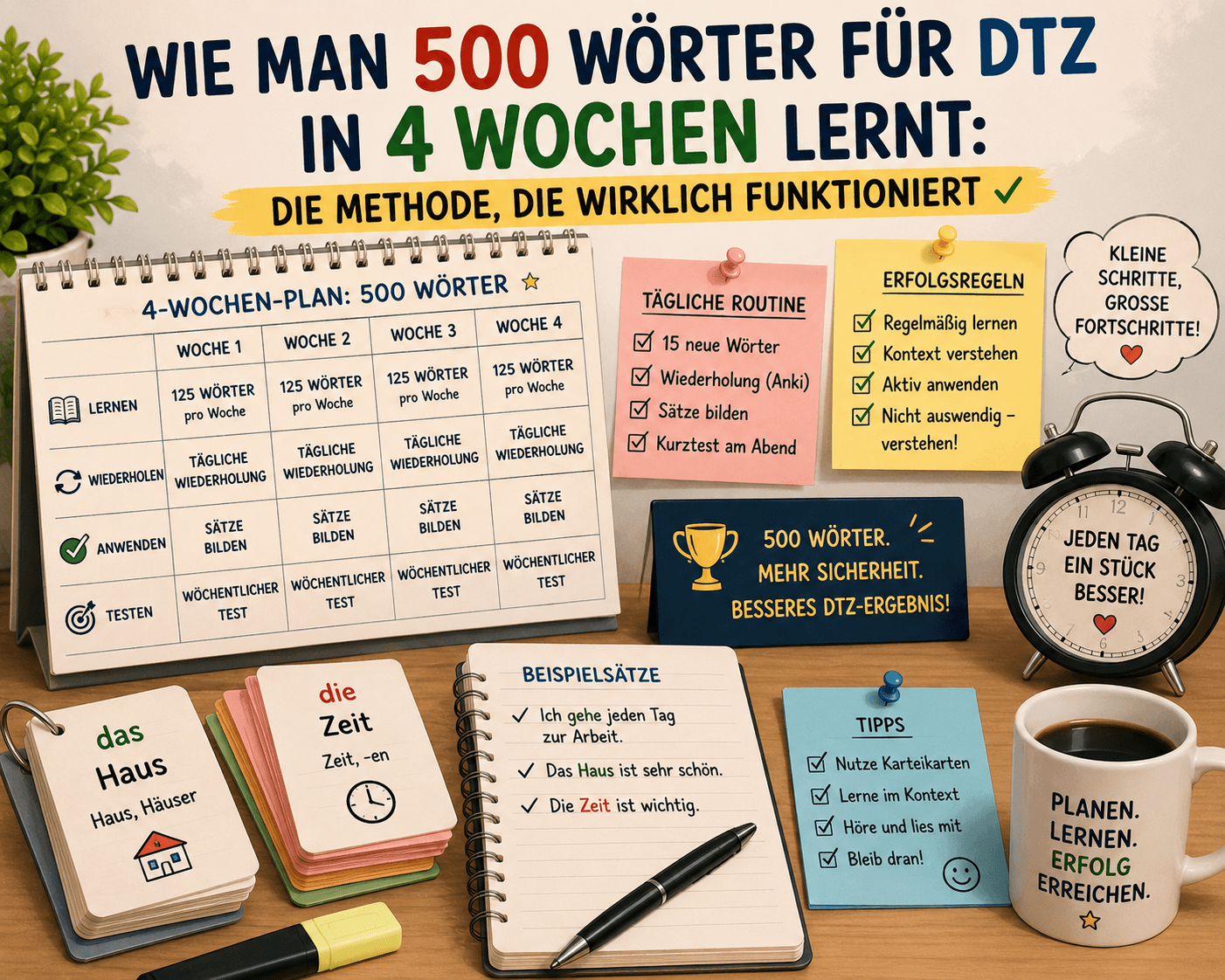
500 DTZ vocabulary in 4 weeks: Spaced Repetition Method with weekly plan
Which 500 words actually appear in the DTZ, how to confidently learn them with Anki in 4 weeks, and why most traditional methods fail — with a concrete daily plan.