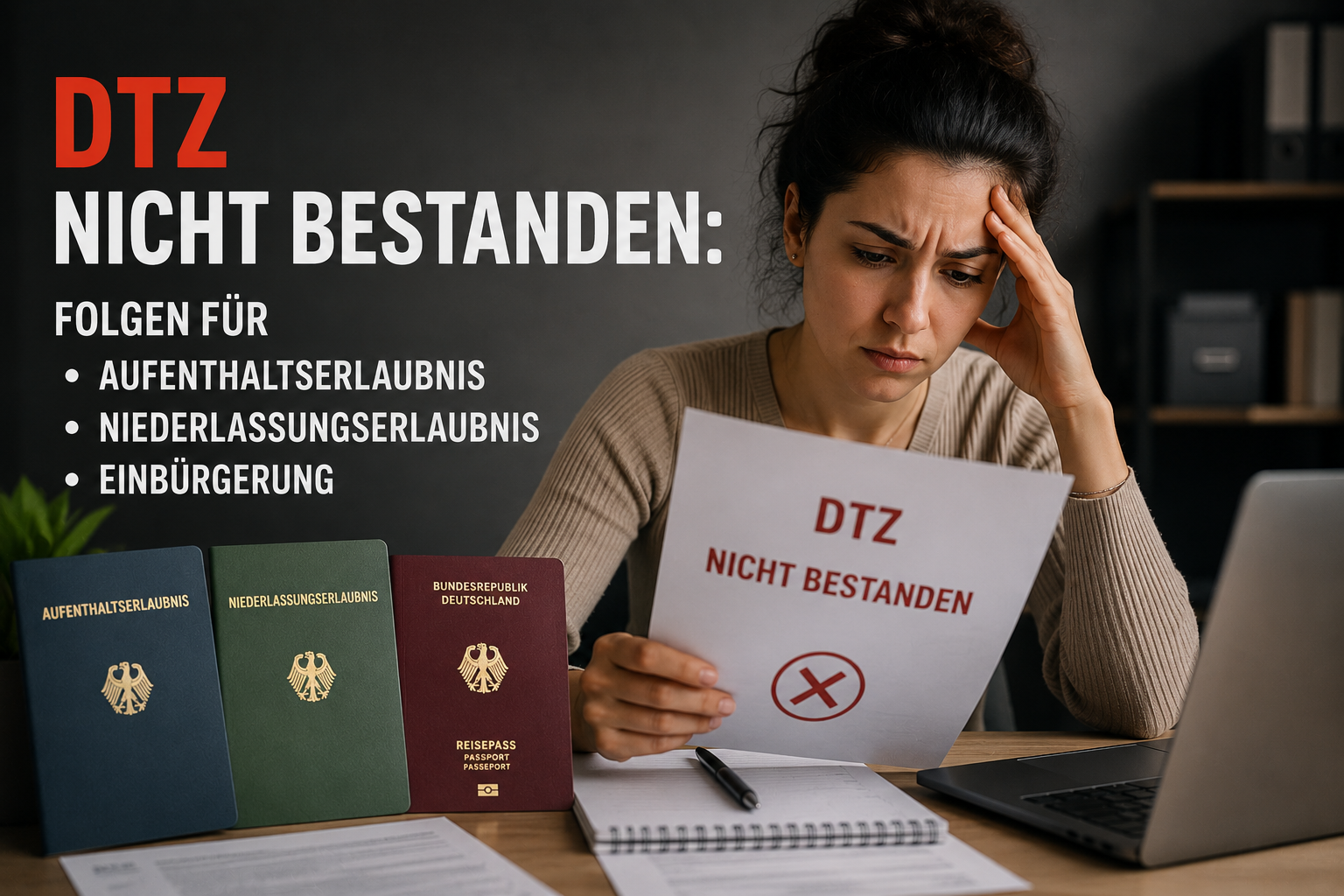
DTZ not passed: Consequences for residence permit, settlement permit, and naturalization
Most people prepare for the DTZ because they need the certificate. But few know specifically what happens if they fail — not on the first attempt, and not after several attempts. What does a missing B1 certificate mean for the residence permit? When does it block the settlement permit? And what has changed in the rules in 2025?
The answers to these questions are more important than most course participants think. Because the DTZ is not just a language test — it is a key to several residence law decisions. Those who understand this learn with a different awareness of what is at stake.
What the DTZ means legally — and why it is more than just an exam
The German Test for Immigrants (DTZ) is the final exam of the state-funded integration course. It is administered by g.a.s.t. and consists of two parts: the DTZ itself and the orientation course test (Living in Germany, short LiD). Only those who pass both receive the official integration course certificate — the document that counts in several residence law procedures.
A common misconception: Many think that the DTZ result directly affects the validity of their current residence permit. This is usually not true. The ongoing temporary residence permit does not automatically lose its validity due to a poor DTZ result. But the DTZ has long-term effects on what is possible afterward — and that is what it comes down to for most affected individuals.
Summary: The DTZ itself does not "break" anything that already exists. But without B1, certain doors do not open at all — settlement permit, accelerated naturalization, cost reimbursement. Depending on personal circumstances, this can mean months or years of delay.
Failed DTZ: What happens specifically — in 3 scenarios
The consequences of failing the DTZ vary depending on the result achieved. There are three possible scenarios — each with different consequences.
If you remain below A2 in two or more exam parts, you will receive no certificate and no partial result that helps.
Consequence: No integration course certificate. No cost reimbursement. No basis for settlement permit or naturalization through the integration course route. Re-examination necessary — since 2025 without automatic additional lessons.
You receive a partial result A2, but no complete integration course certificate.
Consequence: A2 is sufficient for some residence permit extensions. For the settlement permit under § 9 AufenthG and for naturalization, A2 is not enough — B1 is mandatory there. The 50% cost reimbursement is eliminated.
Together with the passed LiD test, you receive the complete integration course certificate at level B1.
Consequence: 50% of the course costs are reimbursed. Basis for settlement permit and naturalization fulfilled. Path to accelerated naturalization after 3 years (instead of 5) is open.
Effects on the residence permit
The temporary residence permit you already have generally remains in place — a poor DTZ result does not lead to automatic deportation. The crucial question is: What happens upon extension, and what happens when applying for a settlement permit?
Extension of the temporary residence permit: No DTZ does not automatically lead to rejection
For the extension of a normal temporary residence permit, the DTZ certificate is not mandatory in most cases. However, some immigration authorities have the option to tie the extension to integration progress — especially if there was a requirement to attend the integration course.
Those who were required to attend the integration course and take the exam, and who did not do so or did not succeed, can expect inquiries or conditions from the immigration authority when extending the residence title. There is no direct legal regulation that automatically denies the extension in this form — but the authorities' discretion is real.
Settlement permit: Without B1, you cannot proceed — this is legally regulated
This is the most important legal consequence — and it is directly stated in the law. § 9 Abs. 2 AufenthG stipulates that for the general settlement permit, among other things, "sufficient knowledge of the German language" must be proven. In practice, this means level B1 (GER).
What this means concretely: Anyone wishing to apply for an unlimited residence permit (settlement permit) after 5 years in Germany must prove B1. The DTZ certificate is one of the recognized proof options — but there are alternatives (more on that below).
Those who cannot prove B1 will not receive the settlement permit. The application will be rejected — and thus one remains on the temporary residence permit, which must be regularly extended.
Cost reimbursement: Those who do not achieve B1 lose the right to 50% reimbursement
Those who complete the integration course as self-payers pay €2.29 per lesson unit. For a 700-hour course, that amounts to about €1,603. Those who present the complete integration course certificate at the end — i.e., passed DTZ B1 and LiD — are entitled to a reimbursement of 50% of these costs.
Those who only achieve A2 or do not achieve any result have no right to this reimbursement. This is not a huge amount, but at around €800 potential reimbursement, it is quite relevant — especially for people on a tight budget.
Effects on naturalization — especially after the 2024 reform
Tip: practise what you've just read with interactive exercises — it sticks better.
Start A2 exercises →Since the reform of the nationality law, which came into force in 2024, several changes have occurred — also regarding the language requirements for naturalization. The most important point in advance: B1 is still required for regular naturalization.
Regular naturalization: B1 is a mandatory requirement — no way around it
For regular naturalization under German law, sufficient knowledge of the German language at least at level B1 is a requirement. The DTZ certificate is a recognized proof, but other certificates (telc B1, Goethe B1, ÖSD B1) are also accepted.
After the 2024 reform, regular naturalization is possible after 5 years of lawful residence (previously 8 years). For special integration achievements (voluntary engagement, special achievements), this period can be shortened to 3 years. In both cases, B1 is mandatory — the reform did not change that.
Accelerated naturalization after 3 years: Only possible with integration course certificate
One of the most interesting innovations of the reform: Those who have demonstrably provided "special integration services" can be naturalized after just 3 years. The integration course certificate — i.e., passed DTZ B1 plus LiD — is an accepted proof of integration achievements.
Therefore, those who only achieve A2 or do not pass the DTZ lose this path to accelerated naturalization. This can mean a difference of two years — two years earlier or later for German citizenship.
What has changed in 2025 — and what it means for you
Since January 1, 2025, there is no longer an automatic option to apply for 300 additional lesson units in the general integration course after failing the DTZ. This option has been completely abolished for the general integration course. This deletion does not explicitly apply to literacy courses and second-language learner courses.
What this means in practice: If you do not pass the DTZ on the first attempt, you must organize and finance the next attempt yourself — without the state automatically providing additional lesson units. If you want to continue learning, you can use a private conversation course or a tandem partner. A vocational language course (DeuFöV) often builds on A2 and brings participants to B1 or higher without additional costs.
Those who complete the general integration course and do not pass the DTZ can repeat the exam — but not within the framework of repeat lessons funded by the state. The exam retake itself is possible and fee-dependent depending on the testing center.
Alternatives: You can prove B1 even without the DTZ certificate
This is a point that surprises many: The DTZ is one option to prove B1 — but not the only one. Those who have not passed the DTZ or prefer another route can also prove B1 through other recognized certificates.
| Certificate | Provider | Recognized for settlement permit | Recognized for naturalization | Special feature |
|---|---|---|---|---|
| DTZ B1 | g.a.s.t. | ✓ Yes | ✓ Yes | Completion of the integration course; cost reimbursement possible |
| telc Deutsch B1 | telc GmbH | ✓ Yes | ✓ Yes | Can be booked privately; no integration course required |
| Goethe-Zertifikat B1 | Goethe-Institut | ✓ Yes | ✓ Yes | Internationally recognized; slightly more expensive |
| ÖSD Zertifikat B1 | ÖSD (Austria) | ✓ Yes | ✓ Yes | Recognized, but less frequently available |
| Deutsches Sprachdiplom II (DSD) | KMK | ✓ Yes | ✓ Yes | Mainly for students abroad |
| Deutsches Schulabschlusszeugnis (Mittlere Reife oder höher) | Schools in Germany | ✓ Yes | ✓ Yes | Counts as proof of sufficient language skills |
Important to know: Those who have not passed the DTZ do not necessarily have to repeat the integration course or wait. You can specifically prepare for telc B1 or Goethe B1 and take this exam privately. These certificates are accepted for settlement permits and naturalization just like the DTZ certificate.
The timing: What is at stake when
To understand why the DTZ result means so much, it helps to look at the typical sequence of residence law steps. Most people who complete an integration course are in the following chronological logic:
Arrival in Germany
Temporary residence permit
Usually issued for 1–3 years, depending on the reason for stay. DTZ is not yet a topic, but the obligation to attend the course may already exist.
Year 1–2
Integration course and DTZ preparation
Language course (600 or 900 lesson units), then DTZ and LiD. Here it is decided whether you receive the certificate and can claim cost reimbursement.
Year 3 (for special cases)
Possibility of accelerated naturalization
Only with a complete integration course certificate (DTZ B1 + LiD) as proof of special integration achievements. Without this certificate, this option is eliminated.
Year 5
Settlement permit — the first major milestone
For the unlimited residence permit (§ 9 AufenthG), B1 is mandatory. Without language proof: rejection, further years with temporary residence permit.
Year 5 (regular) or earlier (for special achievements)
Naturalization
B1 is mandatory. No B1 certificate = no naturalization, no matter how long you have been living in Germany. Exceptions only exist for proven physical or mental disabilities.
Exceptions: Who has a chance even without B1
German residence law has exceptions. Those who can prove that they are unable to reach B1 level for health or personal reasons may be exempt from the language requirement or may be lowered to a lower level. However, these exceptions are narrowly defined and must be actively applied for and proven.
- Age: In the case of the settlement permit, older people (usually from 60 years) may receive relief under certain conditions. The exact requirements vary depending on the residence title and the responsible authority.
- Disability or serious illness: Those who can prove that they are physically or mentally unable to reach the required language level may be exempt from the language requirement. A medical certificate is usually required.
- Proven impossibility of language acquisition: The law mentions "uncontrollable reasons" — i.e., situations in which language acquisition was not possible despite honest efforts. This is set high and rarely succeeds without good documentation.
- Specific residence titles: For some specialized residence titles (e.g., for highly qualified individuals, EU Blue Card), different or reduced language requirements apply.
Important: These exceptions must be actively applied for and are not granted automatically. Those who believe they fall under one of these exceptions should contact the immigration authority or a migration counseling service — and do so early, before applying for a settlement permit or naturalization.
What you can do specifically — step by step
If you did not pass the DTZ or are currently preparing and understand the consequences, you may be wondering: What now? Here are the specific next steps — depending on the situation.
If you just failed the DTZ:
- Stay calm and analyze. Which part of the exam was the problem? Listening and reading, writing, or speaking? The cause determines the solution.
- Look closely at the result. An A2 result is better than no result at all — it does not exclude some options, only certain ones.
- Repeat the exam — or alternatively prepare for telc B1 or Goethe B1 and take this exam privately. Both are fully recognized for settlement permits and naturalization.
- Keep an eye on the timeline. If the settlement permit or naturalization is due in the next 1–2 years, the time for preparation is limited. Do not wait.
- Seek advice from Caritas, AWO, Diakonie, or a migration counseling service — free and without bureaucratic effort.
If you have not taken the DTZ yet and want to understand what is at stake:
- Know your residence title exactly: Which residence law applies? How long is the title valid? When does it expire?
- Check whether and when you want to apply for a settlement permit.
- Realistic assessment: Would you pass the DTZ exam today? If not — start preparing, not just shortly before the exam date.
Targeted preparation for DTZ B1 · All exam parts
Not passing is not an option when you know what is at stake
Those who know the residence law consequences of a failed DTZ see exam preparation differently. On DeutschMeister, you can practice all four exam parts in the real DTZ format — with audio, time limit, and an evaluation that explains exactly what was correct and why. The best protection against the consequences of a failed DTZ is targeted, format-compliant preparation.
Start preparing nowThe first exercise opens directly — no account, no registration. Just start.
Frequently asked questions about the consequences of failing the DTZ
Do you lose your residence permit if you do not pass the DTZ?
No — an already existing temporary residence permit does not automatically lose its validity due to a poor DTZ result. The ongoing permit remains in place. The consequences become apparent when extending or applying for a settlement permit — but not immediately after the exam date.
Can you apply for a settlement permit if you only have A2?
For the general settlement permit under § 9 AufenthG, B1 is required. A2 is not sufficient for that. For some special residence titles and certain groups of people (e.g., recognized refugees under § 26 AufenthG), different regulations may apply. When in doubt, ask the responsible immigration authority.
How many attempts do you have for the DTZ?
The number of exam attempts is not legally limited. You can generally retake the DTZ exam. However, since January 2025, the option to receive 300 additional lesson units in the general integration course after the first failure has been abolished. Therefore, the next attempt must be prepared without state-funded additional hours.
Is only the DTZ counted for naturalization, or are there other options?
There are several recognized B1 certificates. For naturalization, in addition to the DTZ, the Goethe-Zertifikat B1, telc Deutsch B1, and ÖSD Zertifikat B1 are also accepted. A German school graduation certificate (Mittlere Reife or higher) is also considered sufficient language proof. So you are not solely dependent on the DTZ.
Can you be naturalized without B1?
In very limited exceptional cases, yes — if it is proven that the B1 level is not achievable for physical or mental reasons. This exception must be actively applied for and medically documented. It does not apply to people who do not speak German well enough because they have not learned it yet — but only in cases of proven learning disabilities.
What is the difference between DTZ and integration course certificate?
The DTZ is the language exam. You only receive the integration course certificate if you have also passed the LiD test (Living in Germany) with at least 17 out of 33 points in addition to the DTZ at level B1. Only this complete certificate entitles you to cost reimbursement and counts as proof for accelerated naturalization. The DTZ certificate B1 alone is sufficient for the settlement permit and regular naturalization.
Did the 2024 reform lower the language requirements for naturalization?
No. The 2024 reform of the nationality law has shortened the waiting periods for naturalization (regularly from 8 to 5 years, with special achievements to 3 years) and expanded the possibility of dual citizenship. However, the language requirement — at least B1 — has remained unchanged. So anyone who thought that B1 is no longer necessary due to the reform is mistaken.
Ready for A2 exercises?
Don't just read — practice now! Hundreds of interactive exercises, audio tasks and exam training are waiting for you.
War dieser Artikel hilfreich?
Ähnliche Artikel

The difference between A2 and B1: What really changes — and how I made the leap.
What is really the difference between A2 and B1 in German? A personal experience report with 3 surprising facts, 5 tips — and an encouraging conclusion.
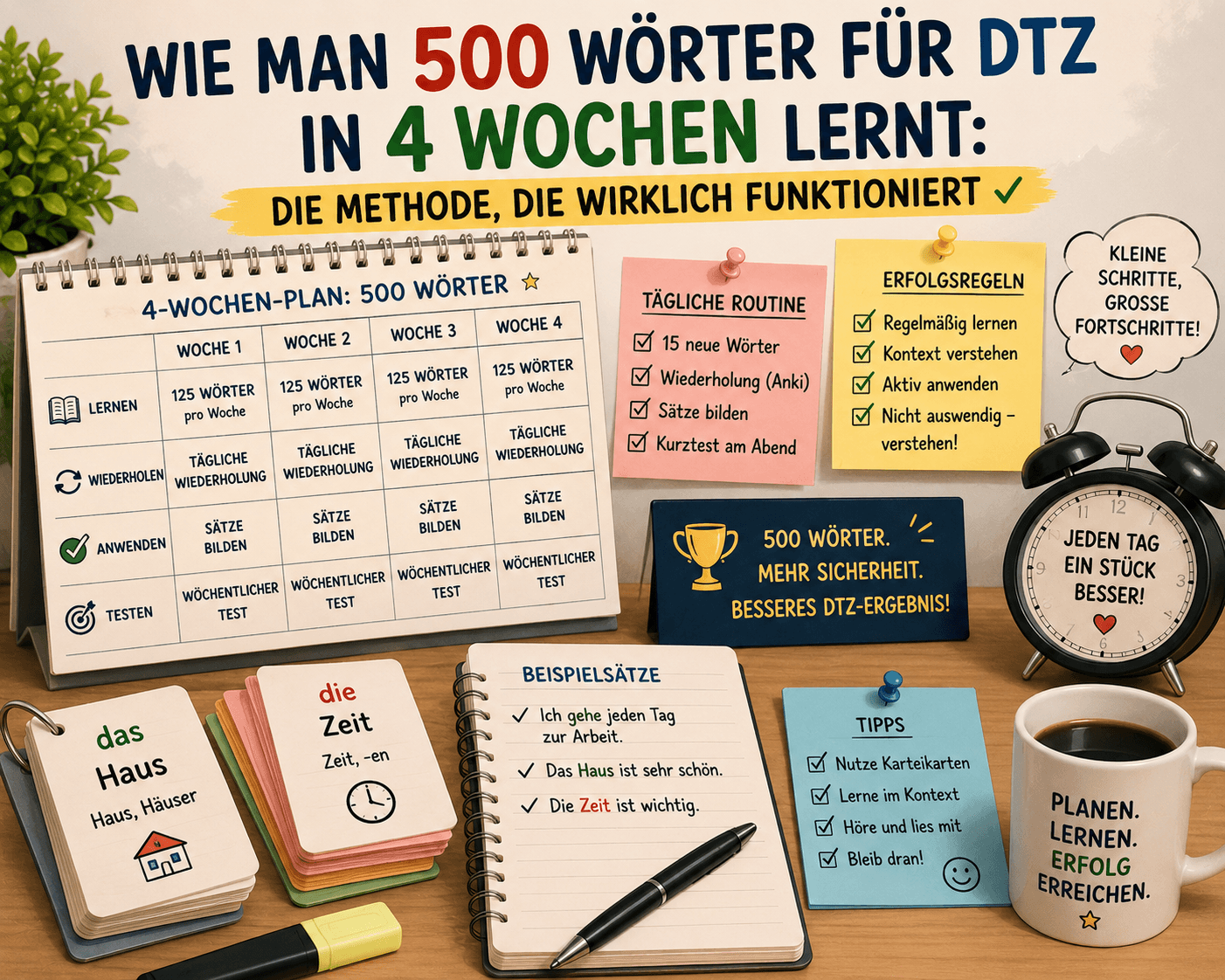
500 DTZ vocabulary in 4 weeks: Spaced Repetition Method with weekly plan
Which 500 words actually appear in the DTZ, how to confidently learn them with Anki in 4 weeks, and why most traditional methods fail — with a concrete daily plan.
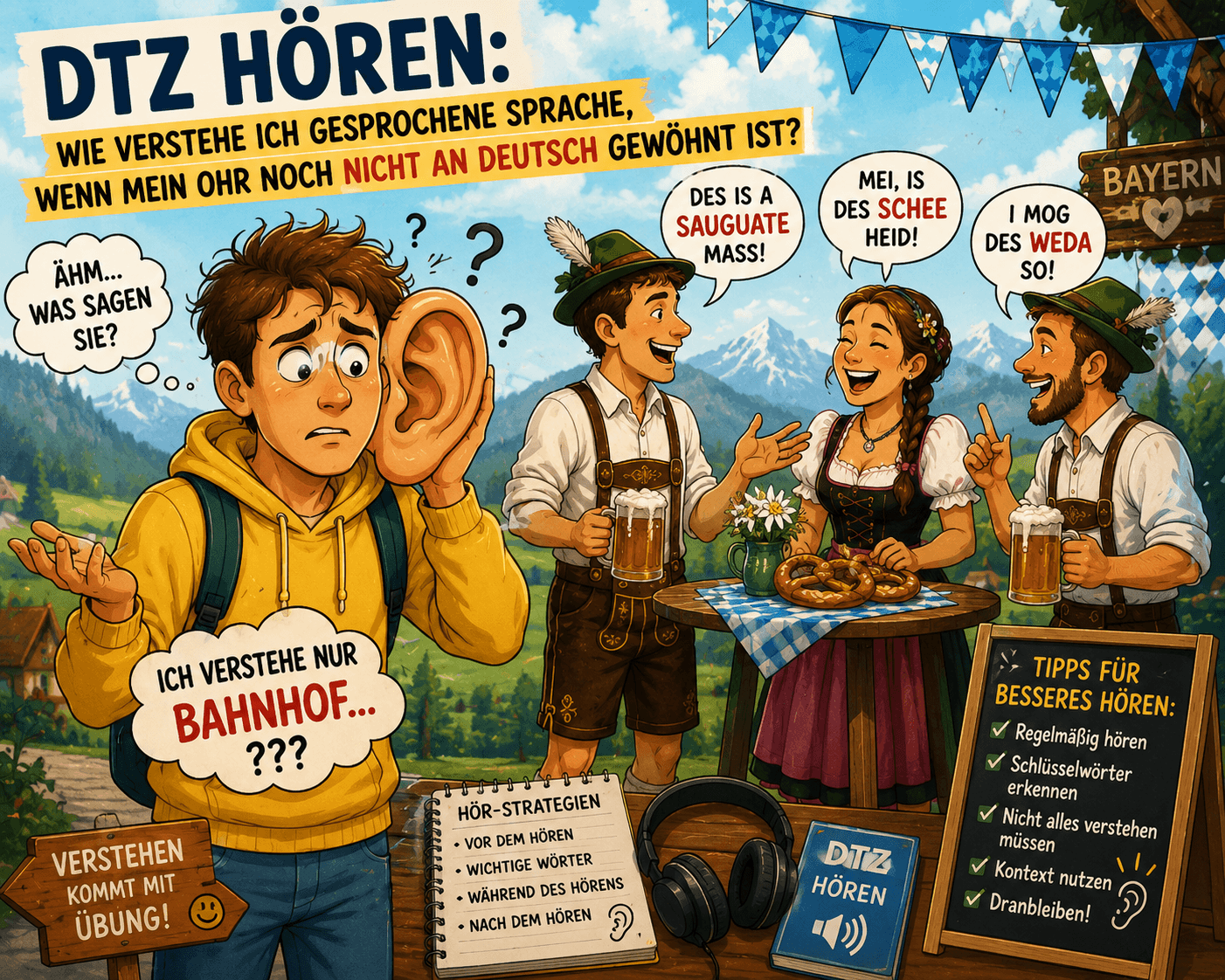
DTZ Listening: How to Understand Spoken German When Your Ear Isn't Used to It Yet
Why does real German sound so different from the textbook version? And how can you train your ear for the DTZ listening test in 6 weeks? Here are 5 concrete techniques, a step-by-step plan, and the best free resources.