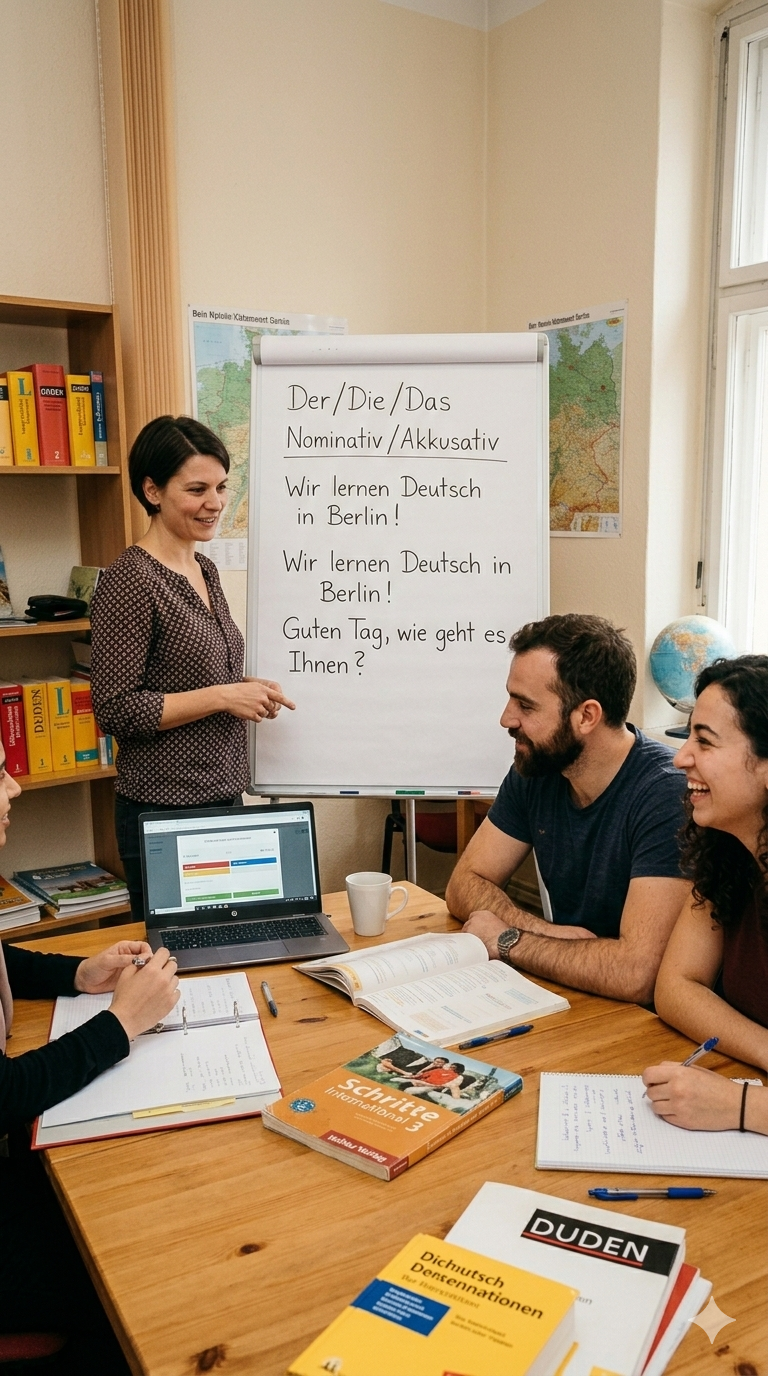
Three Types of Sentences in German: A Simple Explanation for Levels A2–B1
One of the most important topics for passing the DTZ / TELC B1 exam is the correct sentence structure.
Many students know the words but lose points due to:
- incorrect word order
- incorrect verb position
- mistakes with connectors
👉 Good news: all of this can be reduced to 3 simple types of sentences.
⸻
- Verb in 2nd position (Hauptsatz)
This is the main type of sentence used most often.
📌 Rule:
👉 The verb is always in the 2nd position
Connectors:
- und (and)
- oder (or)
- aber (but)
- denn (because)
- sondern (but, after negation)
⸻
Examples:
- Ich lerne Deutsch und ich arbeite viel.
(I am learning German and I work a lot)
- Wir gehen ins Kino oder wir bleiben zu Hause.
(We go to the cinema or we stay at home)
- Ich will kommen, aber ich habe keine Zeit.
(I want to come, but I have no time)
- Ich bleibe zu Hause, denn ich bin krank.
(I stay at home because I am sick)
- Ich trinke nicht Kaffee, sondern ich trinke Tee.
(I don’t drink coffee, but I drink tea)
⸻
✅ Important:
After these words, the word order does not change
⸻
- Verb at the end (Nebensatz)
These are more complex sentences that give you more points on the exam 💪
📌 Rule:
👉 The verb goes to the end of the sentence
⸻
Connectors:
- dass (that)
- weil (because)
- wenn (if / when)
- als (when in the past)
- ob (whether)
- obwohl (although)
⸻
Examples:
- Ich weiß, dass du müde bist.
(I know that you are tired)
- Ich bleibe zu Hause, weil ich krank bin.
(I stay at home because I am sick)
- Wenn ich Zeit habe, komme ich.
(If I have time, I come)
- Als ich klein war, spielte ich viel.
(When I was little, I played a lot)
- Ich weiß nicht, ob er kommt.
(I don’t know whether he is coming)
- Ich gehe spazieren, obwohl es kalt ist.
(I go for a walk although it is cold)
⸻
Tip: practise what you've just read with interactive exercises — it sticks better.
Start B1 exercises →✅ This is exactly the type of sentence that raises you to level B1+
⸻
- Inversion after connectors (Position 1 → Verb)
This is the third type, often underestimated, but very important for Schreiben and Sprechen.
📌 Rule:
👉 If the sentence starts with a connector → the verb immediately follows it
⸻
Connectors:
- deshalb / darum / deswegen (therefore)
- dann (then)
- danach (after that)
- trotzdem (nevertheless)
- außerdem (besides)
⸻
Examples:
- Ich habe viel gearbeitet, deshalb bin ich müde.
(I worked a lot, therefore I am tired)
- Er lernt viel, darum spricht er gut Deutsch.
(He studies a lot, therefore he speaks German well)
- Ich habe keine Zeit, deswegen komme ich nicht.
(I have no time, therefore I am not coming)
- Ich komme nach Hause, dann esse ich.
(I come home, then I eat)
- Ich mache Hausaufgaben, danach gehe ich spazieren.
(I do homework, after that I go for a walk)
- Es ist kalt, trotzdem gehe ich spazieren.
(It is cold, nevertheless I go for a walk)
- Ich lerne Deutsch, außerdem arbeite ich viel.
(I learn German, besides I work a lot)
⸻
Conclusion (this is important for the exam)
To pass B1, you need to:
✅ use all 3 types of sentences
✅ combine simple and complex structures
✅ show logic through connectors
⸻
Quick scheme for memorization:
- Type 1 → verb in 2nd position
- Type 2 → verb at the end
- Type 3 → after connector → verb immediately
⸻
💡 Little lifehack:
If your text has weil, dass, obwohl + deshalb, trotzdem — you already look like B1/B2 😉
Ready for B1 exercises?
Don't just read — practice now! Hundreds of interactive exercises, audio tasks and exam training are waiting for you.
War dieser Artikel hilfreich?
Ähnliche Artikel

The difference between A2 and B1: What really changes — and how I made the leap.
What is really the difference between A2 and B1 in German? A personal experience report with 3 surprising facts, 5 tips — and an encouraging conclusion.
DTZ not passed: Consequences for residence permit, settlement permit, and naturalization
What really happens if you fail the DTZ? Consequences for residence permit, settlement permit, and naturalization — clearly explained with the current status in 2025.
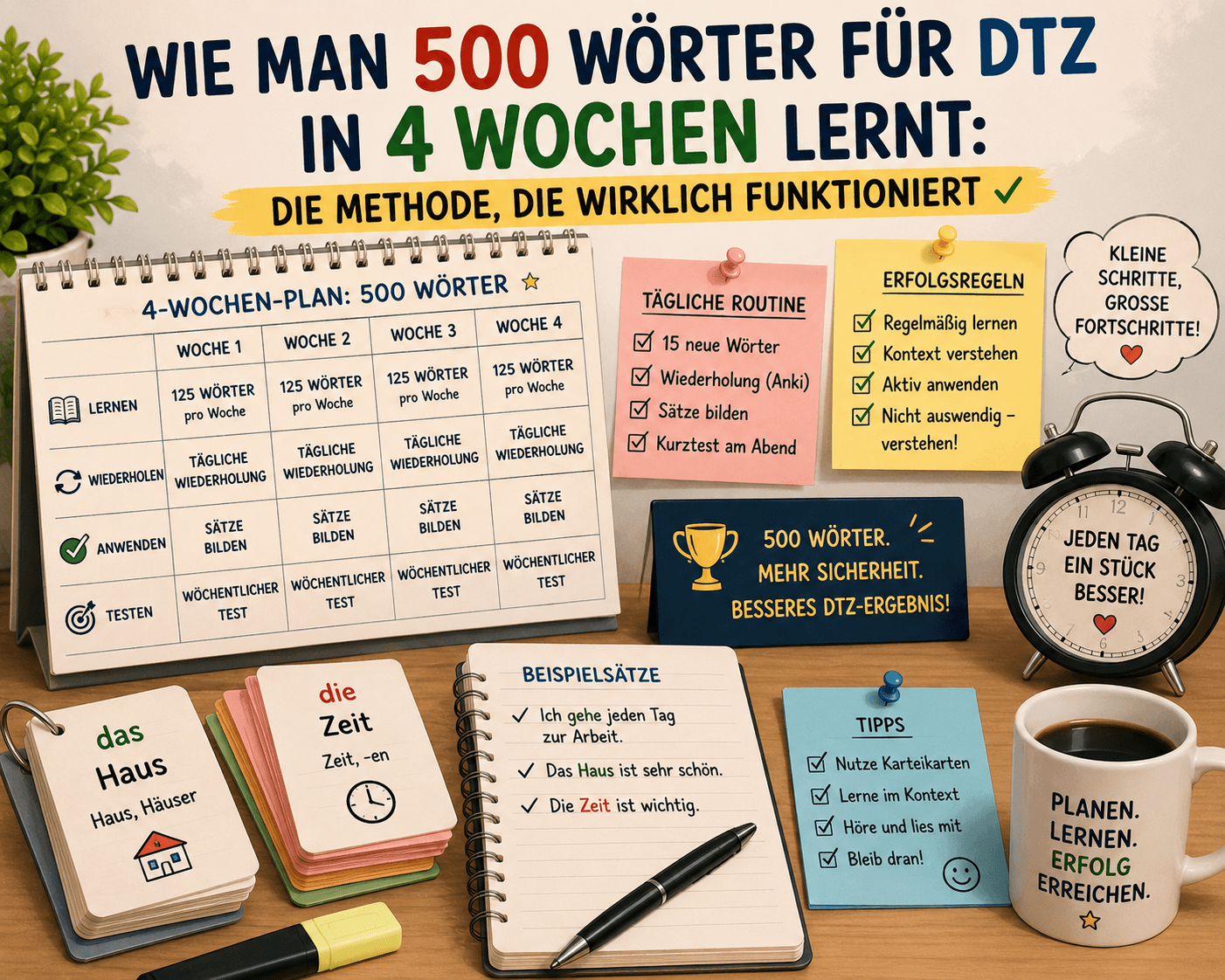
500 DTZ vocabulary in 4 weeks: Spaced Repetition Method with weekly plan
Which 500 words actually appear in the DTZ, how to confidently learn them with Anki in 4 weeks, and why most traditional methods fail — with a concrete daily plan.