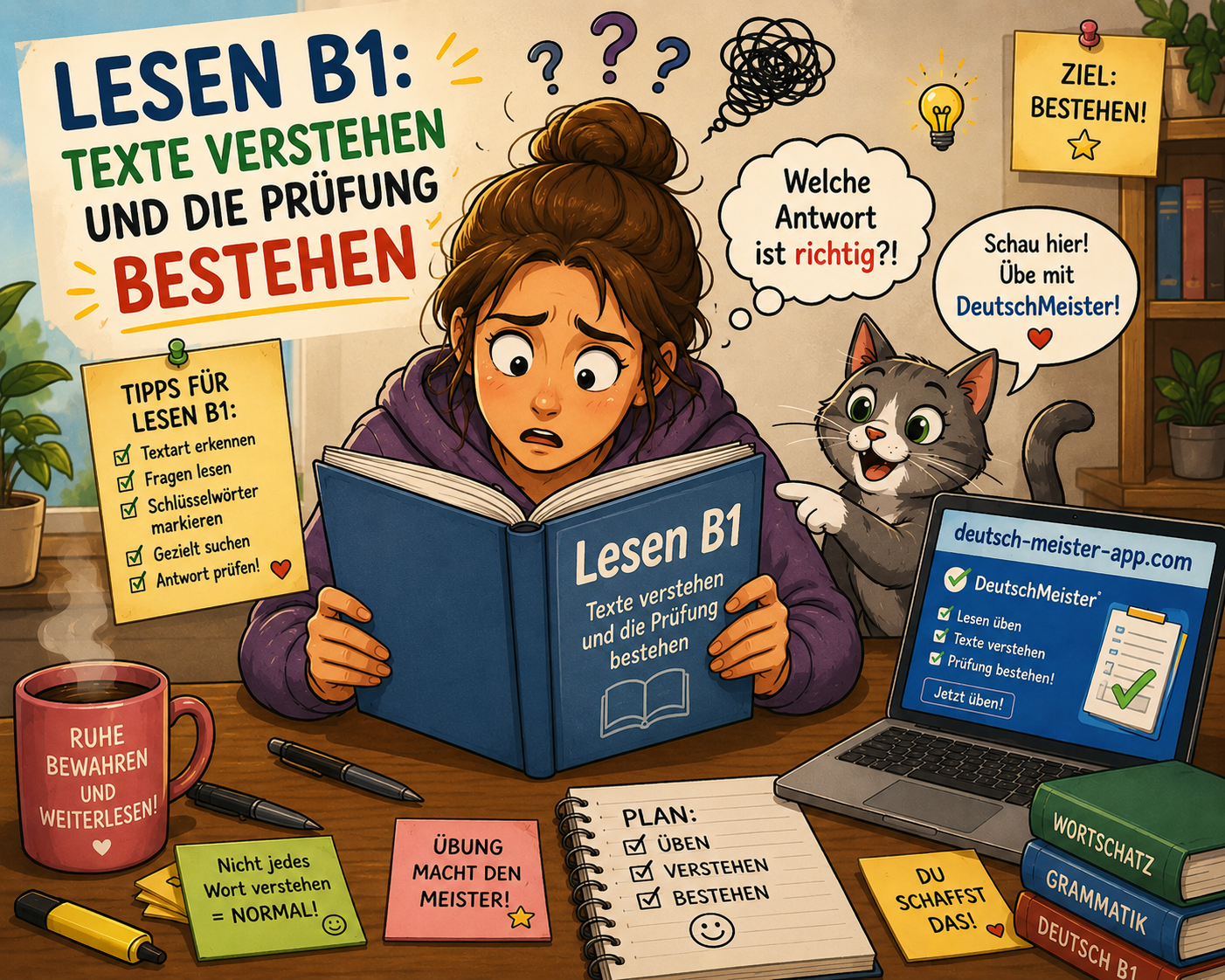
DTZ/TELC Reading B1: Understanding Texts and Passing the Exam
DTZ Reading B1: Understanding texts and passing the exam
Reading strategies, structure of all five parts, typical mistakes, and a practice plan – everything you need for a secure result in the reading part.
Imagine this situation: You are sitting in the DTZ exam, opening the reading part – and immediately feel nervous. The texts seem long, some words are unfamiliar, and the 45 minutes melt away like snow in spring. Do you know this feeling?
The problem is usually not that your language level is too low. Often, it’s simply the lack of the right reading strategy. Reading and understanding in the exam is not the same as reading a book at home. It’s a skill that can be specifically trained – and that’s exactly what this article is about.
Why reading comprehension is more than just knowing words
Tip: practise what you've just read with interactive exercises — it sticks better.
Start B1 exercises →Many think: “If I learn enough words, I will understand texts." This is only partly true. Good reading comprehension depends on three factors at the same time.
Vocabulary
Without a solid basic vocabulary at A2–B1 level, texts remain incomprehensible. But it’s not necessary to know every word.
Reading strategy
Where in the text the answer is and how to avoid unnecessary reading – this directly influences the exam result.
Understanding text structure
Different types of texts (advertisements, articles, letters) follow different logic. Knowing the structure allows for faster work.
Time management
In DTZ Reading, there are 45 minutes for 5 parts. Without clear time allocation, there will be no time left at the end – even if the language skills are good.
3 reading strategies for the DTZ exam
Before we explain the structure of the reading part, three fundamental reading strategies are important – and the question of when to apply which.
1. Skimming – Browsing
What it is: You quickly read through the text to grasp the main theme. No word-for-word reading – just headings, first sentences of paragraphs, highlighted words.
When to apply: At the beginning in parts 3 and 4 (newspaper texts, brochures). This takes 30–60 seconds, but you get a “text map".
Practice: Take any article from nachrichtenleicht.de and say in 30 seconds what it’s about – without reading it completely.
2. Scanning – Targeted searching
What it is: You look for a specific piece of information – a number, a name, a date, a keyword – without reading the entire text.
When to apply: In part 1 (catalogs) and part 2 (advertisements). You already know what you are looking for – now you find it in the text.
Practice: Open a German timetable or menu and find a specific piece of information in 20 seconds without reading everything.
3. Intensive reading – for more difficult parts
What it is: Slow, careful reading to understand the exact meaning of a sentence, the author's opinion, or a nuance.
When to apply: In part 3 (opinion texts) and part 5 (gap text). Here, accuracy counts, not speed.
Structure of the DTZ Reading part: 5 sections in detail
The reading part of the DTZ consists of exactly five parts. Each has a different type of text, a different task, and a different strategy. Knowing this in advance means feeling secure in the exam.
| Part | Type of text | Task type | Tasks | Strategy + Tip |
|---|---|---|---|---|
| Part 1 | Catalogs, directories, timetables | Find the matching entry from 8 options (5 tasks) | 5 | Scanning. Read the task first, then search in the text. Time: ~7 min. |
| Part 2 | Advertisements, short texts | Multiple choice (a/b/c) – correct information from the advertisement | 5 | Scanning + recognizing distractors. Time: ~8 min. |
| Part 3 | Newspaper articles, opinions, reports | True / False – does the statement match the text? | 3 | Read carefully – formulations count. Time: ~9 min. |
| Part 4 | Informational brochures, official texts | Multiple choice (a/b/c) – understanding detail information | 6 | Skimming + intensive reading of targeted sections. Time: ~12 min. |
| Part 5 | Letter or email with gaps | Select the correct word from three options (a/b/c) for each gap | 6 | Grammar + context. Read the sentence before and after the gap completely. Time: ~9 min. |
Example task Part 4 – with explanation
Part 4 is one of the more challenging sections of the reading part. Here you will see how to best approach such tasks.
The city library is open Monday to Friday from 9 AM to 8 PM. On Saturday, it closes at 4 PM. The library is closed on Sundays.
For an annual membership, adults pay 20 euros. Children and teenagers under 18 years old and students with ID receive membership for free. Retirees pay a reduced fee of 10 euros.
Books can be borrowed for four weeks. An extension is possible once – in person, by phone, or online.
a) Also on Sundays until 12 PM
b) Monday to Friday until 8 PM ✓ correct
c) Saturdays until 8 PM
a) All people under 25 years old
b) Only children under 10 years old
c) Children, teenagers, and students ✓ correct
a) As often as you like
b) Once ✓ correct
c) Twice
Try real DTZ tasks directly – Level B1
Theory is good, practice is better. Those who regularly train with real exam tasks recognize typical formulations, text structures, and traps – and enter the exam day calm and prepared.
To the exercisesHow to improve your reading comprehension daily
The reading part in the exam is just a check of what you already can do. To perform well, train regularly – not only with practice tasks but also in real everyday situations.
Read 15 minutes daily
15 minutes daily are more effective than three hours once a week. Regularity is key.
Choose texts at A2–B1 level
Too difficult texts can be demotivating. Choose material that is one level above your current level.
Don’t reach for the dictionary immediately
Try to deduce the meaning of unknown words from the context. This trains real exam competence – without a dictionary.
Learn new words in context
Write down not just the word alone, but the whole sentence. “The library is closed on Mondays" sticks better in memory than just “the library".
Read different types of texts
Advertisements, letters, articles, brochures – each type of text has its own logic. The more formats you practice, the broader your preparation.
Practice with a time limit
Practice with a stopwatch. Get used to not stopping at an unknown word – this is crucial in the exam.
Typical mistakes in DTZ Reading – and how to avoid them
This wastes unnecessary time. The right approach: Read the question first, then search for the answer in the text.
If you don’t know a word – there’s no reason to panic. Try to understand the meaning of the sentence without that word. For most tasks, this is completely sufficient.
Wrong answer options often intentionally contain words from the text – to confuse. The content is important, not the similarity of words.
Part 5 seems difficult – but it only has 6 tasks with a clear format. When in doubt: Eliminate two unlikely options and choose between the remaining ones. Never leave it empty.
45 minutes means just under 9 minutes per part. If you take too long on one part, you risk having no time left for others. Each task counts equally.
Reading books is useful, but not sufficient. DTZ Reading has a specific format: certain task types and time pressure. Train exactly this format.
Your step-by-step preparation plan
Learn the structure of all 5 parts in detail. Do a complete practice set from g.a.s.t. without a time limit – just to see what the tasks look like.
Practice skimming and scanning separately. Daily 10 minutes: Find a specific piece of information in a text within 30 seconds.
Nachrichtenleicht, DW Deutsch lernen, simple newspaper articles. Read different types of texts: advertisements, letters, brochures.
Practice each part individually with a time limit. Analyze mistakes: Why did you choose the wrong answer?
Take a complete reading test in 45 minutes – just like in the exam. Only repetition, no new material.
Useful resources for reading comprehension
Nachrichtenleicht.de
Real news at A2–B1 level. Ideal for daily reading.
nachrichtenleicht.de →g.a.s.t. Practice set DTZ
Free official practice set with real reading tasks in DTZ format.
gast.de/dtz →DW Deutsch lernen
Texts, exercises, and podcasts at levels A1–B2 from Deutsche Welle.
learngerman.dw.com →DeutschMeister
All 5 reading parts in the exact DTZ/telc B1 format – with explanations and progress tracking.
deutsch-meister-app.com →Frequently asked questions about DTZ Reading
Practice now with real DTZ tasks at Level B1
On DeutschMeister, you will find all 5 reading parts in the exact DTZ/telc B1 format – with explanations for correct answers and progress tracking.
To the exercisesReady for B1 exercises?
Don't just read — practice now! Hundreds of interactive exercises, audio tasks and exam training are waiting for you.
War dieser Artikel hilfreich?
Ähnliche Artikel

I almost failed at B1: what no one told me about the structure of the German exam.
A personal story about preparing for the DTZ B1 — and the lessons one should better read before opening the first textbook.

The difference between A2 and B1: What really changes — and how I made the leap.
What is really the difference between A2 and B1 in German? A personal experience report with 3 surprising facts, 5 tips — and an encouraging conclusion.
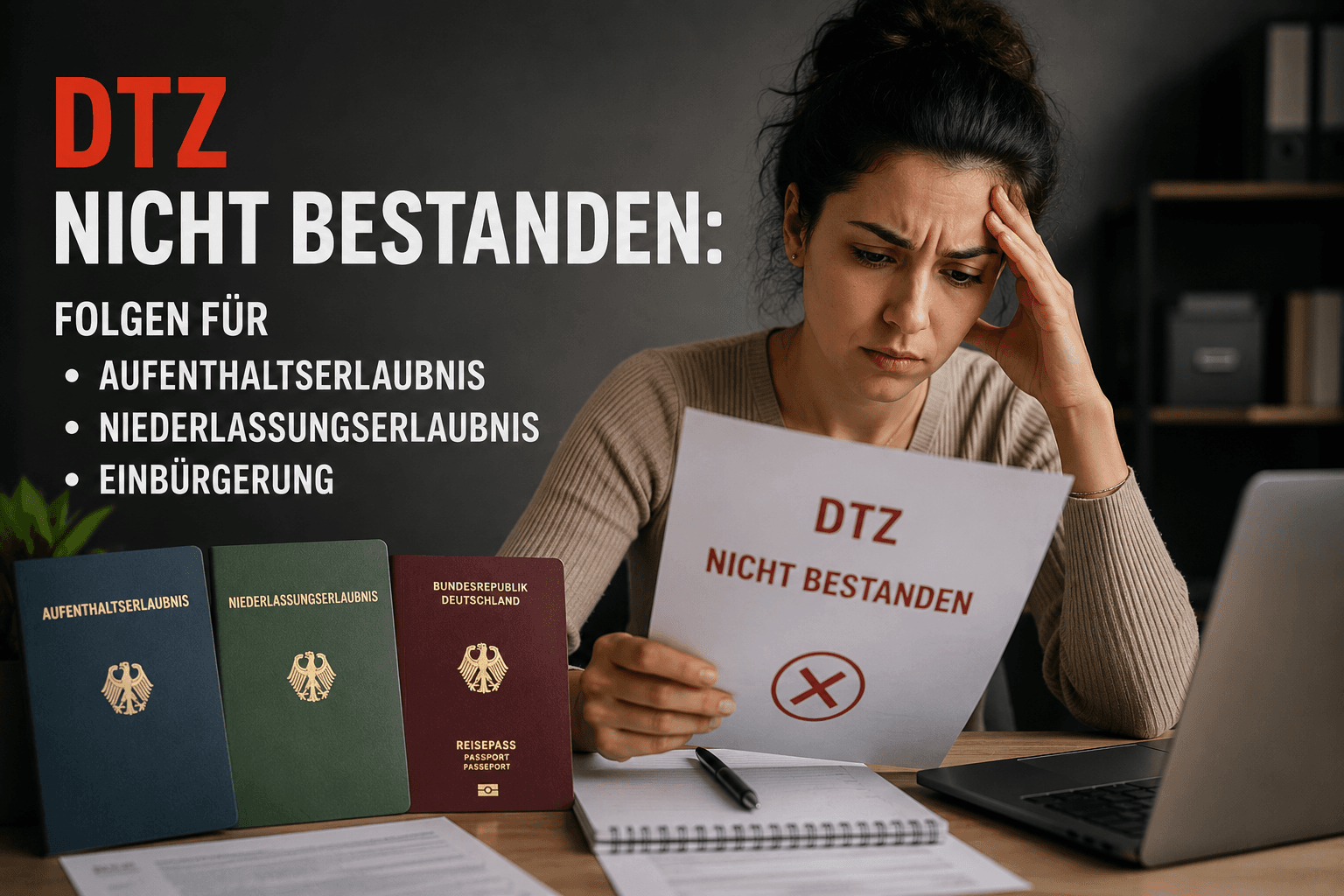
DTZ not passed: Consequences for residence permit, settlement permit, and naturalization
What really happens if you fail the DTZ? Consequences for residence permit, settlement permit, and naturalization — clearly explained with the current status in 2025.