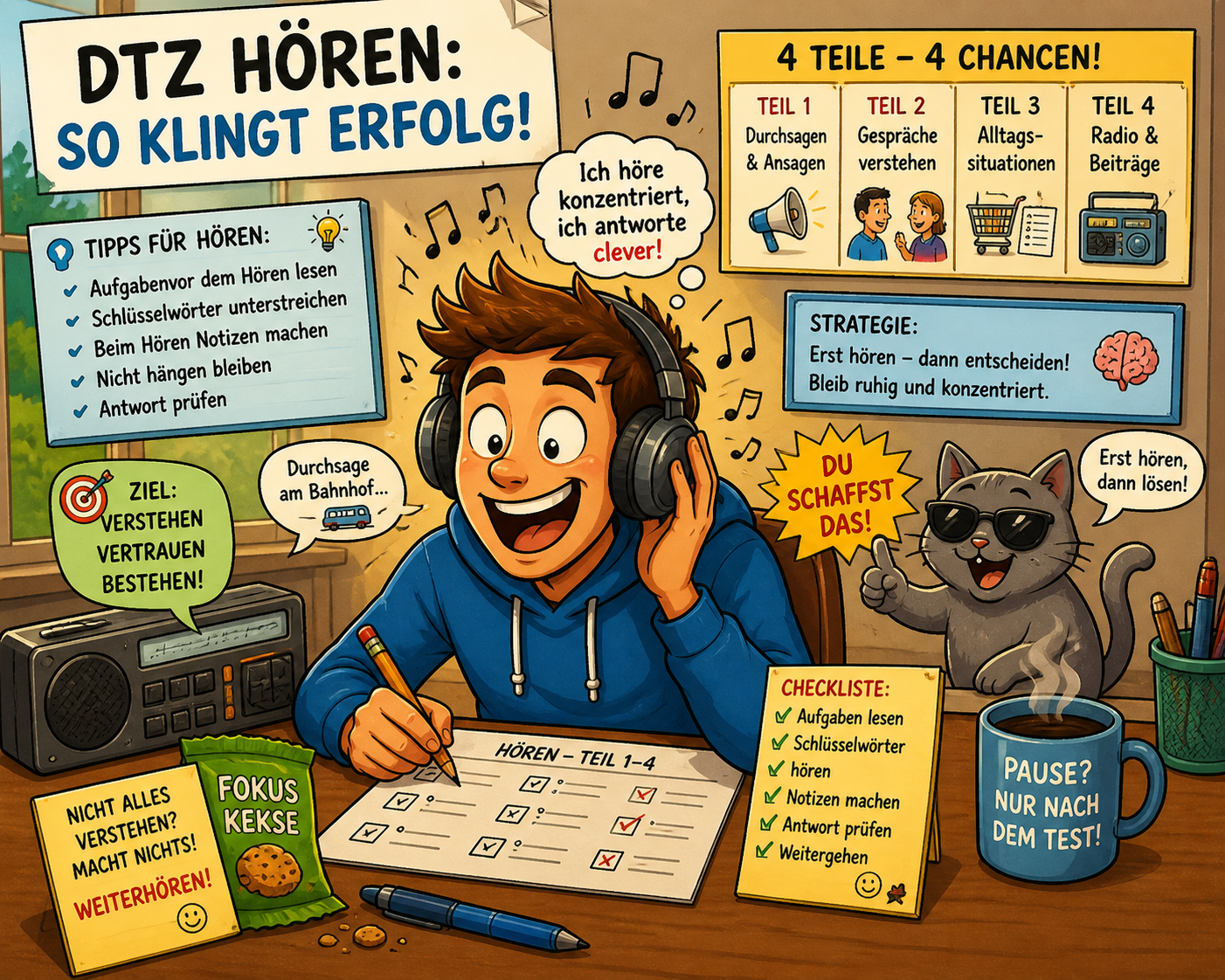
How to change the result 30 seconds before the audio
There is this one moment that many know: The texts in the textbook are already going quite well, the grammar is solid — but then the audio plays, and something is off.
The words sound somehow familiar, but by the time the brain has processed them, the speaker is already saying the next sentence. And in the end, the exam questions feel strangely detached from what was just heard.
This is not a language problem. It is a problem of listening technique — and it can be solved faster than you think.
The listening part of the DTZ B1 has a very specific structure, and each of the four sections requires its own strategy. Those who know them don’t just listen anymore — they listen purposefully.
The difference becomes apparent after just a few practice runs.
This is how the DTZ listening test is structured: 4 parts, 16 tasks, 25 minutes
Listening and reading together form a joint exam block — “Listening and Reading” — with a total of 70 minutes (25 for listening, 45 for reading).
The maximum score for this block is 45, of which 16 points are for listening. For level B1, you need at least 33 to 45 points combined — that is, listening and reading counted together.
| Part | What you hear | Task type | Tasks | Points |
|---|---|---|---|---|
| 1 | Telephone announcements and public announcements | 4 multiple-choice tasks (a / b / c) | 4 | 4 |
| 2 | Short media contributions, radio, information blocks | 5 multiple-choice tasks (a / b / c) | 5 | 5 |
| 3 | Everyday conversations — conversation between two people on a familiar topic | 4 true/false + 4 multiple-choice (a / b / c) | 8 | 8 |
| 4 | Discussion or interview — different opinions of several people on a topic | 3 matching tasks (who said what) | 3 | 3 |
Each section is played twice — you should know this beforehand. So if you didn’t understand something the first time, you get a second chance on the second play.
But only if you know exactly where you missed something — that’s why taking notes during the first listening is mandatory.
Important about the point distribution
Listening and reading are graded as a joint block.
If you do excellently in reading (29 out of 29 points) but poorly in listening (5 out of 16), you get 34 points — which is formally B1.
But if reading is also weak, listening pulls the entire block down.
Never underestimate listening as “less important.”
3 real reasons why you don’t understand anything — even though you know the grammar
Most believe that poor listening comprehension means a poor language level. In reality, there are three different problems — and each has a different solution.
Reason 1: Reductions and connected pronunciation
The textbook says: “Ich habe das nicht gewusst.” But a native speaker says more like: “Ich hab das n'gewusst.”
Two unstressed syllables merge, “nicht” is shortened, the speed is that of a normal conversation. Those who know German only from books and slow recordings simply have never heard this real pronunciation.
Solution: Listen to as much real, unprocessed German as possible.
Easy German on YouTube is ideal: real people, natural language — with subtitles for checking. After 2–3 weeks of regular watching, the ear gets used to the real speaking speed.
Reason 2: The brain translates instead of understanding
As long as the level is still below B1, the brain automatically tries to translate every word into the mother tongue. While it is still working on the first sentence, the speaker is already saying the third.
Translating and understanding are two different processes — and in the exam, only one helps.
Solution: Train “thinking in German” — try to grasp the content directly while listening, instead of translating words.
Helpful: just 15 minutes of radio background or a podcast daily trains the brain to perceive German as a language — not as a code to decode.
Reason 3: You don’t know what to pay attention to
The most common mistake in listening: trying to understand everything. For B1, that’s not necessary at all.
What is asked for are concrete pieces of information — time, place, name, a person’s attitude, main statement. Everything else is background noise.
Those who want to hear “everything at once” lose focus and miss exactly the most important.
Solution: Read the questions before the audio. This way you know exactly what you are looking for — and listen purposefully instead of passively.
The right strategy for each listening part
One rule applies to all four parts: Read the questions before the audio starts — not afterwards.
In the task booklet and on the answer sheet there is a short pause between the instruction and the start of the recording — use this. Beyond that, each section has its own peculiarities.
Part 1: Telephone announcements and public announcements
What you hear: Short automatic announcements — for example, a voicemail, a train station announcement, or information about opening hours. One recording — one question.
What is asked: A concrete fact — time, date, what to do, where to turn to.
STRATEGY
Look at the three answer options (a, b, c) before listening and mark the keywords that differentiate them — usually numbers, times, or actions.
While listening, only look for these keywords — everything else is unimportant.
Example: If the options are “at 9 o’clock,” “at 11 o’clock,” and “in the afternoon” — listen for the time. Filter out everything else.
Part 2: Short media contributions and information blocks
What you hear: Five short, independent contributions — like a news block on the radio. Each is about something different: weather, traffic, an event, a report. There are short pauses in between.
What is asked: One question per contribution — the main information or a concrete fact.
STRATEGY
The first words of each contribution often name the topic: “Today in traffic…”, “The weather tomorrow…”, “A new law…”. This is a hint as to what to pay attention to next.
Answer immediately after each contribution — don’t wait for the end of the entire block.
Common trap: Spending too long on a difficult spot and missing the next contribution. If something is unclear — mark “b” and move on.
Part 3: Everyday conversations — 8 tasks, most weight
What you hear: A longer conversation between two people — a shopping trip, a doctor’s appointment, a booking, a problem solution. Natural and lively, with real reactions.
What is asked: First 4 true/false statements, then 4 multiple-choice questions (a/b/c). A total of 8 tasks — more than in any other section.
STRATEGY
For true/false, the statements follow the order of the conversation. You can use this: If you know that task 11 belongs to the beginning of the conversation and task 12 to the middle, you can set mental markers while listening.
Especially important for true/false: The exact meaning counts. If the audio says “furnished room,” but the statement says “cheap room” — that is false, even if the room might actually be cheap.
Don’t add anything.
Part 3 brings 8 points — more than any other listening section. It’s worth investing especially much practice time here.
Part 4: Discussion or interview — who said what
What you hear: A conversation between two or three people with different viewpoints on a topic — for example, pros and cons of moving to the city, opinions about the new school, or discussion about working hours.
What is asked: 3 matching tasks. You get a list of statements and a list of people — and you have to assign who expressed which opinion.
Sometimes one person has several statements, sometimes some statements belong to no one.
STRATEGY
Before listening: remember or note the names of the people.
While listening: pay particular attention to who is speaking and recognize signal words for opinions: “I think,” “in my opinion,” “I am against,” “I believe that …”.
The people often rephrase statements — so it’s not about finding exact words from the text, but understanding the meaning of the statement.
This makes this section the hardest in the listening part.
Note: If someone agrees with another person’s opinion, that doesn’t mean it is their own statement — check whether they originally expressed it themselves.
The pre-reading technique: How 30 seconds before the audio changes the result
Tip: practise what you've just read with interactive exercises — it sticks better.
Start B1 exercises →This is the simplest and most effective tip for the listening part — and yet most ignore it the first time.
The core: Read the questions and answer options before the recording starts — not afterwards.
Why does that make such a difference? Because the brain automatically adjusts to search for specific information as soon as you know the question.
You hear the same audio — but in a completely different way: purposefully instead of passively.
How pre-reading works in practice
- The start of the section is announced — there are a few seconds left until the first recording. Quickly skim all questions of this section.
- Mark keywords in the answer options — numbers, verbs, names, places. Underline or circle them in the task booklet.
- While listening: keep the pen on the correct line and mark immediately as soon as the answer is heard. Don’t wait for the end of the recording.
- On the second run: only check the questions again where you were unsure. Skip already secured answers.
5-week plan for listening comprehension: From “I hardly understand anything” to confident B1
Five weeks are enough to noticeably improve listening comprehension — if you proceed purposefully.
The logic of the plan: First get the ear used to real language, then get to know the exam format, then refine through practice tests.
Week 1: Train the ear — listen to real language
Daily (20 min.): One Easy German video on YouTube with subtitles. Watch twice: first without subtitles and try to grasp the content; then with subtitles for checking.
Goal of the week: Get the brain used to natural speaking speed and rhythm.
Week 2: Get to know the DTZ listening format
Daily (25 min.): Work through the official practice set from g.a.s.t. — only the listening part.
No time pressure: Analyze each task thoroughly. Why is the correct answer correct? Where in the audio was the decisive information?
Goal of the week: Know each task type from the inside.
Week 3: Strengthen weak sections purposefully
Based on the results from week 2: Identify the most difficult section. Look for further exercises in the same format (on learning platforms or in Schritte Plus B1).
In parallel: Daily DW “Langsam gesprochene Nachrichten” — real news, spoken a bit slower. Especially trains part 2.
Goal of the week: Raise the weakest section to the level of the others.
Week 4: Practice tests under exam conditions
Twice a week: Do the complete listening block with a timer — 25 minutes, no breaks, no rewinding. Exactly like in the real exam.
Then: Error analysis.
Goal of the week: Feel the real exam pace, reduce nervousness through habituation.
Week 5: Fine-tuning and maintaining form
Daily (15 min.): One practice listening block or a thematic podcast. Don’t learn anything new — just maintain the level.
One week before the exam: Repeat the strategy for each section once more. In the evenings, 10 minutes of relaxed listening — without tasks, just for the ear.
Goal of the week: Go into the exam well prepared and without unnecessary stress.
What a real listening exercise in exam format looks like
Theory is good — but listening comprehension only improves through actual listening.
To understand what exactly awaits you in the exam, it’s worth working through a real task in the original format once: with audio, time limit, and the same question types that also appear in the DTZ.
What is special about exam-like practice tasks is not only the content but the feeling for the process — when to read the questions, how fast you have to react, how the second run differs from the first.
Those who have experienced this once in a real practice environment go into the exam with a completely different awareness of the time pressure.
Sample task · Listening Part 1 · Level B1
Understanding telephone announcement — multiple choice
In this task, you hear a short announcement — as typically appears in part 1 of the DTZ listening test: a voicemail, a train station announcement, or telephone information. From three answer options, you listen out the correct one. The audio is played twice, with a short pause in between — just like in the real exam.
Start task part 1The exercise opens directly in task mode. After submitting, you see at which point in the audio the solution was found.
Sample task · Listening Part 3 · Level B1
Understanding everyday conversation — true / false + multiple choice
Part 3 brings 8 of 16 possible points in the listening block — that is half. In this task, you hear a natural conversation between two people and first decide which statements are true or false, then choose the correct multiple-choice answers. Exactly the task type that should be trained the most.
Start task part 3After submitting, you receive a detailed evaluation — with explanations why each statement is true or false.
Resources for listening training: What really helps for the DTZ
Not all resources are equally useful for DTZ preparation. Here are those that really fit the format and level of the exam.
| Resource | Why useful for the DTZ | Trains which part | Where to find |
|---|---|---|---|
| g.a.s.t. practice sets | Official material with exactly the format and difficulty level of the DTZ. The only 100% reliable benchmark. | All 4 sections | gast.de/dtz |
| Easy German (YouTube) | Street interviews with native speakers, bilingual subtitles. Trains real speaking speed. | Part 3, Part 4 | YouTube |
| DW Slowly Spoken News | Real news, spoken a bit slower. Ideal for understanding media contributions. | Part 1, Part 2 | dw.com/de/s-7111 |
| Slow German (Podcast) | Monologues on everyday topics, slow tempo, transcript available. Good for beginners. | Part 3 (preparation) | Spotify / Apple Podcasts |
| DeutschMeister | Listening exercises in exact DTZ format — with answer analysis and explanations where in the audio the solution was found. | All 4 sections | deutsch-meister-app.com |
Frequently asked questions about the DTZ listening test
How often is each recording played in the DTZ?
Each section is played twice. There is a short pause between the first and second run.
Use the first run for a general understanding and first answers, the second to check and complete uncertain answers.
Is it allowed to take notes while listening?
Yes. In the task booklet, you may make any markings — underline answer options, put question marks, note heard keywords.
Important though: The answers must be transferred to the official answer sheet — only that is graded.
What to do if you don’t understand a recording at all?
Mark “b” and move on.
Statistically, the middle option “b” in three-choice tasks is slightly more often correct than “a” or “c” — but the more important thing is: don’t get stuck and don’t panic.
Missing one answer out of 16 is one point — and that does not decide the result. Hesitating and panicking can cost three to four more points.
Which listening section is the hardest?
Usually part 4 — where you have to distinguish the viewpoints of several people in a discussion.
The reason: You have to simultaneously follow who is speaking and understand the content.
But part 3 is often difficult too, because there are 8 tasks and conversation details can be easily confused.
If you don’t know where your weakness lies — just do a complete practice test and evaluate the results by section.
Is the listening in the DTZ different from the Goethe or telc B1 test?
Yes, and clearly so. The number of sections, task types, and question format are different.
For example, the listening part in Goethe B1 is structured differently than in the DTZ.
Those taking the DTZ should practice exclusively with g.a.s.t. material — and not with general “B1 exam training” books that may prepare for a different format.
Does watching series help with listening comprehension?
Yes — but with one condition: watch with German subtitles, not with translation.
With translation, you read instead of listen.
Series train understanding of natural language and expand vocabulary, but do not replace targeted practice with the DTZ format.
Use series as a supplement — not as main preparation.
Ready for B1 exercises?
Don't just read — practice now! Hundreds of interactive exercises, audio tasks and exam training are waiting for you.
War dieser Artikel hilfreich?
Ähnliche Artikel

I almost failed at B1: what no one told me about the structure of the German exam.
A personal story about preparing for the DTZ B1 — and the lessons one should better read before opening the first textbook.

The difference between A2 and B1: What really changes — and how I made the leap.
What is really the difference between A2 and B1 in German? A personal experience report with 3 surprising facts, 5 tips — and an encouraging conclusion.
DTZ not passed: Consequences for residence permit, settlement permit, and naturalization
What really happens if you fail the DTZ? Consequences for residence permit, settlement permit, and naturalization — clearly explained with the current status in 2025.