
How to Successfully Pass the German Language Exam (B1): Practical Tips
Preparation for the German language exam (DTZ, telc B1, Goethe B1) often seems difficult and chaotic. Many people study “a bit of everything,” but don’t get results.
The truth is, passing the exam successfully is not just about knowing the language, but understanding the exam format itself.
In this article — key tips that will help you pass the exam faster and more effectively.
⸻
- Understand the exam structure
Most B1 level exams consist of 4 parts:
- Lesen (reading)
- Hören (listening)
- Schreiben (writing)
- Sprechen (speaking)
👉 Important:
Prepare by blocks, not “a little bit of everything.”
⸻
- The main rule: learn the format, not just the language
The most common mistake is trying to learn all German.
✅ The right approach:
- understand the types of tasks
- know typical questions
- use ready-made answer templates
👉 This yields results much faster than just studying grammar.
⸻
- Schreiben (writing): the easiest way to score points
Writing is the part where it’s easiest to get a high score.
What you need to do:
Learn a clear letter structure:
- Einleitung (introduction)
- Hauptteil (main part)
- Schluss (conclusion)
Typical phrases:
- Ich schreibe Ihnen, weil…
- Vielen Dank für Ihre Nachricht.
- Ich würde mich sehr freuen, wenn…
👉 Tip:
Learn 10–15 universal sentences and just adapt them to the topic.
⸻
- Sprechen (speaking): not perfect, but confident
At the exam, it’s important not to speak “perfectly,” but to:
- speak confidently
- not stay silent
- respond to the interlocutor
Useful phrases:
- Das finde ich interessant.
- Da bin ich nicht ganz einverstanden.
- Meiner Meinung nach…
👉 How to practice:
- speak aloud daily
- record yourself
- listen to your mistakes
⸻
Tip: practise what you've just read with interactive exercises — it sticks better.
Start B1 exercises →- Hören (listening): the problem is not words, but speed
Many think they don’t know the words. The real problem is the speed of speech.
How to train:
- listen daily for 10–15 minutes
- listen to the same audio 2–3 times
- first — get the general meaning
- then — focus on details
👉 The best resource is exam samples.
⸻
- Lesen (reading): strategy is more important than translation
❌ Don’t translate every word.
✅ The right strategy:
1. read the question
2. find key words
3. quickly scan the text
👉 This saves a lot of time during the exam.
⸻
- Grammar: only what’s necessary
No need to learn all grammar.
For B1 level, it’s enough to know:
- word order (TEKAMOLO)
- modal verbs
- Perfekt / Präteritum (basic)
- subordinate clauses: weil, dass, wenn
👉 Focus on usage, not theory.
⸻
- The right preparation plan
Here’s a realistic plan that works:
Daily:
- 15 min — listening
- 15 min — reading
- 15 min — writing or speaking
2–3 times a week:
- full practice test
⸻
- The main mistake 90% of people make
❌ Learning words in lists
✅ Correct:
- learn words in sentences
- use them in context
👉 This way words are remembered much faster.
⸻
Conclusion
To pass the B1 exam, you don’t need perfect German.
You need to:
- understand the format
- use templates
- practice regularly
- work with real exam tasks
⸻
💡 Want to prepare as effectively as possible?
Try our platform 👉 deutsch-meister-app.com
Here you will find tasks as close as possible to the real exam.
Ready for B1 exercises?
Don't just read — practice now! Hundreds of interactive exercises, audio tasks and exam training are waiting for you.
War dieser Artikel hilfreich?
Ähnliche Artikel

The difference between A2 and B1: What really changes — and how I made the leap.
What is really the difference between A2 and B1 in German? A personal experience report with 3 surprising facts, 5 tips — and an encouraging conclusion.
DTZ not passed: Consequences for residence permit, settlement permit, and naturalization
What really happens if you fail the DTZ? Consequences for residence permit, settlement permit, and naturalization — clearly explained with the current status in 2025.
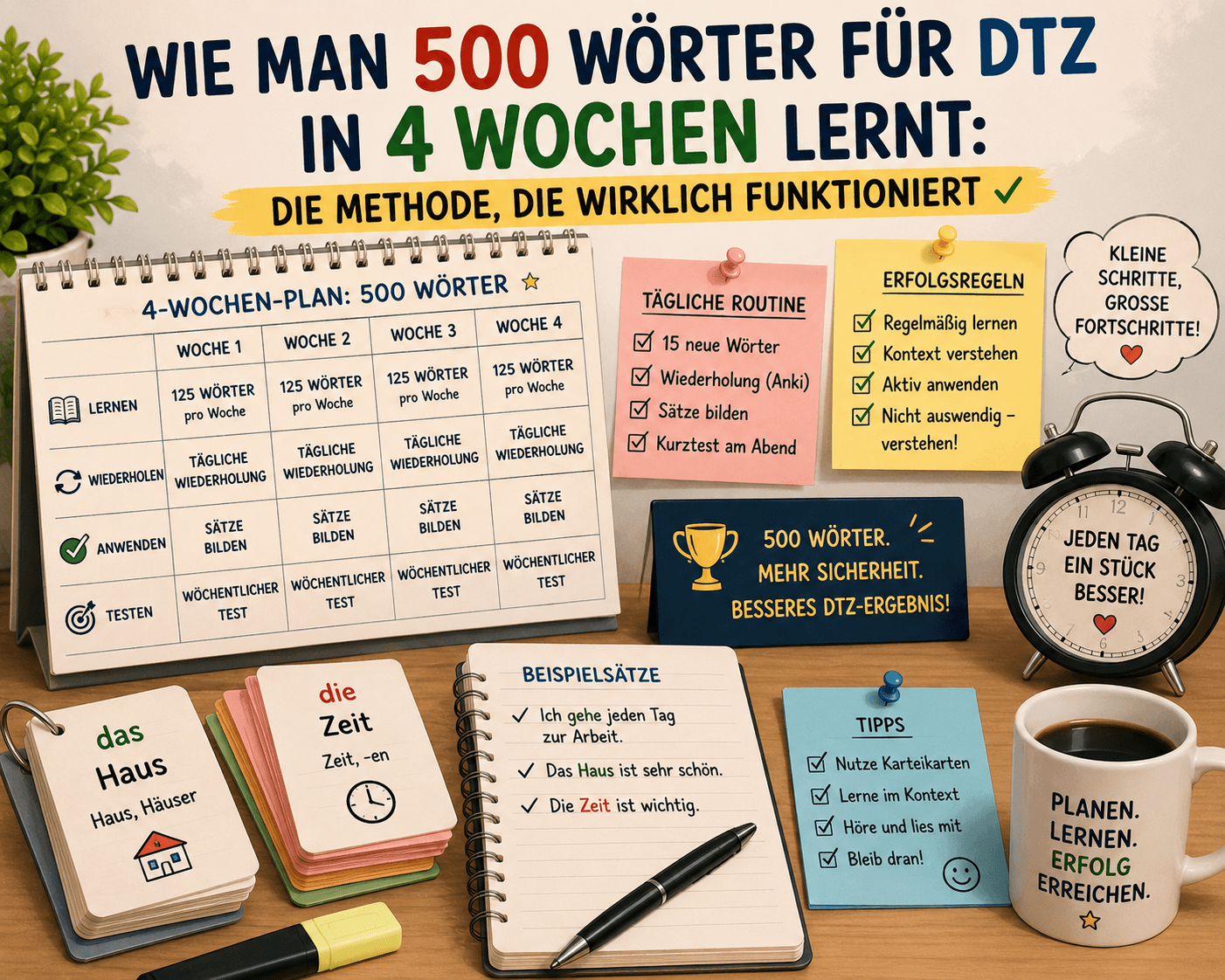
500 DTZ vocabulary in 4 weeks: Spaced Repetition Method with weekly plan
Which 500 words actually appear in the DTZ, how to confidently learn them with Anki in 4 weeks, and why most traditional methods fail — with a concrete daily plan.