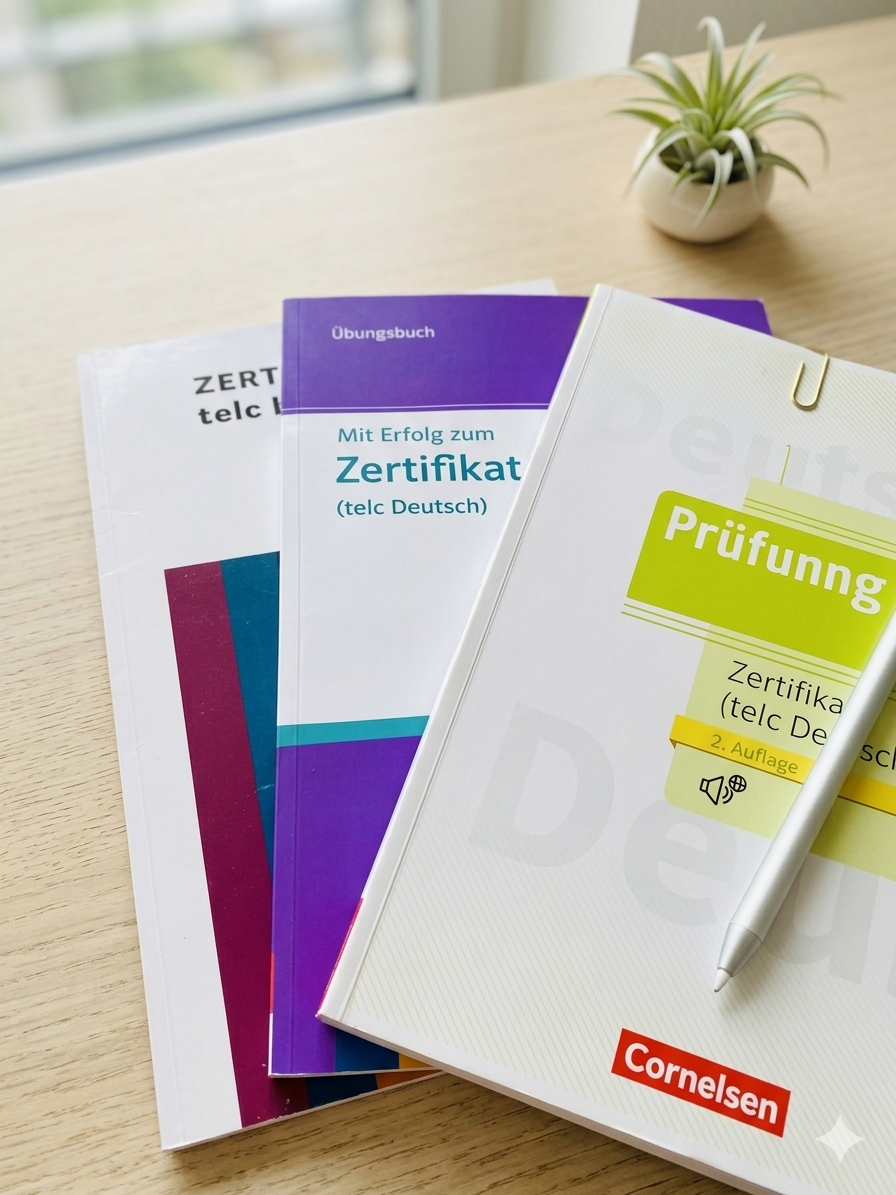
Full Format of the DTZ Exam: Everything You Need to Know Before Registering
Exam Preparation · DTZ / BAMF
Full DTZ Format
DTZ — Deutsch-Test für Zuwanderer — is not just a test. It is an official state exam, the result of which can affect your residence permit, family reunification, and naturalization paths. Before starting preparation, it is important to clearly understand: what this exam is, who takes it, how it is organized, and what exactly is assessed.
CONTENTS
- What DTZ is and who organizes it
- Who takes DTZ and why
- Exam structure: 4 sections
- Scoring system and levels
- How the certificate level is determined
- Exam day rules
- Where to start preparation
- Frequently Asked Questions
1. What DTZ is and who organizes it
DTZ (Deutsch-Test für Zuwanderer) is an official German language exam for migrants in Germany, assessing levels A2–B1 according to the Common European Framework of Reference for Languages (GER). It is the final exam of the BAMF integration course (Bundesamt für Migration und Flüchtlinge).
Since 2023, the administration and conduct of DTZ is carried out by the organization g.a.s.t. (Gesellschaft für Akademische Studienvorbereitung und Testentwicklung e.V.) — one of the leading developers of language tests in Germany, affiliated with Ruhr-Universität Bochum.
EXAM LEVEL
A2 – B1 (GER)
ORGANIZER
g.a.s.t. (since 2023)
CLIENT
BAMF
ADDITIONAL INFO
gast.de/dtz
2. Who takes DTZ and why
DTZ is taken by participants of the BAMF integration course — a mandatory course for migrants from third countries, which includes 600+ hours of language learning and an orientation course. The DTZ exam is the official completion of the course.
The DTZ result is important for:
- ✅ Residence permit: successfully passing DTZ may be a condition for extending or obtaining a permanent residence permit (Niederlassungserlaubnis).
- ✅ Naturalization: confirmation of B1 level is one of the requirements for obtaining German citizenship.
- ✅ Family reunification: for some types of family reunification, language level confirmation is mandatory.
- ✅ Practical significance: regardless of legal requirements — B1 level opens more opportunities for work and social integration.
3. Exam structure: 4 sections
DTZ consists of written (Hören + Lesen + Schreiben) and oral (Sprechen) parts. The written part lasts 100 minutes, the oral part — 16 minutes.
H
Hören — Listening
~25 minutes · 16 tasks · 16 points
Detailed article →
| Teil 1 | Phone and public announcements | 4 Multiple Choice · 1 listening |
| Teil 2 | Media messages | 5 Multiple Choice · 2 listenings |
| Teil 3 | Everyday dialogues | 4 true/false + 4 MC · 2 listenings |
| Teil 4 | Discussion, different opinions | 3 matching · 2 listenings |
L
Lesen — Reading
45 minutes · 25 tasks · 25 points
Detailed article →
| Teil 1 | Catalogs, directories | 5 Multiple Choice |
| Teil 2 | Announcements | 5 matching |
| Teil 3 | Press texts, letters | 3 true/false + 3 MC |
| Teil 4 | Information brochures | 3 true/false |
| Teil 5 | Gap-fill letter | 6 Multiple Choice |
S
Schreiben — Writing
30 minutes · 1 task · max 20 points
Detailed article →
Writing a semi-formal or formal letter in response to a received letter. 4 Leitpunkte. Assessed by 4 criteria (Content, Communicative Design, Accuracy, Vocabulary).
Sp
Sprechen — Speaking CRITICAL
~16 minutes · paired exam · max 100 points
Detailed article →
3 parts: Teil 1 (talk about yourself), Teil 2 (photo), Teil 3 (joint planning). Result below A2 = no certificate regardless of other sections.
4. Scoring system and levels
Tip: practise what you've just read with interactive exercises — it sticks better.
Start B1 exercises →| Section | Max points | B1 Level | A2 Level | Below A2 |
|---|---|---|---|---|
| Hören + Lesen | 45 | 33–45 | 20–32 | 0–19 |
| Schreiben | 20 | 15–20 | 7–14 | 0–6 |
| Sprechen | 100 | 75–100 | 35–74.5 | 0–34.5 |
5. How the certificate level is determined
⚠ Sprechen — mandatory condition. If Sprechen is below A2 — no certificate regardless of Hören+Lesen and Schreiben.
B1 certificate — when possible:
Sprechen B1 AND at least one of the two: Hören+Lesen B1 or Schreiben B1.
A2 certificate — when possible:
Sprechen A2 or higher AND at least one of the two: Hören+Lesen A2 or Schreiben A2.
No certificate — when:
Sprechen below A2 (regardless of other sections). Or: Sprechen A2, but both Hören+Lesen and Schreiben below A2.
6. Exam day rules
ALLOWED ✅
- Identification document
- One or two ballpoint pens
- Drink
FORBIDDEN ❌
- Dictionaries and any auxiliary materials
- Mobile phone and electronics
- Talking with other participants
⚠ The written part (Hören + Lesen + Schreiben) is conducted without breaks — 100 minutes straight. Time for each section is strictly limited and does not carry over to the next.
7. Where to start preparation
-
Download the official Übungssatz from g.a.s.t.
A free exam sample is available at gast.de/dtz. This is your main guide: real format, real task types, real difficulty level. -
Identify your weak spots
Take a practice exam and analyze the results: in which sections are most mistakes? Focus specifically on them. -
Practice under real exam conditions
With a timer, in silence, with an answer sheet. Familiarity with the format and conditions — is a separate skill that significantly affects the result. -
Pay special attention to Sprechen
Even if language comes easily — practice speaking aloud daily. This is the only section where failure cancels the entire exam.
DeutschMeister — a DTZ preparation platform built exactly according to g.a.s.t. methodology. Exercises for all 4 sections, timer, AI-check for Schreiben, and instant answer checking. Start for free.
8. Frequently Asked Questions about DTZ
What is DTZ (Deutsch-Test für Zuwanderer)?
DTZ is an official state German language exam for migrants, which is the final exam of the BAMF integration course. It assesses levels A2–B1. Since 2023, administration is carried out by g.a.s.t. (Bochum).
How many sections are in the DTZ exam?
DTZ consists of 4 sections: Hören (~25 min), Lesen (45 min), Schreiben (30 min), and Sprechen (~16 min). The first three form the written part (100 min without breaks), Sprechen is separate.
How many times can you take DTZ?
DTZ can be retaken. Participants of the BAMF integration course have the right to one retake at the state's expense. Further attempts are paid independently.
Is DTZ different from telc B1 or Goethe B1?
Yes. DTZ is a specific BAMF/g.a.s.t. exam related to the integration course. telc B1 and Goethe B1 are separate certification exams from different organizations. All three confirm B1 level but have different formats and legal applications.
Where to get official DTZ practice materials?
Official free Übungssätze are available at gast.de/dtz. For systematic preparation with automatic checking and AI support — DeutschMeister.
Summary
DTZ is a predictable exam with a clear structure, known criteria, and stable format. A key mistake in preparation is practicing "general language" rather than the real exam format. Know the format of each section, practice under real exam conditions, do not ignore Sprechen — and the result will become much more predictable.
DETAILED ARTICLES ON EACH SECTION
- DTZ Hören: 12 practical tips to pass listening the first time →
- DTZ Lesen: how to read quickly and answer correctly →
- DTZ Schreiben: letter structure and common mistakes →
- DTZ Sprechen: why a low score disqualifies — and how to avoid it →
Ready for B1 exercises?
Don't just read — practice now! Hundreds of interactive exercises, audio tasks and exam training are waiting for you.
War dieser Artikel hilfreich?
Ähnliche Artikel

I almost failed at B1: what no one told me about the structure of the German exam.
A personal story about preparing for the DTZ B1 — and the lessons one should better read before opening the first textbook.

The difference between A2 and B1: What really changes — and how I made the leap.
What is really the difference between A2 and B1 in German? A personal experience report with 3 surprising facts, 5 tips — and an encouraging conclusion.
Shadowing Method German: Improve Pronunciation and Fluency in 4 Weeks
What is shadowing and how does it work? Step-by-step guide, 4-week plan, and the best free resources for shadowing in German — with a focus on DTZ.