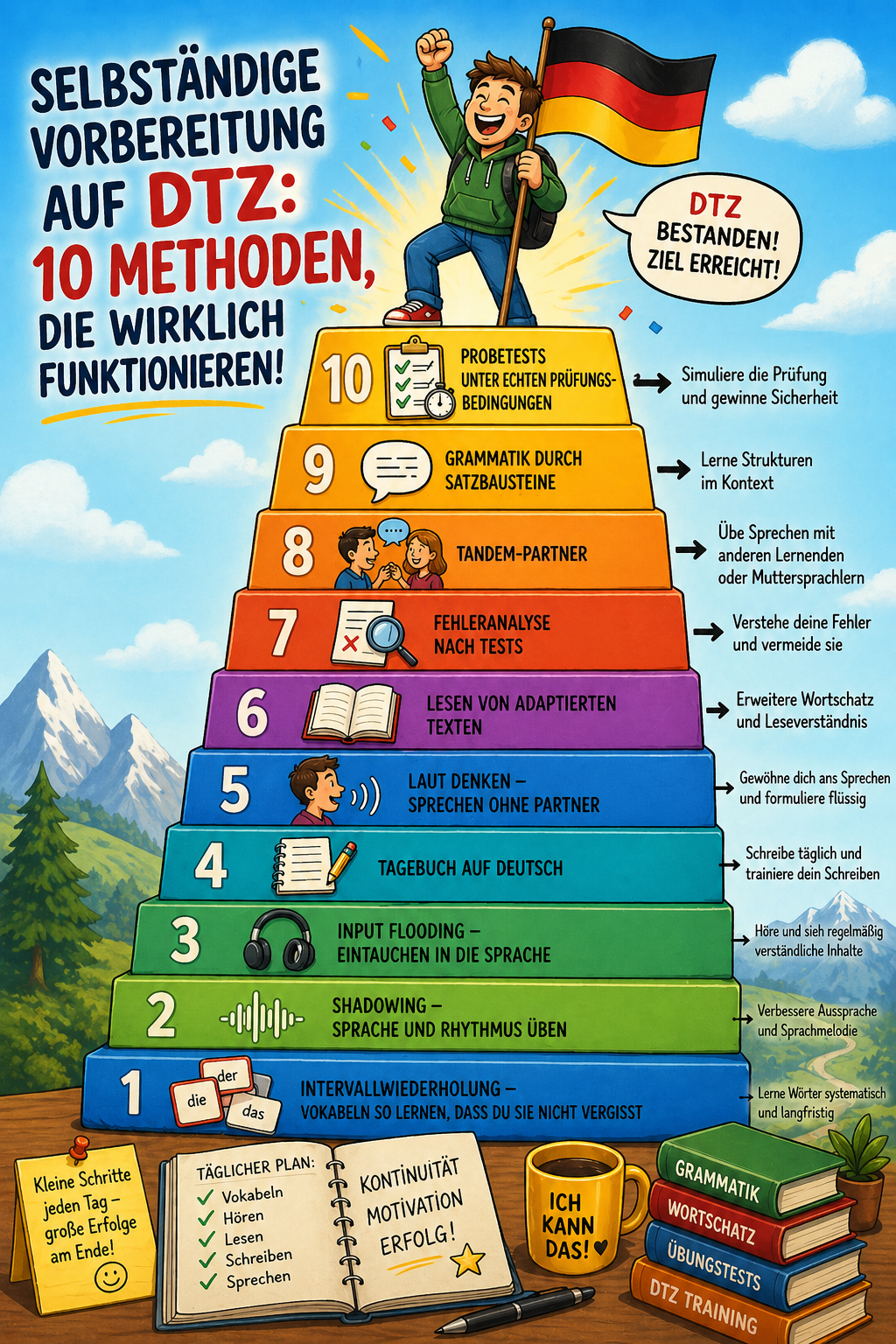
Independent Preparation for DTZ: 10 Methods That Really Work
The integration course is 600 or 900 hours. It sounds like a lot, but if you subtract time for organizational matters, breaks, days when everyone slowly goes through one topic — the actual practice is much less than it seems.
Most people finish the course feeling like they know something, but still cannot speak confidently. And the DTZ exam comes just a few months later.
Self-study is not an alternative to the course, but a supplement to it. Those who study an additional 30–40 minutes daily outside the course come to the DTZ with a completely different confidence.
In this article — ten methods, each tested by real people who prepared for the exam on their own. Not abstract advice like "read more and watch videos," but concrete techniques with explanations on how exactly to apply them.
A myth that costs people nerves:
"If I attended all 600 hours of the course — I am ready for the DTZ." The course provides a base and structure. But the exam checks not whether you learned the language, but whether you can use it in specific situations under time pressure. These two things are trained differently.
Method 1: Spaced repetition — learn words so you don’t forget them
Have you ever learned a new word and a week later couldn’t even roughly remember what it meant? It’s not bad memory — it’s lack of a system.
Spaced repetition is a method based on how human memory really works: a word needs to be repeated exactly at the moment when you are about to forget it.
In practice, it looks like this: you see a new word today, then tomorrow, then after 3 days, then after a week, then after a month.
What to use:
- Anki — free, fully customizable, with ready-made decks for the DTZ vocabulary.
- Quizlet — simpler, has a mobile app, quick to start.
Minimum dose: 15 minutes daily — in the morning or at noon. Don’t skip two days in a row.
Method 2: Shadowing — a technique that sets pronunciation and speech rhythm
Shadowing literally means "to follow like a shadow." You take audio — a podcast, video, dialogue — and try to speak simultaneously with the native speaker.
For DTZ, this is especially useful for preparing for Sprechen: after two to three weeks of regular shadowing, your speech becomes noticeably smoother.
How to practice:
- Choose audio at A2–B1 level.
- Listen to a sentence — pause — repeat aloud.
- When you feel more confident — speak along with the audio.
Good sources: Deutsche Welle "Langsam gesprochene Nachrichten," podcasts "Slow German" by Annik Rubens.
Method 3: Input flooding — immersion without stress
The brain absorbs language most effectively when it receives material that is understandable but slightly more difficult than the current level — "comprehensible input +1."
Practically, this means: replace some entertainment with German-language content.
What to watch and listen to:
- YouTube: Easy German, DW Deutsch lernen, Nicos Weg.
- Podcasts: Slow German, Coffee Break German, Deutsch — warum nicht?
- Series: Dark or Babylon Berlin — with German subtitles.
Method 4: Diary in German
You don’t need to write a lot. Three to four sentences about your day — and that’s enough to keep your writing skill in shape.
You write about real things from your life — and the brain memorizes words in context.
How to organize:
Write in a notebook or Google Docs. First, put your thoughts down, then check. Once a week, review what you wrote and correct mistakes.
Topic prompt:
describe your day → your city → what surprised you in Germany → what you plan to do.
Method 5: The "talking aloud" technique
Speaking is a separate muscular skill that you can train even alone.
Comment on your actions aloud throughout the day. Cooking — tell yourself what you are doing. Riding the metro — describe what you see outside the window.
Specific exercises for DTZ Sprechen:
- Teil 1A: answer aloud on a timer — 2 minutes.
- Teil 2A: describe a photo aloud for 90 seconds.
- Teil 3: conduct a dialogue with yourself.
Methods 6–10: quick overview
Tip: practise what you've just read with interactive exercises — it sticks better.
Start practicing →| # | Method | How to apply | What it trains | Time |
|---|---|---|---|---|
| 6 | Reading adapted texts | Read short articles from nachrichtenleicht.de. | Lesen, vocabulary | 10–15 min |
| 7 | Error analysis after tests | Write down exactly why you made a mistake. | All sections | 20 min after test |
| 8 | Tandem partner | 2–3 conversations per week, 20 minutes each. | Sprechen | 2–3 times/week |
| 9 | Grammar through templates | Learn ready-made sentence templates. | Korrektheit | 10 min |
| 10 | Practice tests | Full practice test with timer. | All sections | Once a week |
Realistic plan: from A2 to B1 in 3 months
Month 1: Vocabulary + grammar base
Daily: Anki — 15 new words + review. Diary — 4–5 sentences. Nachrichtenleicht — one article.
Weekends: Shadowing with Deutsche Welle. Grammar review.
Goal: active vocabulary of 800–1000 words at A2–B1 level.
Month 2: Exam formats + practice all sections
Daily: Anki, exercises with Hören or Lesen, record yourself on video.
Weekends: full Schreiben letter, Tandem session or Teil 3 alone.
Goal: know the format of each DTZ part inside out.
Month 3: Refinement + exam simulation
Daily: Anki — only problem cards. Diary. Exercises on weak spots.
Weekends: one full timed practice test once a week.
Goal: pass the full practice test at least twice.
Free resources
| Resource | What it’s useful for | Where to find | Price |
|---|---|---|---|
| g.a.s.t. Übungssätze | Official DTZ practice tests | gast.de/dtz | Free |
| Deutsche Welle — Nicos Weg | Series level A1–B1 | dw.com/nicosweg | Free |
| nachrichtenleicht.de | News level B1 | nachrichtenleicht.de | Free |
| Anki | Spaced repetition | apps.ankiweb.net | Free |
| Easy German | Live speech with subtitles | YouTube | Free |
| DeutschMeister | Exercises in DTZ format | deutsch-meister-app.com | Freemium |
Frequently Asked Questions
Is it really possible to learn German to B1 in 3 months on your own?
From zero — no. In 3 months on your own, you can rise from A2 to confident B1 if you already have a base after a course.
Can you prepare for DTZ without a tutor?
Yes, and many people do. Official practice tests, online exercises, and a Tandem partner can help a lot.
Does Duolingo help for DTZ preparation?
As an introduction — yes. But Duolingo does not fully train the DTZ format: Schreiben, official announcements, planning dialogues.
How many new words should I learn per day?
Ideally — 10–15 new words per day along with the article and an example sentence.
How to know that I am ready for DTZ?
The most reliable signal is the results of official practice tests.
Do I need to prepare separately for each part of the DTZ?
Yes. Hören, Lesen, Schreiben, and Sprechen are different skills with different strategies.
Ready to practice your German?
Don't just read — practice now! Hundreds of interactive exercises, audio tasks and exam training are waiting for you.
War dieser Artikel hilfreich?
Ähnliche Artikel
I almost failed at B1: what no one told me about the structure of the German exam.
A personal story about preparing for the DTZ B1 — and the lessons one should better read before opening the first textbook.
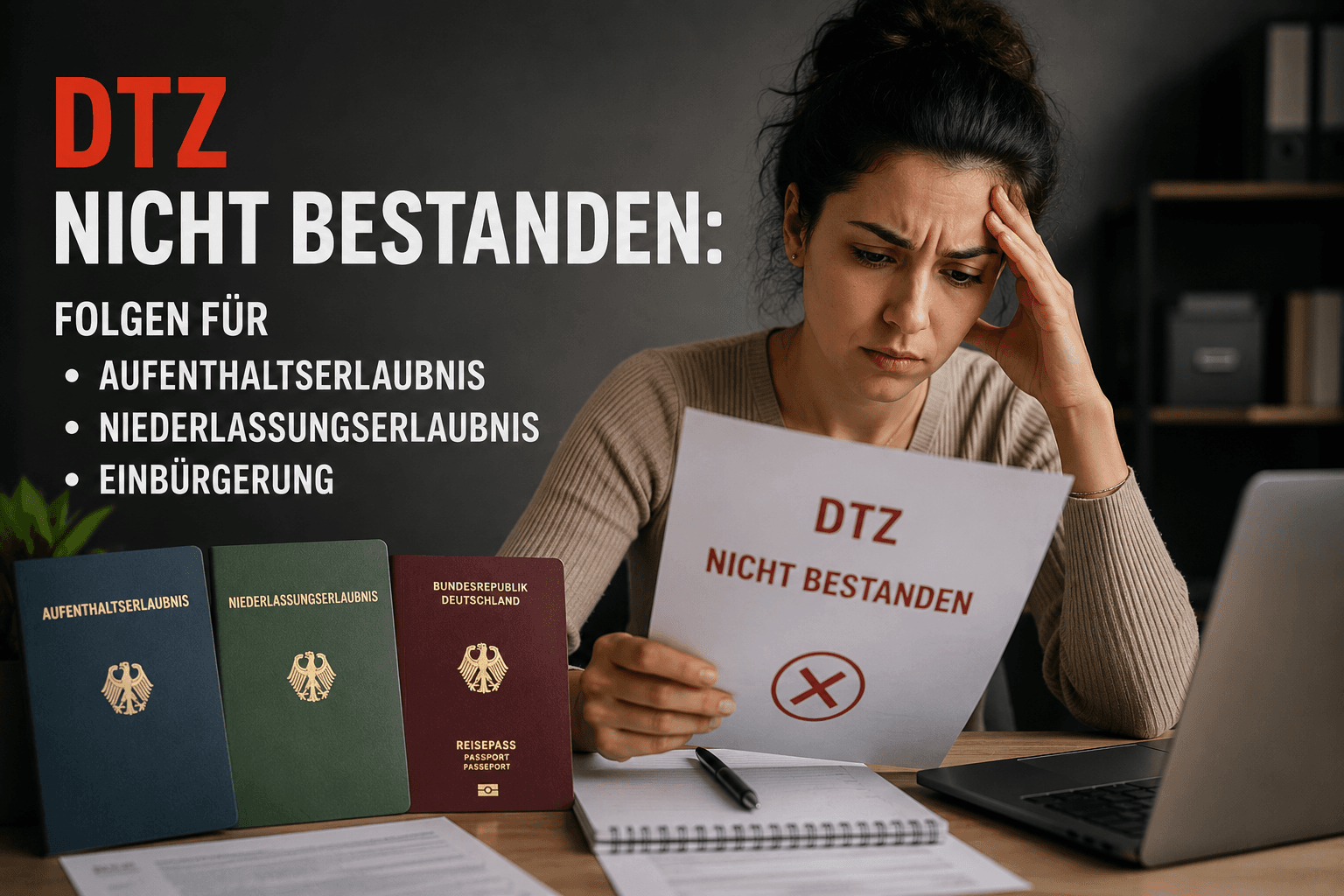
DTZ not passed: Consequences for residence permit, settlement permit, and naturalization
What really happens if you fail the DTZ? Consequences for residence permit, settlement permit, and naturalization — clearly explained with the current status in 2025.
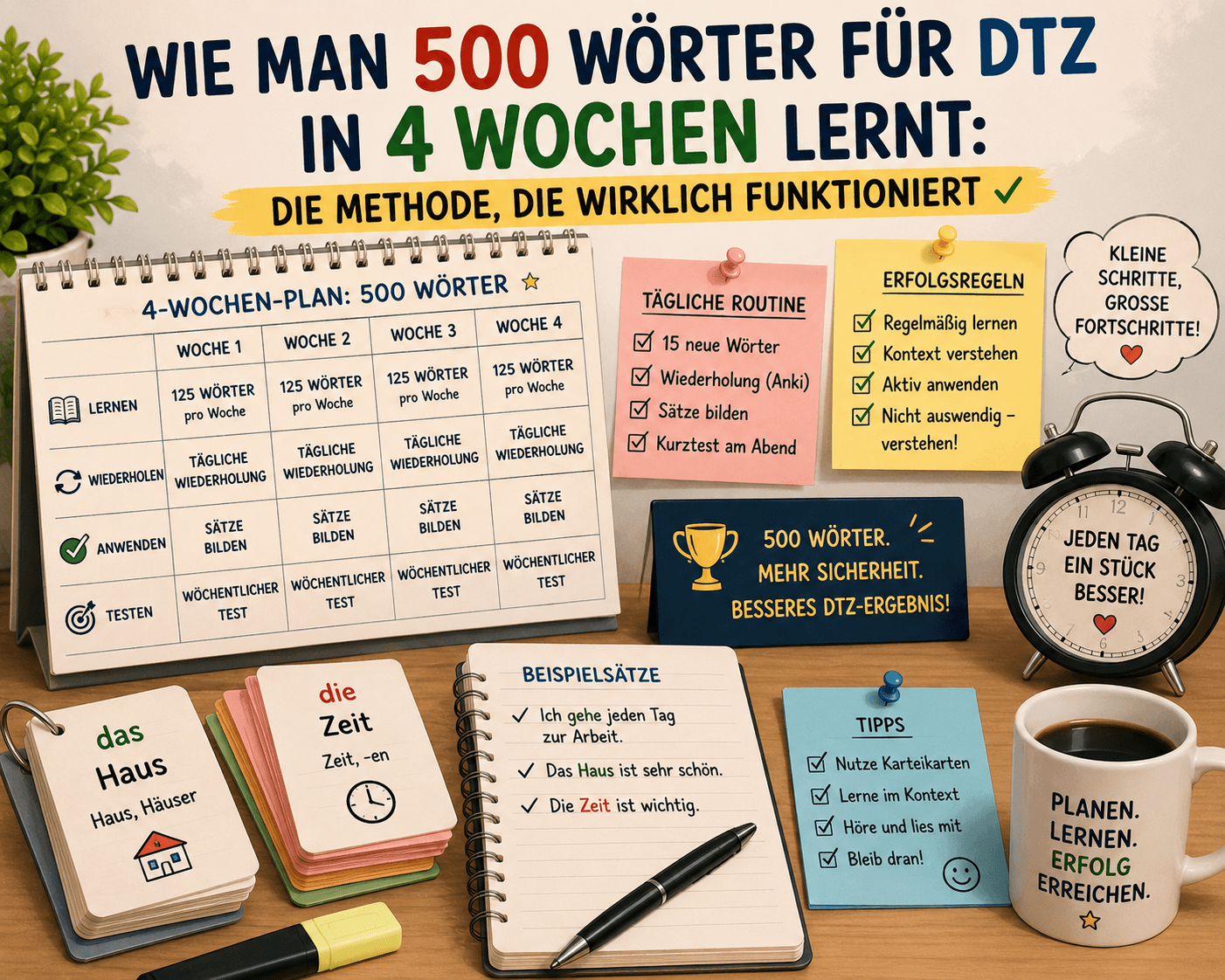
500 DTZ vocabulary in 4 weeks: Spaced Repetition Method with weekly plan
Which 500 words actually appear in the DTZ, how to confidently learn them with Anki in 4 weeks, and why most traditional methods fail — with a concrete daily plan.