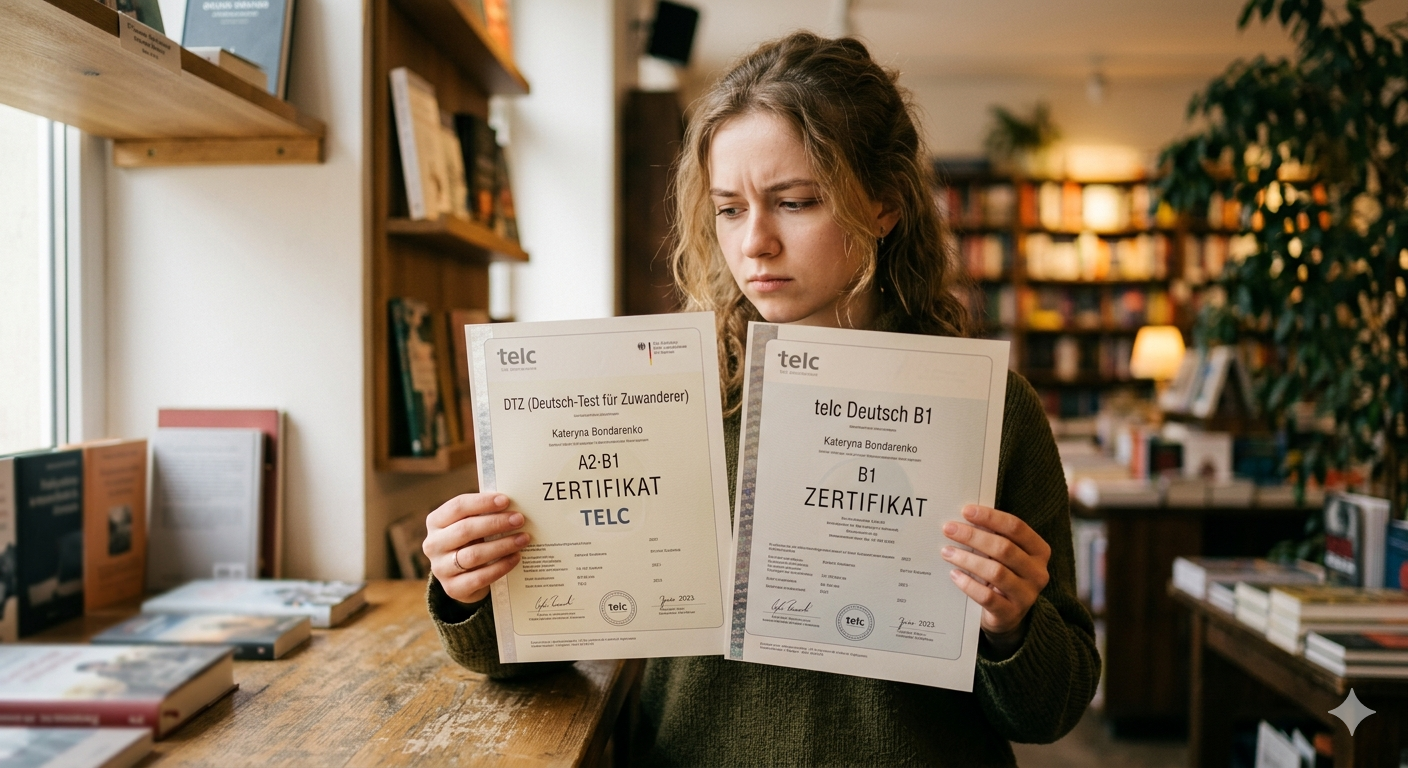
DTZ or telc B1? The key differences
You want to take an official German certificate at level B1 – but you don’t know whether to choose the DTZ or the telc German B1? You are not alone. Many migrants in Germany face exactly this question.
Both exams test the same language skills – but they have important differences: in the target group, structure, costs, and where they are recognized. In this article, we explain everything you need to know – so you can make the right decision for yourself.
What is the DTZ – and what is telc B1?
The DTZ (German Test for Migrants)
The DTZ is the official final test of the state integration course in Germany. It is developed by the organization g.a.s.t. (Society for Academic Study Preparation and Test Development) and recognized by the BAMF (Federal Office for Migration and Refugees).
The DTZ is specially designed for migrants and newcomers. It tests everyday German at levels A2 and B1. Those who complete the integration course automatically take the DTZ at the end.
The telc German B1
telc stands for “The European Language Certificates” and is a private provider. telc GmbH is a subsidiary of the German Adult Education Association (DVV). The telc German B1 exam follows the Common European Framework of Reference (CEFR) and tests level B1.
telc exams can be taken independently of the integration course at licensed test centers. The certificate is recognized in many countries and institutions.
DTZ vs. telc B1: The direct comparison
| Criterion | DTZ | telc German B1 |
|---|---|---|
| Issuer | g.a.s.t. / BAMF | telc GmbH (DVV) |
| Target group | Migrants with integration course | All learners (open to everyone) |
| Language levels | A2 and B1 (from one exam) | Only B1 |
| Exam modules | Listening, Reading, Writing, Speaking | Listening, Reading/Language Elements, Writing, Speaking |
| Total duration | approx. 2.5 hours (written + oral) | approx. 2.5–3 hours (written + oral) |
| Language elements (cloze test) | Partially (in Reading part 5) | Separate exam part – Language elements |
| Costs (approx.) | Often free included in integration course | 150–200 € (depending on test center) |
| Where to take? | Only at the end of the integration course | At licensed telc test centers, adult education centers, language schools |
| Recognition in Germany | ✅ Fully recognized – BAMF, immigration office, naturalization | ✅ Fully recognized – BAMF, immigration office, naturalization |
| International recognition | Limited (mainly Germany) | Broader – known worldwide in many countries |
| Suitable for naturalization? | ✅ Yes (B1 certificate) | ✅ Yes |
Structure in detail: DTZ
The DTZ consists of four exam parts:
- Listening (25 min.) – 4 parts: telephone messages, media contributions, conversations, opinions; total 16 tasks
- Reading (45 min.) – 5 parts: catalogs, advertisements, press texts, brochures, cloze text in letter; total 22 tasks
- Writing (30 min.) – 1 task: semi-formal or formal letter with 4 guiding points
- Speaking (approx. 16 min.) – 3 parts: talking about yourself, describing a picture, planning together
From one exam, you can get two different certificates:
- Certificate A2 – if you reach A2 in speaking and at least A2 or B1 in one other part
- Certificate B1 – if you reach B1 in speaking and at least B1 in one other part
- No certificate – if you score below A2 in speaking (regardless of other results!)
Structure in detail: telc German B1
Tip: practise what you've just read with interactive exercises — it sticks better.
Start B1 exercises →The telc German B1 consists of five exam parts:
- Listening (approx. 25 min.) – global and selective understanding of texts; multiple-choice and true/false
- Reading (approx. 45 min.) – short texts, newspaper articles, informal messages
- Language elements (approx. 15 min.) – especially in telc! Cloze texts with word choice; you test grammar and vocabulary in context
- Writing (approx. 30 min.) – writing a letter or an email
- Speaking (approx. 15 min.) – picture description, conversation on a topic, solving a task together
Sample tasks: DTZ vs. telc
Writing task comparison
DTZ – Writing
Situation: You were at your doctor. You have to inform your boss that you cannot work tomorrow.
Guiding points: Why are you writing? / What did the doctor say? / How long will you be absent? / Request for understanding
telc B1 – Writing
Situation: Your friend asks you in an email if you can help with moving. You reply.
Points: Agreeing / Why do you like to help? / What can you bring? / When can you come?
Language elements – Only in telc
“I am very interested ______ music. I have been playing guitar for three years, ______ I have never had lessons."
a) in / although ✓ b) at / because c) with / so that
This type of task does not exist as a separate part in the DTZ – in telc it is an independent module.
Which exam is right for you?
Choose the DTZ if …
- … you are currently taking an integration course (the DTZ is the automatic final exam)
- … you want to spend little money on the exam (often free in the course)
- … you want a “safety option”: from one exam you can get A2 or B1
- … you need the certificate for Germany (residence permit, naturalization)
Choose telc B1 if …
- … you have not taken an integration course but still need a B1 certificate
- … you want to use the certificate internationally (e.g. for foreign universities or employers)
- … you want flexibility in where and when to take the exam
- … you already have a good language level and want to test directly at B1
- … your employer or university specifically asks for a telc certificate
Which exam is more difficult?
This is a common question. The honest answer: Both exams test level B1 – so they are similarly difficult. But there are small differences:
- The DTZ does not have a language elements module – those who find grammar in isolated texts difficult have a small advantage with the DTZ.
- telc has slightly more exam parts, which slightly extends the total duration.
- The DTZ speaking part is often perceived as more accessible due to its everyday relevance.
- DTZ has the advantage of the double certificate – you can still get the A2 certificate with fewer points.
Your decision: step by step
-
Ask yourself: Am I currently taking an integration course?
Yes → You automatically take the DTZ. No separate registration needed. -
Ask yourself: What do I need the certificate for?
Only for Germany → Both are equivalent. International → Rather telc. -
Ask yourself: What is your budget?
Low budget → DTZ (free in course). Want more flexibility → telc (paid, but available everywhere). -
Prepare for the specific format:
Learn the task types of your exam – whether DTZ or telc. Practice with real sample tasks.
Common misunderstandings
- “DTZ and telc are the same.” – No. They test the same language level but have different structure, issuers, and areas of use.
- “I can just choose the easier exam.” – There is no easier one. Learn for the format you need.
- “Only one certificate is recognized.” – Both certificates are recognized by BAMF and German authorities for residence permits and naturalization.
- “With DTZ I can only get B1.” – No! Depending on the result, DTZ gives either A2 or B1 – from a single exam.
📖 Further articles: DTZ exam: Everything about the structure | Writing: Practice letters correctly | Speaking: The most critical exam part
Frequently Asked Questions (FAQ)
Can I be naturalized in Germany with telc B1?
Yes. The telc German B1 certificate is officially recognized for naturalization in Germany – just like the DTZ certificate (B1).
Can I take telc B1 without attending a course?
Yes. telc exams are open to everyone – you can register directly at a licensed telc test center without having taken a course.
What happens if I complete the integration course but only get A2?
You receive the DTZ A2 certificate. That is sufficient for many purposes but not for naturalization (which requires B1). You can retake the exam or additionally take telc B1.
How do I prepare for the language elements in telc?
Practice grammar in context: prepositions, conjunctions (because, although, so that, that), verb forms, and word order. Do cloze exercises – preferably with real telc sample tasks on a specialized platform.
Are DTZ and telc B1 equally difficult?
Both test level B1 – so they are similarly demanding. But the format is different. Those who specifically train for their format have the best advantage. General German learning is not enough.
Conclusion
DTZ and telc B1 are two different paths to the same goal: a recognized certificate at level B1. The DTZ is the natural conclusion of the integration course – free, with the possibility of A2 or B1. telc B1 is more flexible, internationally more widely recognized, and open to everyone.
The most important thing for both exams: Practice the specific format of your exam. Learn the task types. Train all four modules. And never forget – for both DTZ and telc – speaking.
You have the choice. Now you have all the information to make a good decision. 💪
👉 Want to pass the exam confidently?
At deutsch-meister-app.com you can prepare specifically for DTZ and telc B1. All four exam modules, real task formats, AI feedback for letters and speaking training – all on one platform. Specially developed for migrants in Germany, with interface in 7 languages.
Ready for B1 exercises?
Don't just read — practice now! Hundreds of interactive exercises, audio tasks and exam training are waiting for you.
War dieser Artikel hilfreich?
Ähnliche Artikel

The difference between A2 and B1: What really changes — and how I made the leap.
What is really the difference between A2 and B1 in German? A personal experience report with 3 surprising facts, 5 tips — and an encouraging conclusion.
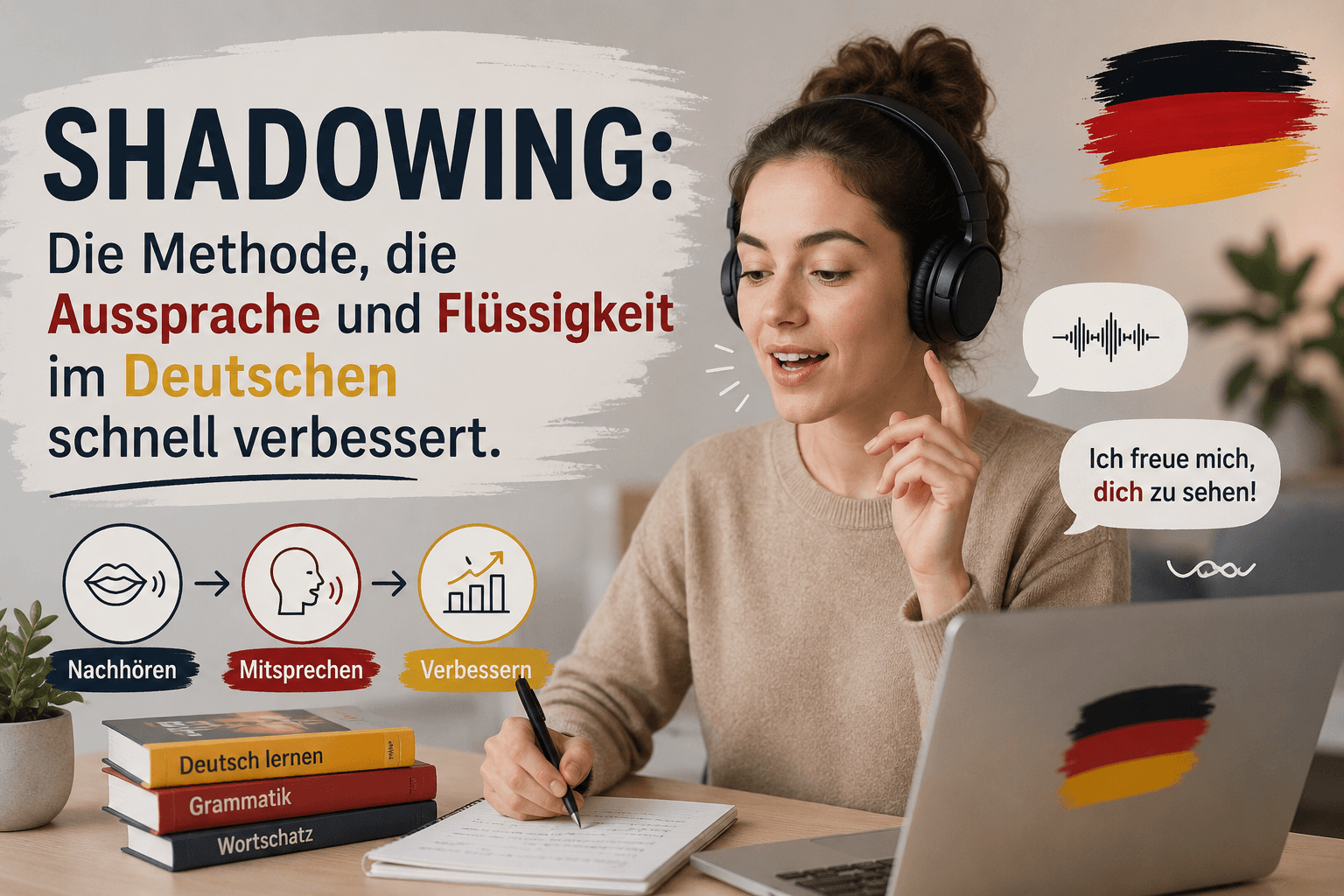
Shadowing Method German: Improve Pronunciation and Fluency in 4 Weeks
What is shadowing and how does it work? Step-by-step guide, 4-week plan, and the best free resources for shadowing in German — with a focus on DTZ.
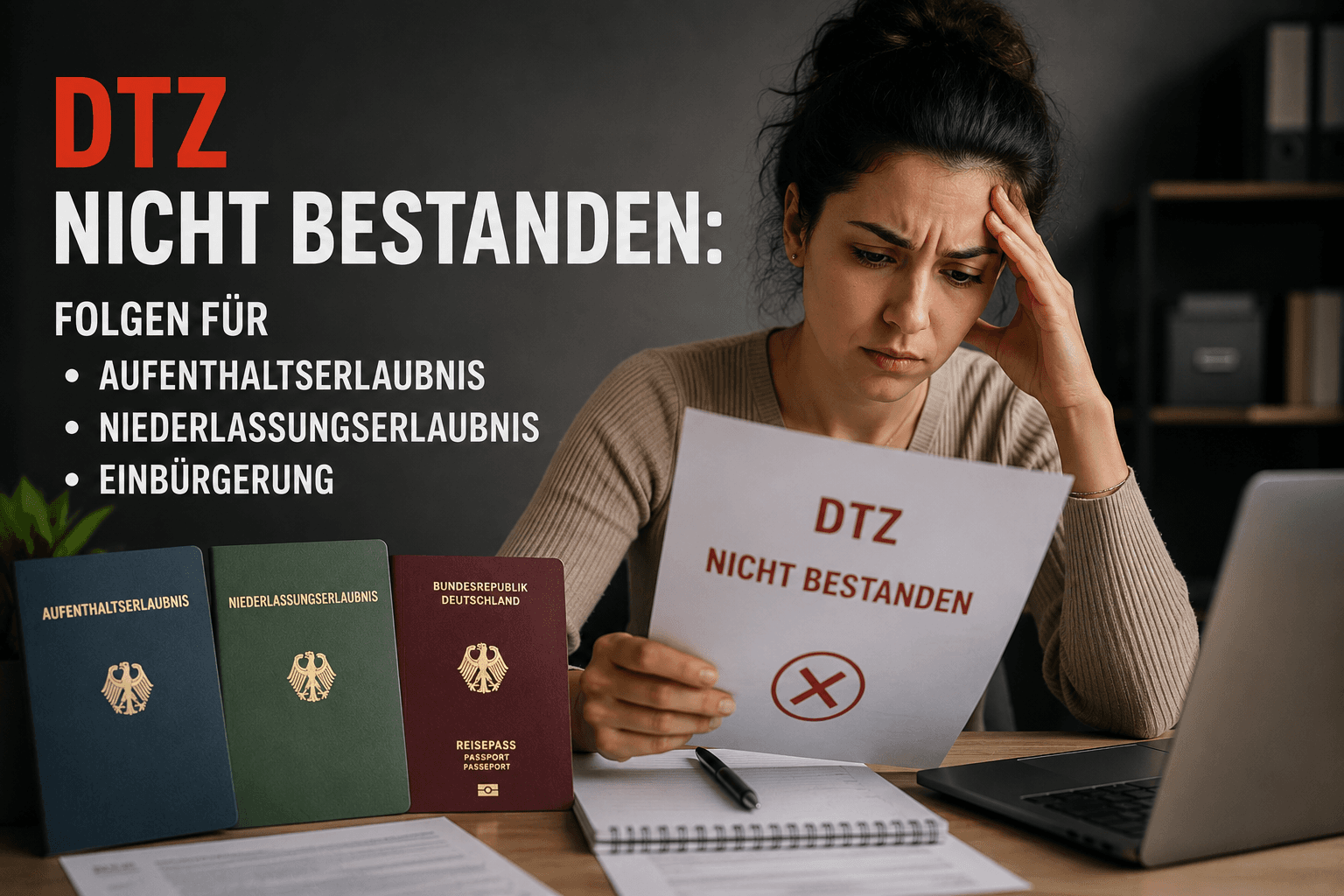
DTZ not passed: Consequences for residence permit, settlement permit, and naturalization
What really happens if you fail the DTZ? Consequences for residence permit, settlement permit, and naturalization — clearly explained with the current status in 2025.