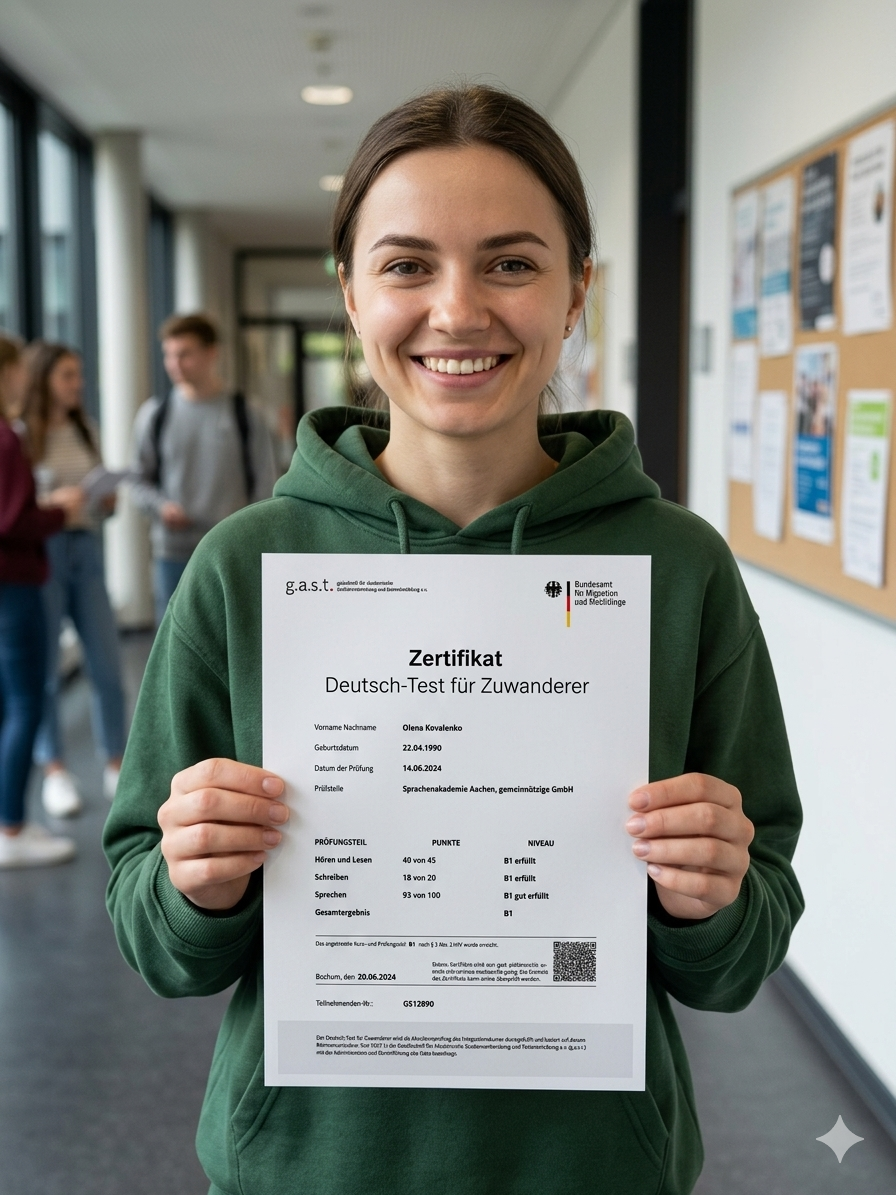
How to Pass the DTZ and telc B1 Exams: Practical Tips for Preparation
Reading time: about 8 minutes
April 4, 2026 · DeutschMeister Team
You signed up for the DTZ or telc B1 exam — and now you don’t know where to start? Or you’re already studying but feel like you’re progressing too slowly? This article is your practical guide. No fluff, no general words. Only what really helps.
What is the DTZ exam and why is it needed
DTZ (Deutsch-Test für Zuwanderer) is an official state exam for migrants in Germany, organized by the g.a.s.t. organization and recognized by BAMF (Federal Office for Migration and Refugees). The exam certifies levels A2 or B1 according to the Common European Framework of Reference for Languages (CEFR).
telc B1 is an alternative recognized exam from the telc organization, which also certifies level B1 and is accepted for obtaining a residence permit, family reunification, and long-term integration in Germany and Austria.
The B1 certificate is needed for:
continuing the residence permit (Niederlassungserlaubnis)
family reunification (Familiennachzug)
applying for German citizenship (Einbürgerung)
admission to certain educational institutions
qualification confirmation when looking for a job
DTZ exam structure: what to expect
Understanding the exam structure is already half the success. The exam consists of 4 parts:
🎧 Hören (Listening) — 25 minutes
4 tasks, each with different formats: phone announcements, short news in the media, everyday conversations, various opinions on one topic. Answer formats: Multiple Choice, True/False, matching tasks.
Main difficulty: you hear the recording only 1–2 times. No possibility to rewind.
📖 Lesen (Reading) — 45 minutes
5 tasks: catalogs and registers, announcements, newspaper texts, informational brochures, filling gaps in a letter. Formats: Multiple Choice, matching, True/False.
Main difficulty: large text volume within limited time. You need to be able to quickly find the necessary information, not read everything in order.
✍️ Schreiben (Writing) — 30 minutes
One task: write a semi-formal or formal letter on a given topic. Evaluated on 4 criteria: task fulfillment, text coherence, vocabulary, grammatical constructions.
Main difficulty: many people write a good text but do not answer all parts of the task — and lose points.
🗣️ Sprechen (Speaking) — about 16 minutes
3 parts: talking about yourself, conversation based on a photo prompt, joint planning with another exam participant.
⚠️ CRITICAL WARNING: If you get a result “below A2” in Sprechen — you do not receive any certificate, regardless of the results of other parts. This is an official rule of the DTZ and telc methodology, which often surprises those who did not know about it in advance. Be sure to practice speaking.
10 practical tips on how to prepare for the DTZ and telc B1 exam
Start with diagnosing your level
Before learning everything at once — understand exactly where your weak spots are. Take a trial test for each exam part and see where you make the most mistakes. Often it turns out that your Hören is already good, but Schreiben needs more attention. On deutsch-meister-app.com there is a diagnostic test that immediately shows your starting level for each module.
Study the language daily — even for 15 minutes
Regularity is more important than duration. Daily practice for 15–20 minutes is more effective than 3 hours once a week. The brain consolidates new words and structures through repetition, not through one-time “marathons.” Set a specific time — for example, morning coffee + 15 minutes of exercises. Make it a ritual.
Hören: listen to live language, not just textbooks
To train listening, it’s not enough to just listen to lessons. Connect live sources:
podcasts for German learners (“Slow German,” “Deutsch warum nicht?” by Deutsche Welle)
news at slow speed (DW Langsam gesprochen)
simple YouTube videos with subtitles
At the exam, you will hear real conversational language — and you need to get used to it in advance.
Lesen: learn to read “scout-style”
At the DTZ/telc B1 exam, you don’t have time to read every word. The key skill is scanning the text: first read the question, then look for the relevant part of the text. Don’t start reading the entire text from the beginning. Practice this skill on real exam-format texts — not on ordinary textbook exercises.
Schreiben: learn letter templates by heart
The Schreiben task always requires writing a letter — and this is actually an advantage. There are standard opening and closing phrases, standard constructions for requests, complaints, thanks, information inquiries. Learn and use them.
Important: before writing, be sure to reread all task points and mark that you answered each one. A common mistake is to write a good letter but miss one of the points. The AI writing check on deutsch-meister-app.com analyzes your text by the same 4 criteria as the real examiner.
Sprechen: speak aloud every day
Tip: practise what you've just read with interactive exercises — it sticks better.
Start B1 exercises →Most people avoid speaking before the exam — and this is the biggest mistake. Sprechen is trained only through practice. Speak aloud:
retell in German what you just read
describe photos (this is a direct exam task!)
talk about your day in front of a mirror
find a language partner or practice with an AI assistant
Even 5 minutes of daily speaking aloud gives noticeable results in 2–3 weeks.
Memorize new words through context, not lists
Rote memorization of word lists is an ineffective method. It’s much better to remember a word in a sentence or situation. For example, not just “der Antrag = application,” but “Ich muss einen Antrag stellen — I need to submit an application.” The spaced repetition system automatically reminds you of words just when you almost forgot them — this is the most effective scientifically proven memorization method.
Do full exam simulations
2–3 weeks before the exam, be sure to do at least 1–2 full simulations — with a timer, in conditions as close to real as possible. This removes the fear of the unknown and helps understand where you still don’t manage to fit in time. All tasks on deutsch-meister-app.com are built strictly according to the DTZ and telc methodology — so simulation on the platform = a real rehearsal exam.
Don’t ignore grammar — but learn it through exercises
Reading grammar paragraphs rarely helps at the exam. It’s more effective to do exercises where you use the grammatical construction in action. Pay special attention to:
noun declensions (Kasus: Nominativ, Akkusativ, Dativ)
verbs with prepositions
complex sentences with weil, dass, obwohl, wenn
Konjunktiv II (hätte, wäre, würde) — often found in Schreiben
Prepare psychologically — exam fear is real but conquerable
More than 90% of people feel anxiety before a language exam. But there is an important difference between “I don’t know the language” and “I don’t know the exam format.” Most failures are due to the second reason. When you know exactly: how many tasks, what format, how much time, what is expected of you — stress level drops significantly. Preparation in the real format = confidence in the exam room.
When to start preparing for DTZ?
The optimal period is 8–12 weeks before the exam with daily practice of 30–60 minutes. If you have less time — focus on weak spots and be sure to train Sprechen.
Approximate preparation times depending on current level
Current language level Recommended preparation time
Beginner (A1) 4–6 months
Intermediate (A2) 2–3 months
Almost B1 4–8 weeks
Frequently asked questions about the DTZ and telc B1 exam
Can I take the DTZ without an integration course?
Yes. The DTZ exam is open to everyone, regardless of whether you attended an integration course.
How much does the DTZ exam cost?
Approximate cost — from 100 to 150 euros depending on the testing center. Check the exact price directly at the accredited test center.
How many times can I retake?
The number of attempts is unlimited. But each attempt costs time and money. So it’s better to prepare well once.
What is the difference between DTZ and telc B1?
Both exams are recognized by BAMF and certify level B1. DTZ is conducted by g.a.s.t., telc B1 by the telc organization. The structure is similar, but there are minor differences in task formats. The DeutschMeister platform prepares for both exams.
What happens if I get “below A2” in Sprechen?
It means you will not receive any certificate — regardless of other results. That’s why speaking must be practiced without fail, not left to the last moment.
Summary: formula for successfully passing the DTZ or telc B1 exam
Passing the DTZ or telc B1 exam is quite realistic, even if you study the language under difficult conditions and have limited time. Here’s what you need:
✅ Know the exam structure perfectly
✅ Practice daily — at least 20 minutes
✅ Practice Sprechen aloud (this is mandatory, not optional)
✅ Write letters and check them by official criteria
✅ Do full timed exam simulations
✅ Prepare according to the real format — not general-purpose textbooks
The DeutschMeister platform was created by people who have gone through this path themselves. All exercises are built strictly according to the official DTZ and telc methodology. AI checks your writing by the criteria of a real examiner. And you know exactly where your weak spots are — and what to do about them.
Start preparing today — and come to the exam confidently.
👉 deutsch-meister-app.com
Ready for B1 exercises?
Don't just read — practice now! Hundreds of interactive exercises, audio tasks and exam training are waiting for you.
War dieser Artikel hilfreich?
Ähnliche Artikel

The difference between A2 and B1: What really changes — and how I made the leap.
What is really the difference between A2 and B1 in German? A personal experience report with 3 surprising facts, 5 tips — and an encouraging conclusion.
DTZ not passed: Consequences for residence permit, settlement permit, and naturalization
What really happens if you fail the DTZ? Consequences for residence permit, settlement permit, and naturalization — clearly explained with the current status in 2025.
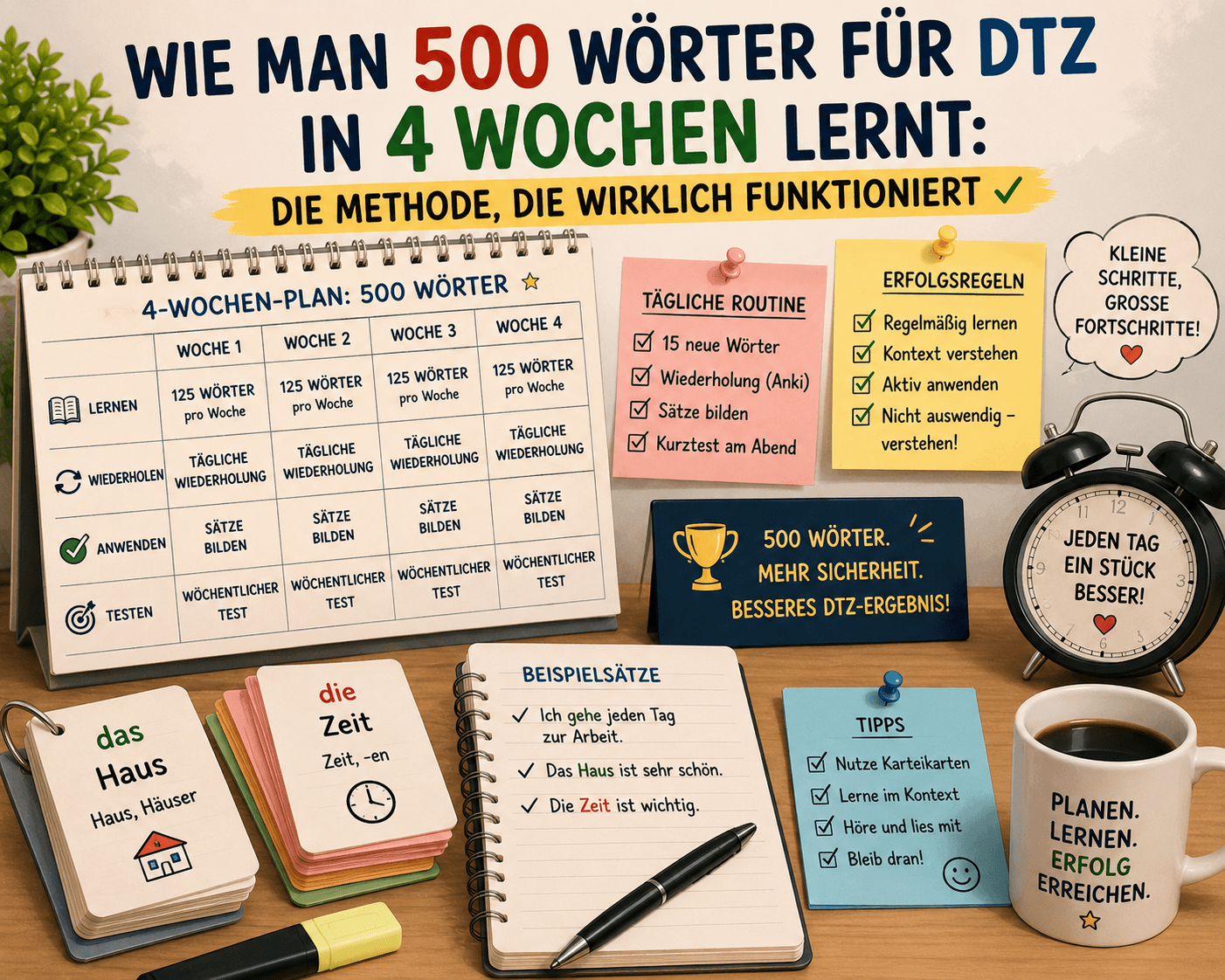
500 DTZ vocabulary in 4 weeks: Spaced Repetition Method with weekly plan
Which 500 words actually appear in the DTZ, how to confidently learn them with Anki in 4 weeks, and why most traditional methods fail — with a concrete daily plan.