
I almost failed at B1: what no one told me about the structure of the German exam.
Almost failed at B1: what no one told me about the structure of the German exam
A personal story about preparing for the DTZ B1 — and the lessons that are better read before opening the first textbook.
I prepared for the German exam for almost half a year. I worked through textbooks, learned vocabulary, practiced listening comprehension every evening. I thought my level was already at B1, maybe even a bit higher. And when I finally sat for the DTZ exam, the first thing that threw me off was not the difficult vocabulary or the fast speaking pace of the speakers. It was the fact that I simply did not understand how the exam itself was structured.
I didn't know how much time was allocated for each part. I didn't know that there are five different types of tasks in reading, each requiring its own reading strategy. I didn't know that in writing, not only grammar is assessed, but also the "content" separately — and that a single forgotten point of the task lowers the content score, even if the sentences are formulated flawlessly. I had the language. I did not have the structure of the exam.
Most learners preparing for an official German exam learn the language — but not the exam. They do not know its structure, are unaware of the typical mistakes made by previous participants, and do not realize that in almost every written or oral part, 100% of the given points must be covered — and it should not just be "spoken well on the topic."
The exam structure is not a formality — it is half the battle
When I finally got my hands on the official materials and worked through a complete practice set according to the g.a.s.t. methodology, everything fell into place. The DTZ B1 consists of four parts, and each is structured completely differently:
- Listening (25 min.) — four parts: announcements on the phone, short information in the media, everyday conversations (True/False and Multiple-Choice), and different opinions on a topic (matching to statements a–f). Each part has its own answer format — those who cannot switch confidently between formats lose valuable time understanding the instructions during the recording.
- Reading (45 min.) — five parts: catalogs and directories, advertisements with matching tasks, press and official announcements, informational brochures, and finally filling in words in a letter. The last part is often left unfinished — because too much time is lost in the first three blocks.
- Writing (30 min.) — one task: write a semi-formal or formal message (letter, application, statement) based on given points.
- Speaking (16 min., in pairs) — three parts: talking about oneself and responding to questions, discussing an experience based on a picture prompt and also responding to questions, and planning something together with the partner.
Listening and reading together make up 45 tasks, and the level (A2 or B1) is determined separately for this block — just as separately as for writing and speaking. There is no single overall result of "pass/fail," but three independent partial results, each with its own threshold.
For level B1 in listening + reading, you need at least 33 out of 45 points. In writing, the B1 threshold is at least 15 out of 20 points, assessed according to four criteria separately: content, communicative design, correctness, and vocabulary. Even excellent grammar does not save the work if the entire task is not covered in content.
Would you like to see the real structure of the DTZ B1?
At DeutschMeister, you will find exercises that are structured exactly according to the official g.a.s.t. and BAMF methodology — with explanations for each task type.
Try DTZ-B1 exercisesDTZ and telc are not the same, even if the methodology is similar
This is where I made the second mistake. I studied with general telc B1 textbooks, assuming it was exactly the same as the DTZ, just under a different name. That is not true.
The DTZ (German Test for Immigrants) was specifically developed for the completion of the integration course. Its topics revolve around the lives of immigrants in Germany: housing, work, everyday life, contact with authorities, neighbors, doctors. It assesses A2 and B1 separately for each exam part — so there is no single pass/fail result. A person can achieve B1 in listening/reading and simultaneously only A2 in writing — that is a normal, intended result format.
The general telc B1 (without reference to the integration course) tests a broader range of topics and is oriented towards other life situations, not necessarily related to moving to Germany. The task formats are somewhat similar (Multiple-Choice, matching, True/False), but the focuses, text topics, and even the expectations for written work differ.
Even further away are the specialized exams: telc B1·B2 Care — for nursing staff, with specialized terminology for patient care, documentation, and communication in shift work — and DTB B2 Profession — job-related German at B2 level with more demanding texts, argumentation, and business correspondence. Preparing with general B1 materials for care or with DTZ B1 materials for DTB B2 almost certainly leads to failure, as vocabulary, task formats, and assessment criteria differ fundamentally.
Clarify, before you open a textbook, exactly which certificate you need: DTZ (for the completion of the integration course), general telc B1, telc B1·B2 Care (for the nursing profession), or DTB B2 Profession (for work at B2 level). This not only determines the vocabulary but also the format of each individual task.
B1 and B2 are not "just a bit harder" — they follow a different logic
Tip: practise what you've just read with interactive exercises — it sticks better.
Start B1 exercises →When I looked at the B2 materials (in preparation for a friend's DTB B2 Profession), the difference from B1 was not only in vocabulary. In B1, closed task formats dominate — Multiple-Choice, matching, True/False. In B2, there is significantly more open production: One must independently formulate a reasoned answer, engage in a discussion, respond to the opinion of the conversation partner, and write more complex texts that are often already linked to professional life, no longer just to everyday life. The reading texts are longer and denser, the topics more abstract.
Simply put: In B1, you are tested on whether you can manage in everyday life in Germany. In B2, whether you can argue, persuade, and communicate professionally. Preparing for B2 with B1 strategies is a typical mistake of those who have simply "gone one level higher" in the textbook without changing the approach to the exam itself.
Are you preparing for B2 (care or profession)?
The exercises at DeutschMeister are organized by level and exam type — so you train exactly the task logic that awaits you in the exam.
Go to exercises by levelMistakes that no one warns you about beforehand
In conversations with other participants after the exam — and recalling my own missteps — I compiled a list of what undermines the result more often than weak grammar:
- Time loss on the first tasks of reading. The fifth part (filling in words in the letter) is often overlooked because all the time is spent on the first three blocks.
- Inattentive reading of the instructions in listening. The answer format changes from part to part — sometimes Multiple-Choice, sometimes True/False, sometimes matching. Those who are not used to switching lose the thread in the middle of the recording.
- Not covering all points in writing. The task always contains several specific points (guiding points) that must be addressed. Missing a point lowers the content score — even if the rest of the text is very well written.
- Silence when asked questions in speaking. Parts 1B and 2B consist of responses to questions from the examiners, not a monologue. Many only prepare the "narrative about themselves" and get stuck as soon as an additional question arises.
The oral part is the riskiest section of the entire exam. A weak result in speaking significantly devalues even excellent scores in listening, reading, and writing — underestimating preparation for the oral part is one of the most costly mistakes.
The "100% rule" that I understood too late
The most important realization I came to only after the exam: In the written and oral parts, you cannot "answer approximately on the topic." Each task — both in writing and speaking — is based on specific points that must be fully addressed. The assessors do not count the "overall impression," but check compliance with each given point. A missed point in the letter or an unaddressed topic in the conversation — and the content score drops, even with flawless language.
Before I write or speak an answer, I mentally (and when practicing, also in writing) list each point of the task individually and check: Is it present in my text or answer? This takes 20 seconds but saves half of the content points.
What I would have advised myself at the beginning
Language is the foundation without which nothing works. But a foundation without a blueprint is just a pile of building materials. Before learning vocabulary, it is worth:
- Clarifying exactly which certificate is needed — DTZ, general telc B1, telc B1·B2 Care, or DTB B2 Profession.
- Working through at least one complete practice set exactly in this format to see the structure instead of guessing.
- Learning the assessment criteria for writing and speaking — and practicing to cover 100% of the points instead of "writing prettily around the topic."
- Giving the oral part as much attention as the written part.
In the end, my exam went well — but not because I learned a hundred additional vocabulary words in the last week. But because I finally understood the rules by which I would be assessed.
Don't make my mistake
DeutschMeister builds exercises exactly according to the official structure of DTZ, telc B1, telc B1·B2 Care, and DTB B2 Profession — with explanations of the assessment criteria and analysis of typical mistakes in each exam part.
Start preparing correctlyReady for B1 exercises?
Don't just read — practice now! Hundreds of interactive exercises, audio tasks and exam training are waiting for you.
War dieser Artikel hilfreich?
Ähnliche Artikel

The difference between A2 and B1: What really changes — and how I made the leap.
What is really the difference between A2 and B1 in German? A personal experience report with 3 surprising facts, 5 tips — and an encouraging conclusion.
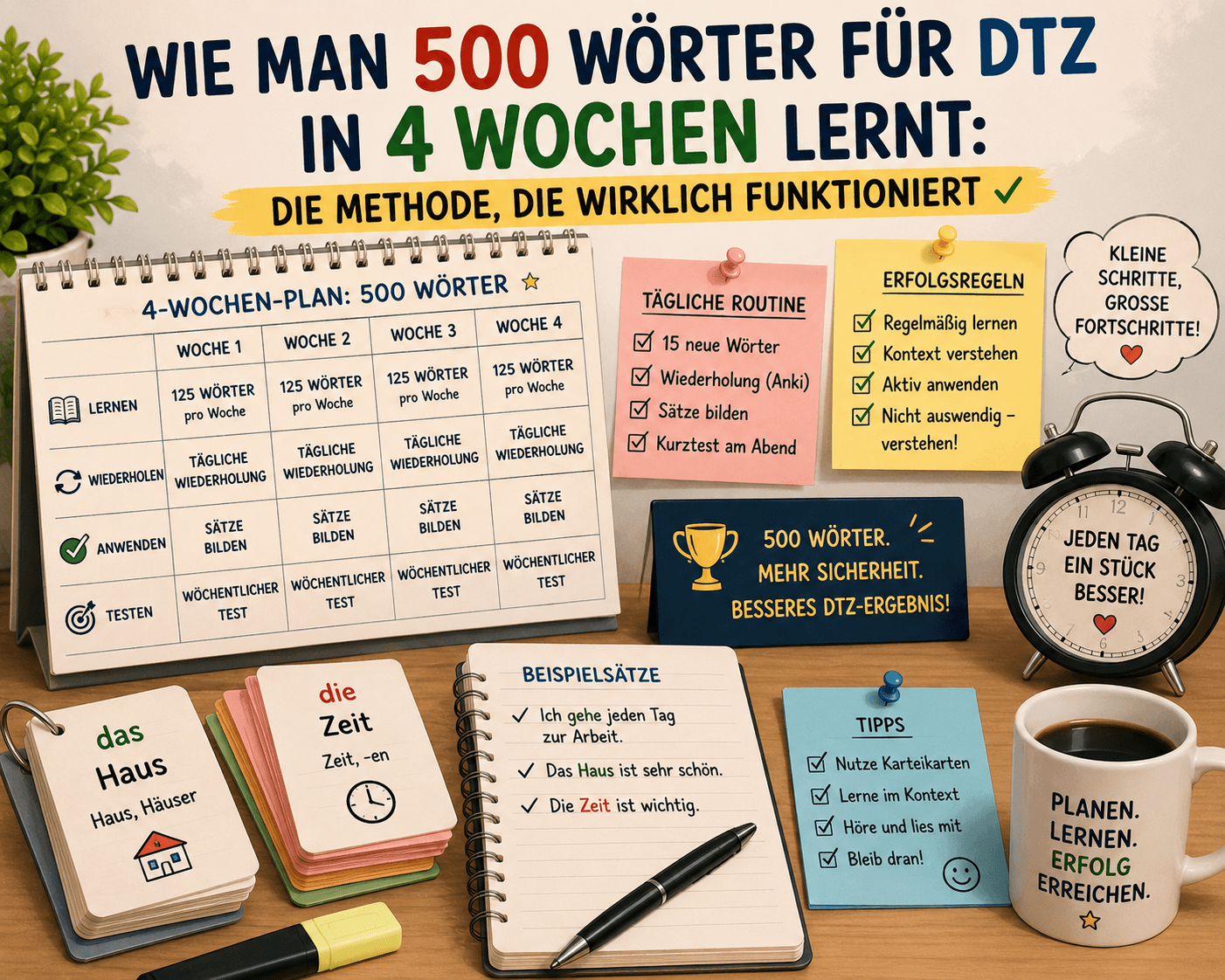
500 DTZ vocabulary in 4 weeks: Spaced Repetition Method with weekly plan
Which 500 words actually appear in the DTZ, how to confidently learn them with Anki in 4 weeks, and why most traditional methods fail — with a concrete daily plan.

DTZ Listening: How to Understand Spoken German When Your Ear Isn't Used to It Yet
Why does real German sound so different from the textbook version? And how can you train your ear for the DTZ listening test in 6 weeks? Here are 5 concrete techniques, a step-by-step plan, and the best free resources.