Writing B1: Ready-made sentence templates for successfully passing the exam
One of the most effective strategies for passing the B1 exam is using ready-made sentence templates.
Many candidates get lost in the Schreiben part because they "don't know what to write."
But in reality, the exam does not test perfect language, but:
- logic
- structure
- coherence of the text
👉 That’s why ready-made constructions = quick points.
⸻
Why templates work
In the exam, it is important to show:
- a clear introduction
- logical development of ideas
- polite form
- complex sentences
And all this can be done using universal phrases.
⸻
Main templates for Schreiben B1
- Introduction: start correctly
Ich schreibe Ihnen, weil ich ein Problem habe.
(I am writing to you because I have a problem.)
✔️ Provides a clear structure
✔️ Immediately shows the purpose of the letter
⸻
- Explanation of the reason
Der Grund dafür ist, dass …
(The reason is that …)
✔️ Shows the ability to build subordinate clauses
✔️ Adds points for grammar
⸻
- Logical transition to the request
Deshalb möchte ich Sie bitten, …
(Therefore, I would like to ask you …)
✔️ Makes the text logical
✔️ Shows structure
⸻
- Politeness = high level
Ich wäre Ihnen sehr dankbar, wenn Sie …
(I would be very grateful if you …)
✔️ Makes a strong impression
✔️ Raises the score
⸻
- Complex questions
Könnten Sie mir bitte mitteilen, ob … ?
(Could you please inform me whether …?)
✔️ Complex sentence
✔️ + points for grammar
⸻
- Conditional constructions
Falls es möglich ist, …
(If it is possible, …)
✔️ Looks “mature”
✔️ Shows level
⸻
Tip: practise what you've just read with interactive exercises — it sticks better.
Start B1 exercises →- Additional information
Außerdem möchte ich hinzufügen, dass …
(Furthermore, I would like to add that …)
✔️ Perfect for the second paragraph
✔️ Improves text logic
⸻
- Argumentation
Ich habe bereits versucht, das Problem zu lösen.
(I have already tried to solve the problem.)
✔️ Makes the text convincing
✔️ Provides arguments
⸻
- Important formal phrase
Ich bitte um eine schnelle Rückmeldung.
(I kindly ask for a quick response.)
👉 A very appropriate formal phrase that can be used in almost every letter.
✔️ Shows politeness
✔️ Strengthens the conclusion
⸻
- Strong closing of the letter
Für Ihre Unterstützung bedanke ich mich im Voraus.
(Thank you in advance for your support.)
👉 The perfect final phrase.
✔️ Ends the letter professionally
✔️ Leaves a very good impression on the examiner
⸻
How to use these templates
👉 The best strategy:
1. Learn 10–15 such sentences
2. Memorize the structure
3. Insert your own words according to the topic
⸻
Example of B1 letter structure
1. Introduction
👉 Ich schreibe Ihnen, weil …
2. Reason
👉 Der Grund dafür ist, dass …
3. Request
👉 Deshalb möchte ich Sie bitten …
4. Additional information
👉 Außerdem möchte ich hinzufügen …
5. Closing
👉 Ich wäre Ihnen sehr dankbar, wenn …
👉 Ich bitte um eine schnelle Rückmeldung.
👉 Für Ihre Unterstützung bedanke ich mich im Voraus.
⸻
Mini tip for B1 TELC / DTZ
✨ If you use 3–4 sentences from this list in one letter —
your text will look much more confident and professional.
⸻
Conclusion
To write a good Schreiben B1, you don’t need to invent complicated texts.
You need to:
- use ready-made constructions
- build a logical text
- write confidently and clearly
👉 This is exactly what the exam tests.
Ready for B1 exercises?
Don't just read — practice now! Hundreds of interactive exercises, audio tasks and exam training are waiting for you.
War dieser Artikel hilfreich?
Ähnliche Artikel

The difference between A2 and B1: What really changes — and how I made the leap.
What is really the difference between A2 and B1 in German? A personal experience report with 3 surprising facts, 5 tips — and an encouraging conclusion.
DTZ not passed: Consequences for residence permit, settlement permit, and naturalization
What really happens if you fail the DTZ? Consequences for residence permit, settlement permit, and naturalization — clearly explained with the current status in 2025.
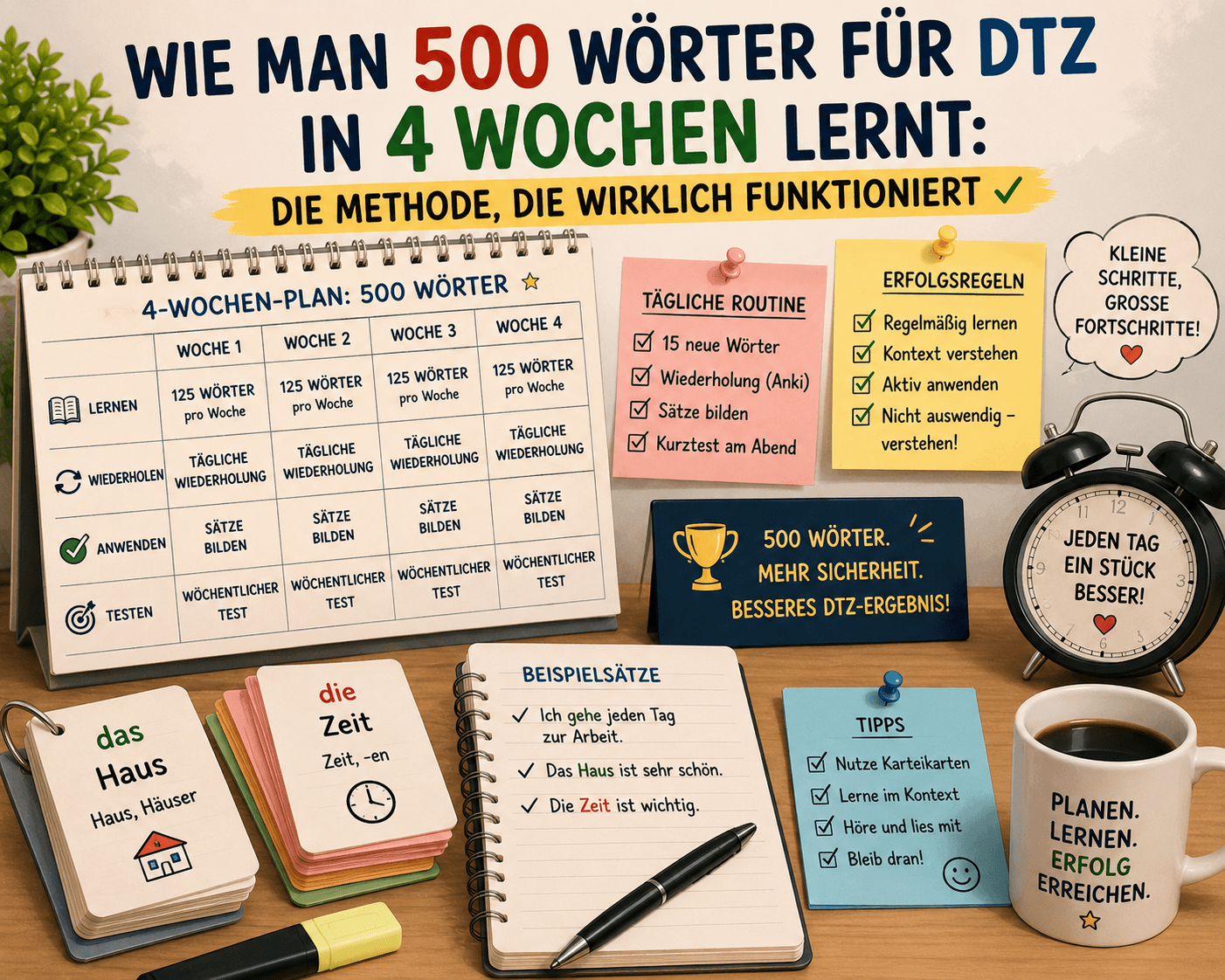
500 DTZ vocabulary in 4 weeks: Spaced Repetition Method with weekly plan
Which 500 words actually appear in the DTZ, how to confidently learn them with Anki in 4 weeks, and why most traditional methods fail — with a concrete daily plan.